

Skoprovet (Skomonteringen), c1918
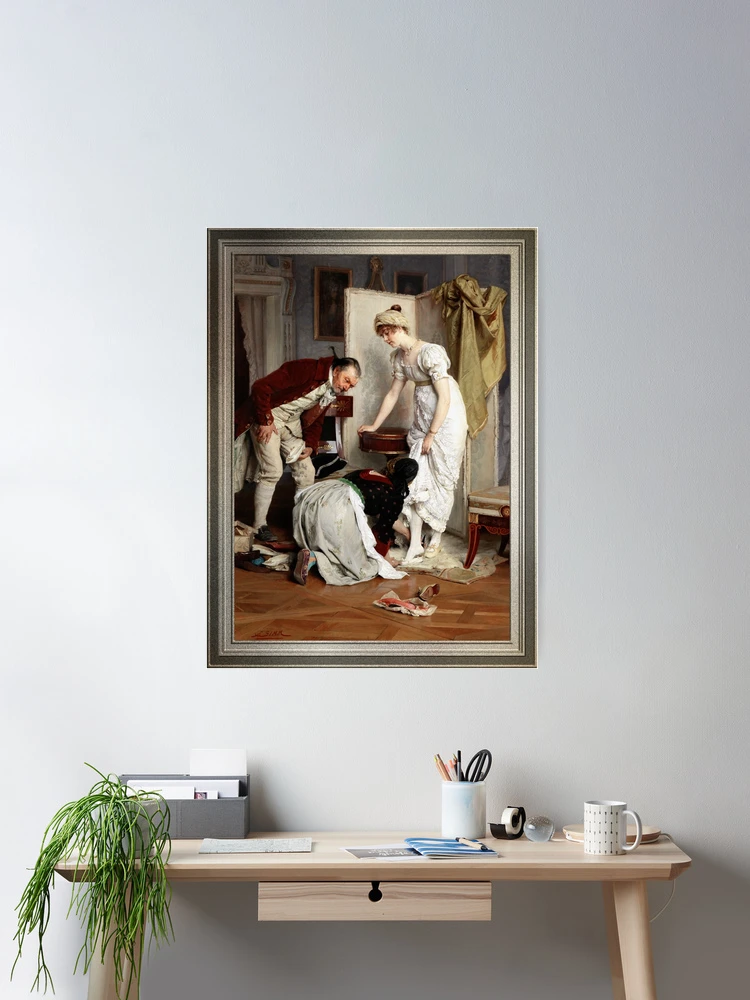
“Skoprovet (Skomonteringen)” is a finely detailed, elegant painting created in 1918 by the Austrian artist Franz Xaver Simm, infödd 1853 and passed away in 1918. The painting encapsulates an intimate and somewhat theatrical moment within a well-to-do European household. Simm, a prominent artist of the late 19th and early 20th centuries, was known for his vivid depictions of everyday life, especially those showcasing social interactions within refined settings. This painting reflects his mastery in capturing delicate expressions, texturer, and emotions.
The scene is set indoors, in a grand, well-appointed room that suggests a blend of aristocratic taste and classical elegance. Simm’s technique here speaks to his acute attention to detail. The room itself features a mix of decorative elements, ornate furniture, realistiskt rich textiles, and sumptuous flooring that provide a sense of space, lyx, och förfining. The colors are warm, with a soft interplay of natural light filtering through the room, highlighting the richness of the wood floor and the clothing of the figures involved in the scene.
Innehållsförteckning
Subject and Figures
The central focus of the painting is the intimate moment between the characters, three individuals in various stages of interaction. I förgrunden, a well-dressed young woman stands, poised with an air of grace. Hennes klädsel, a delicate white gown adorned with fine lace, evokes the style of the late 18th or early 19th centuries, a nod to fashion during the Rococo and early Regency periods.
She is engaged in a shoe fitting, with one of her shoes being carefully adjusted by a female servant kneeling on the floor at her feet. The servant, dressed in traditional, modest attire, is focused on her task, with her back slightly arched as she attends to the shoes of the lady. The gesture of the servant kneeling emphasizes the social dynamics of the period, where women of the lower class served those of the higher class with humility and care.
To the left of the composition, an older man in a red jacket bends forward, seemingly inspecting the process of the shoe fitting. His posture is one of authority and interest, as he leans over, his head tilted toward the young woman. The elderly man appears to be an attentive observer, possibly the woman’s father or an influential figure in her life, som tittar på med en blick av oro eller godkännande.
Denna interaktion mellan figurerna, en elegant klädd ung kvinna, en blygsam tjänare, och en bekymrad äldre man, föreslår en berättelse om hemlivet i ett ädelt eller rikt hushåll. Figurerna förkroppsligar en känsla av hierarki, där tjänaren intar den lägsta ställningen, medan mannen och kvinnan intar maktpositioner och förfining.
Tjänarens kroppsspråk, med huvudet sänkt i ödmjukhet, står i skarp kontrast till kvinnans raka hållning, som förkroppsligar den nåd och lugn som förväntas av kvinnor i ett så högt samhälle.
Föremål och detaljer
Flera nyckelobjekt i scenen bidrar ytterligare till den lyxiga atmosfären i rummet. De fint utformade trämöblerna, ett skåp och ett litet bord, visas i bakgrunden. Dessa föremål, designad med invecklade sniderier, återspeglar periodens smak för utsmyckat hantverk. På golvet, precis till höger om den knästående tjänaren, ett par skor och ett tygstycke ligger slarvigt strödda, ger intrycket att skoanpassningsprocessen har pågått under en tid.
Själva skorna, även om det inte är detaljerat i sin helhet, verkar föreslå high fashion, överensstämmer med den centrala kvinnofigurens raffinerade stil. Dessa föremål, tillsammans med den känsliga mattan under karaktärernas fötter, framkalla en känsla av rikedom och komfort.
Målningens bakgrund är fylld med subtila detaljer, som ett inramat porträtt och mjuka draperier som hänger från sidan, som antyder rummets överflöd. Väggarna är dekorerade med ljusa färger och konst, möjligen återspeglar smaken hos hushållets invånare, which includes portraits and references to classical themes.
Humör och tema
The mood of the painting is dignified yet intimate, with an underlying sense of quiet interaction. Inställningen, though formal and elegant, speaks to a more private, domestic moment that contrasts with the often grander and more public moments of aristocratic life.
The theme of shoe fitting could symbolize the mundane yet essential rituals of daily life, with the woman’s posture and attire suggesting a deep connection to her status and her social role. It speaks to themes of grace, skönhet, and the ever-present hierarchy in society during this period.
There is a distinct calmness to the atmosphere, punctuated only by the action of the servant as she bends to adjust the shoe. The older man, while not directly involved in the process, lägger till ett element av faderlig eller auktoritativ tillsyn, vilket förstärker idén om kvinnans status och hennes relation till omgivningen.
Valet av ämne i “Skomonteringen” avslöjar Simms intresse av att skildra en förfinad social ordning där klassskillnader är synliga i de mest intima miljöerna. Den noggranna återgivningen av tyger, texturer, och samspelet mellan ljus och skugga bidrar alla till målningens övergripande känsla av verklighet och elegans. Den här scenen, som lätt kunde ha bevittnats i vilket adelshushåll som helst under perioden, kapslar in en värld av sofistikering och den komplexa dynamiken mellan klass, kön, och auktoritet.
Stil och teknik
Stilen på Franz Xaver Simms verk kännetecknas av mycket realistisk representation och noggrann uppmärksamhet på detaljerna i kläder, uttryck, and interior decor. His use of light and shadow to create depth and atmosphere, combined with the soft color palette, contributes to the painting’s overall harmonious and refined look. The detailed brushwork captures the texture of the clothing, möbler, and skin with remarkable accuracy, showcasing Simm’s skills as a painter of domestic scenes.
The composition itself, with the figures positioned around the central action of the shoe fitting, is well-balanced and lends a sense of order to the piece. The way light gently bathes the figures highlights their roles within the scene, with the servant slightly shadowed, the man brightly illuminated, and the woman catching a soft glimmer of light on her face and attire.
Simm’s “Skoprovet” is a prime example of the historical realism movement, where artists sought to present life as it was, with all its textures, känslor, and relationships.
Detta är en retuscherad digital konst gammal mästare reproduktion av en public domain image.