

Dream Girl
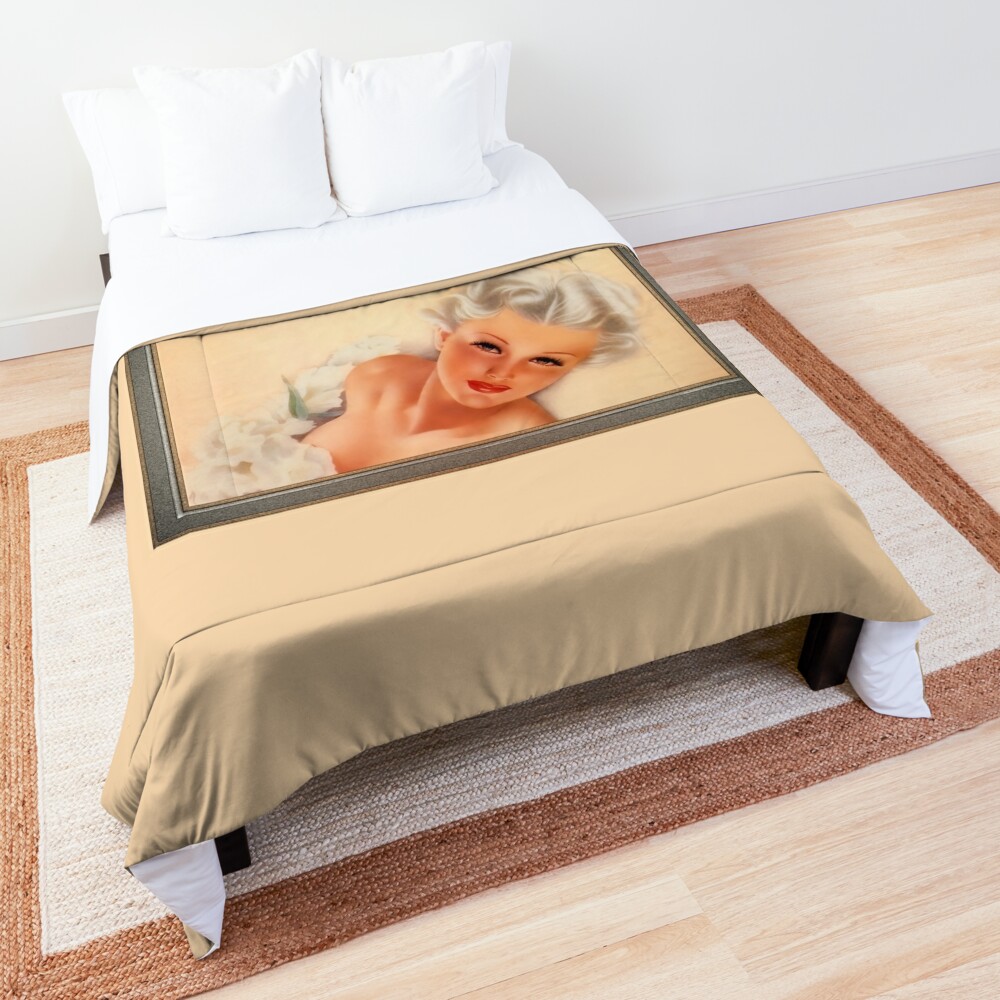
“Dream Girl,” created by Peruvian artist Delwedd deiliad Alberto Vargas (1896 – 1982) in the 1940s, captures the seductive allure of feminine beauty and elegance with a style that epitomizes the glamour of mid-century pin-up art. Known for his meticulous attention to detail, Vargas expertly combines delicate elements of portraiture with soft, dreamlike qualities that evoke an air of both innocence and sensuality.
Y gwaith celf hwn, which draws viewers into a serene and nostalgic world, remains one of his most iconic pieces. Vargas’s unmistakable flair for capturing the human form in a manner that is both realistic and idealized is fully on display in “Dream Girl.”
Tabl Cynnwys
Pwnc a Chyfansoddiad
Wrth wraidd “Dream Girl” lies a beautiful, youthful woman. Mae hi'n syllu i fyny yn dawel, mae ei mynegiant yn un o dawelwch a thawelwch. Mae nodweddion y pwnc wedi'u rendro'n osgeiddig, yn arddangos lefel uchel o fireinio yn nhechneg yr artist. Ei chroen disglair, gyda'i esmwythder tebyg i borslen, ymddangos bron yn ethereal yn erbyn y cefndir tawel.
Mae chwarae ysgafn y golau ar ei hwyneb yn amlygu meddalwch ei mynegiant, gan bwysleisio ei mawr, llygaid tywyll, gwefusau llawn, ac yn llyfn, aeliau bwaog ysgafn. Mae cromlin wan ei gwddf yn arwain i lawr at ei hysgwyddau meddal, gwella ei ffigwr gosgeiddig a benywaidd.
Mae gwallt melyn platinwm y fenyw wedi'i steilio mewn tonnau meddal sy'n rhaeadru'n ysgafn ar draws ei phen, gan fframio ei hwyneb fel eurgylch o sidan. Mae effaith cyffyrddus ei gwallt yn rhoi synnwyr o symudiad, fel petai wedi ei ddal mewn awel fwyn, further adding to the dreamlike quality of the image. This characteristic of movement is contrasted with her calm, passive demeanor, inviting the viewer into a world of poised elegance.
Objects and Elements
Surrounding the subject are subtle hints of nature, including soft white flowers that rest delicately around her, almost as if they have grown from the same delicate dreamlike state in which she exists. These floral elements are painted with soft strokes that blend seamlessly into the rest of the image, emphasizing the ethereal quality of the portrait. The flowers themselves appear almost weightless, with their petals depicted in a way that mimics the softness and fragility of the woman’s figure.
The background of the piece is a gentle wash of warm beige and peach tones, which enhances the overall softness of the scene. The delicate lightness of the background contrasts with the vividness of the subject’s face, which is the focal point of the painting. Vargas’s use of soft gradients in the background creates a hazy, dreamlike atmosphere, further inviting the viewer into a moment of quiet reverie.
Deunyddiau a Chanolig
Alberto Vargas was a master of his medium, and his work with oil paints in “Dream Girl” is a testament to his exceptional technique. The use of oils allowed him to achieve a smooth, flawless surface that enhances the lifelike quality of the subject’s skin and features.
The colors blend harmoniously, with an emphasis on soft pastels and subtle gradients that evoke a feeling of warmth and intimacy. Vargas’s brushwork is meticulous, gan ddangos ei fedr i ddal arlliwiau cain golau, cysgod, a gwead.
Mae'r trawsnewidiad meddal rhwng arlliwiau yn allweddol i naws y ddelwedd, ac mae hylifedd strôc Vargas yn rhoi ymdeimlad i'r gwrthrych o gael ei ddal mewn eiliad fer o amser, fel pe gallai'r ddelwedd doddi i ffwrdd neu symud gydag anadl syml o wynt. Yr effaith derfynol yw un o geinder caboledig a harddwch bythol, a oedd yn nodweddiadol o gelf pin-up llofnod Vargas.
Arddull a Thechneg
“Dream Girl” yn ymgorffori arddull llofnod Alberto Vargas, arlunydd enwog sy'n adnabyddus am ei ddarluniau pin-yp a oedd yn gorchuddio cloriau cylchgronau a hysbysebion yng nghanol yr 20fed ganrif. Mae ei waith wedi'i wreiddio'n ddwfn yn nhraddodiad celf pin-yp Americanaidd ond mae'n mynd y tu hwnt i gynrychioliadau arferol y cyfnod.. While Vargas’s women were often depicted in playful, seductive poses, he infused each of his subjects with a sense of grace and sophistication that set him apart from other pin-up artists.
His style is a blend of realism and idealization, where the human form is rendered with a high degree of detail while maintaining an almost fantastical allure. The women in Vargas’s portraits, such as the one in “Dream Girl,” are idealized depictions of beauty, captured in moments of tranquility that evoke a sense of fantasy. Y darn hwn, yn arbennig, reflects his mastery of creating an intimate connection with the viewer through the subject’s gaze and the tenderness of the scene.
Thema a Hwyliau
The central theme of “Dream Girl” revolves around the celebration of femininity, harddwch, a gras. The mood is one of serenity, tawelwch, and fantasy. The subject is neither overtly sexualized nor overly stylized in a way that detracts from her natural beauty. Yn lle hynny, the piece invites contemplation of the soft allure that exists in quiet moments. The colors and gentle composition exude warmth, calmness, a cheinder oesol, echoing the fantasy worlds of the golden era of Hollywood glamour.
The overall mood is also one of nostalgia, as the viewer is transported back to an earlier time when such portraits of women were emblematic of both class and allure. Y meddal, ethereal qualities of the image serve as a reminder of a more innocent, yet enchanting, vision of feminine beauty, one that is untainted by the complexities of modern life.
Nghasgliad
“Dream Girl” by Alberto Vargas stands as a magnificent example of mid-20th-century art that celebrates the beauty of the human form and captures the viewer’s imagination through delicate realism and idealized femininity. Through his use of soft tones, graceful composition, and mastery of oil painting, Vargas brings to life an image that is both a product of its time and timeless in its elegance.
The woman in this piece is an ethereal vision, whose quiet charm and beauty continue to captivate audiences even decades after its creation. This artwork is not just a portrait; it is a dream captured in paint, an embodiment of grace, harddwch, and the fantasy of perfect femininity.
Mae hwn yn atgynhyrchiad hen feistr celf ddigidol wedi'i ailfeistroli o ddelwedd parth cyhoeddus sydd ar gael i'w brynu ar-lein fel a print cynfas wedi'i rolio.
Bio artist
Gwybodaeth Isod O Wikipedia.org
Ganed yn Arequipa, Periw, roedd yn fab i'r ffotograffydd Periw nodedig Max T.. Vargas. Symudodd Alberto Vargas i'r Unol Daleithiau yn 1916 ar ôl astudio celf yn Ewrop, Zurich, a Genefa cyn y Rhyfel Byd Cyntaf.
Tra'r oedd yn Ewrop daeth ar y cylchgrawn Ffrengig La Vie Parisienne, gyda chlawr gan Raphael Kirchner, a ddywedodd ei fod yn ddylanwad mawr ar ei waith.
Roedd ei yrfa gynnar yn Efrog Newydd yn cynnwys gwaith fel arlunydd ar gyfer y Ziegfeld Follies ac i lawer o stiwdios Hollywood. Crogodd Ziegfeld ei lun o Olive Thomas yn y theatr, a meddyliwyd amdani fel un o'r Merched Vargas cynharaf.
Vargas’ roedd y darn enwocaf o waith ffilm ar gyfer poster y 1933 ffilm The Sin of Nora Moran, sy'n dangos Zita Johann bron yn noeth mewn sefyllfa o anobaith. Yn aml, enwir y poster yn un o'r posteri ffilm mwyaf a wnaed erioed.
Daeth yn enwog yn y 1940au fel crëwr pin-ups eiconig o'r Ail Ryfel Byd ar gyfer cylchgrawn Esquire o'r enw “Merched Vargas.” Rhwng 1940 a 1946 Cynhyrchwyd Vargas 180 paentiadau ar gyfer y cylchgrawn.
Cafodd celf trwyn llawer o awyrennau America a'r Cynghreiriaid o'r Ail Ryfel Byd ei hysbrydoli a'i haddasu o'r pin-ups Esquire hyn, yn ogystal â rhai George Petty, ac artistiaid eraill.