

Elizabeth Wharton Drexel
Portrait of Elizabeth Wharton Drexel c1905 by Italian Painter Giovanni Boldini (1842 – 1931); an Italian genre and portrait painter who was known as the Master of Swish, due to the flowing brush strokes of his painting style.
This is an elegant portrait of Elizabeth Wharton Drexel (1868 – 1944), who was an American socialite and author of two books “King Lehr” and the Gilded Age (1935) and Turn of the World (1937).
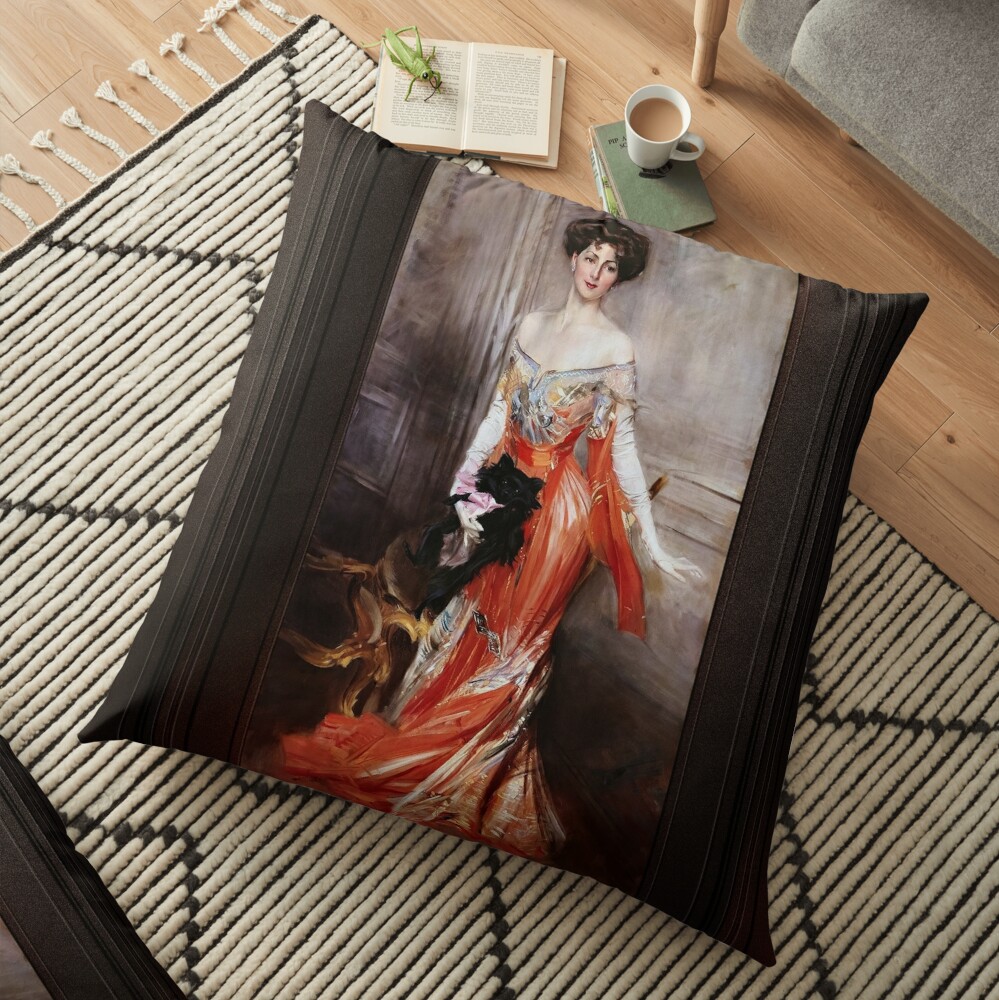
She is seen her wearing a vibrant orange silk dress with large white, gold and blue accents along the lower parts of the dress; while the top portion consist of an abstract pattern.
She is wearing arms length white evening glove and is standing by a chair while she holds her little black dog with her right hand near her waist.
Ĉi tio estas retuŝita cifereca arto malnova majstra reproduktaĵo de publika domajna bildo aĉetebla kiel a tolo presaĵo rete.
Informoj Malsupre Derivita De Vikipedio.org
Boldini estis naskita en Ferrara, Italio en decembro 31, 1842, al filo de pentristo pri religia temo. En 1862 en la aĝo de 20, li iris al Florenco dum ses jaroj por studi kaj okupiĝi pri pentraĵon.
Li nur malofte frekventis klasojn ĉe la Akademio de Belartoj, sed en Florenco, renkontis aliajn realismajn farbistojn konatajn kiel la Macchiaioli, kiuj estis italaj antaŭuloj de impresionismo.
Ilia influo vidiĝas en la pejzaĝoj de Boldini kiuj montras lian spontanean respondon al naturo, kvankam estas pro liaj portretoj ke li iĝis plej konata
Transloĝiĝo al Londono, Boldini ekhavis sukceson kiel portretisto. Li kompletigis portretojn de ĉefrangaj membroj de socio inkluzive de Lady Holland kaj la Dukino de Westminster.
En 1872 li translokiĝis al Parizo, kie li renkontis kaj amikiĝis kun Edgar Degas. Dum la malfrua 19-a jarcento li iĝis la plej moda portretisto en Parizo, kun impeta stilo de pentraĵo kiu elstarigas iom da el la Macchiaioli-influo kaj brio rememoriga pri la laboro de pli junaj artistoj., kiel ekzemple John Singer Sargent kaj Paul Helleu.
En 1889, li estis nomumita komisaro de la itala sekcio de la Pariza Ekspozicio, kaj ricevis la Honoran Legion por tiu nomumo. En 1897 li havis solludan ekspozicion en Novjorko; kaj li ankaŭ partoprenis la Venecian Bienalon en 1895, 1903, 1905, kaj 1912.