

Empress Carlota of Mexico
Empress Carlota of Mexico (nee Princess Charlotte of Belgium) c1850s by German Painter Hermann Winterhalter (1808 – 1891); younger brother of the portrait painter Franz Xaver Winterhalter (1805 – 1873).
This beautiful portrait of the young Empress Carlota is set with her standing or possibly sitting in front of a textured multi-colored wall.
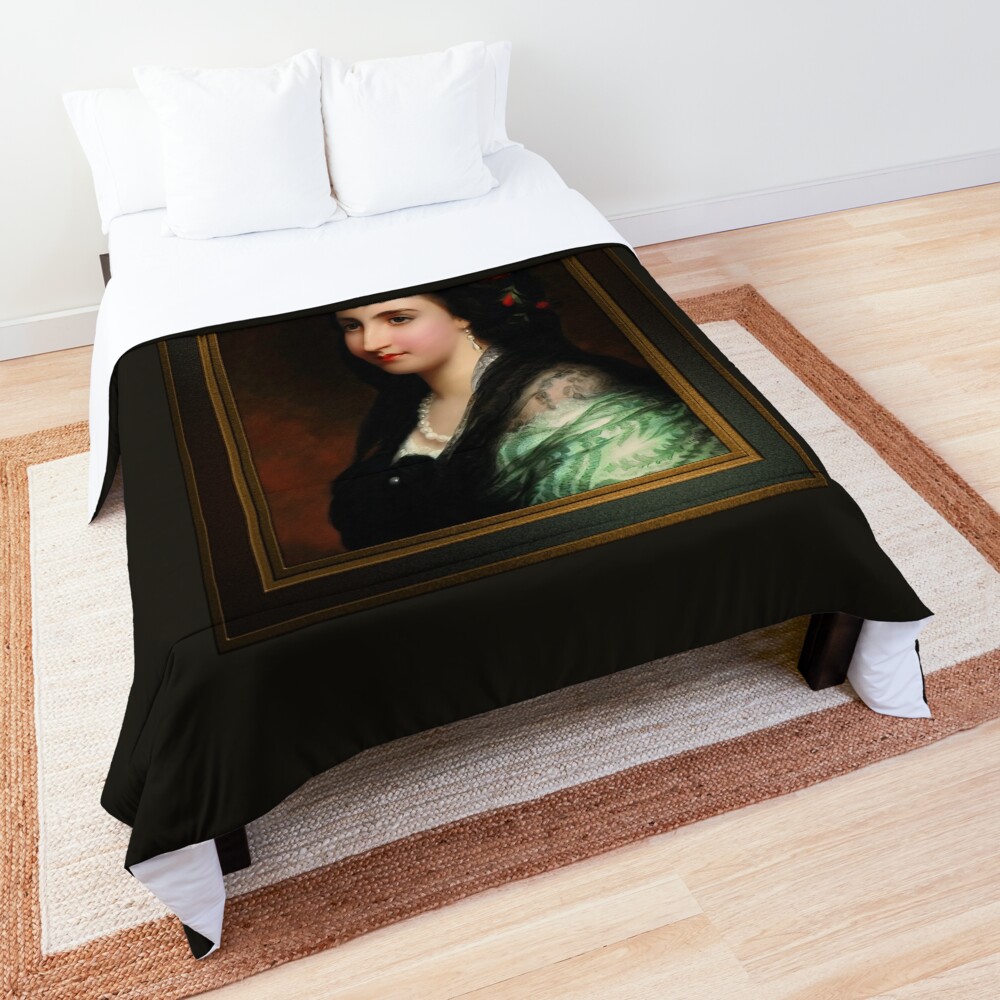
She is presented in three quarter view facing to the left of the viewer, looking off into the distance with a minute smile on her face.
She is wearing a white dress with ruffled trim along its borders, a green embroidered sheer shawl and on top of that a black embroidered kerchief.
Placed withing her black hair is a large red flower, and two smaller red flowers with green leaves that are attached to there stems.
She is also wearing a set of earrings that are composed of a round pearl at the top and a tear drop pearl on the bottom; that compliment the pearl necklace around her neck and the pearl pin that holds the ends of her black kerchief to the chest portion of her dress.
Toto je remasterovaná reprodukce starých mistrů digitálního umění obrázku ve veřejné doméně, který je dostupný jako a tisk na plátno online.
Níže uvedené informace jsou odvozeny z Wikipedia.org
Hermann Winterhalter was born in the small village of Menzenschwand, (nyní součástí Sankt Blasien), v německém Černém lese v Bádenském kurfiřtství, v dubnu 20, 1805.

He was the seventh child of Fidel Winterhalter (1773 – 1863), farmář a výrobce pryskyřice v obci, a jeho manželky Evy Meyerové (1765 – 1838), člen dlouho zavedené rodiny Menzenschwand.
His father was of peasant stock and was a powerful influence in his life making him follow in his older brother Franz Winterhalter footsteps whom Hermann was very close to. Z osmi bratrů a sester, pouze čtyři přežili dětství.
Hermann began his artistic career, when he was first trained as a lithographer (Lithography is a method of printing originally based on the immiscibility of oil and water. The printing is from a stone (lithographic limestone) or a metal plate with a smooth surface. It was invented in 1796 by German author and actor Alois Senefelder (1771 – 1834) as a cheap method of publishing theatrical works.).
From there he later went on to study painting in Munich, Germany and Rome, Itálie; after which he moved to Paris, France where he worked with his brother Franz and exhibited at the Salon from 1838 – 1841, 1847 a 1869.
In th 1850s Hermann independently started a small portrait practice of his own, creating respected works such as Young Girl from Ariccia and the portrait of his Parisian patron Nicolas-Louis Planat de la Faye.
After the fall of the Second French Empire (which was the 18-year Imperial Bonapartist regime of Napoleon III from January 14, 1852 to September 4, 1870, between the Second Republic and Third Republic, of France.); Hermann a jeho bratr Franz se rozhodli odejít do Badenu; historické území v jižním Německu a severním Švýcarsku, na obou stranách horního Rýna.
Kde Franz zemřel 1873; zatímco Hermann téměř 20 více let, zemřel v únoru 24, 1891 v Karlsruhe – druhé největší město německé spolkové země Bádensko-Württembersko.