

Empress Carlota of Mexico
Empress Carlota of Mexico (geboren prinses Charlotte van België) c1850s by German Painter Hermann Winterhalter (1808 – 1891); younger brother of the portrait painter Franz Xaver Winterhalter (1805 – 1873).
This beautiful portrait of the young Empress Carlota is set with her standing or possibly sitting in front of a textured multi-colored wall.
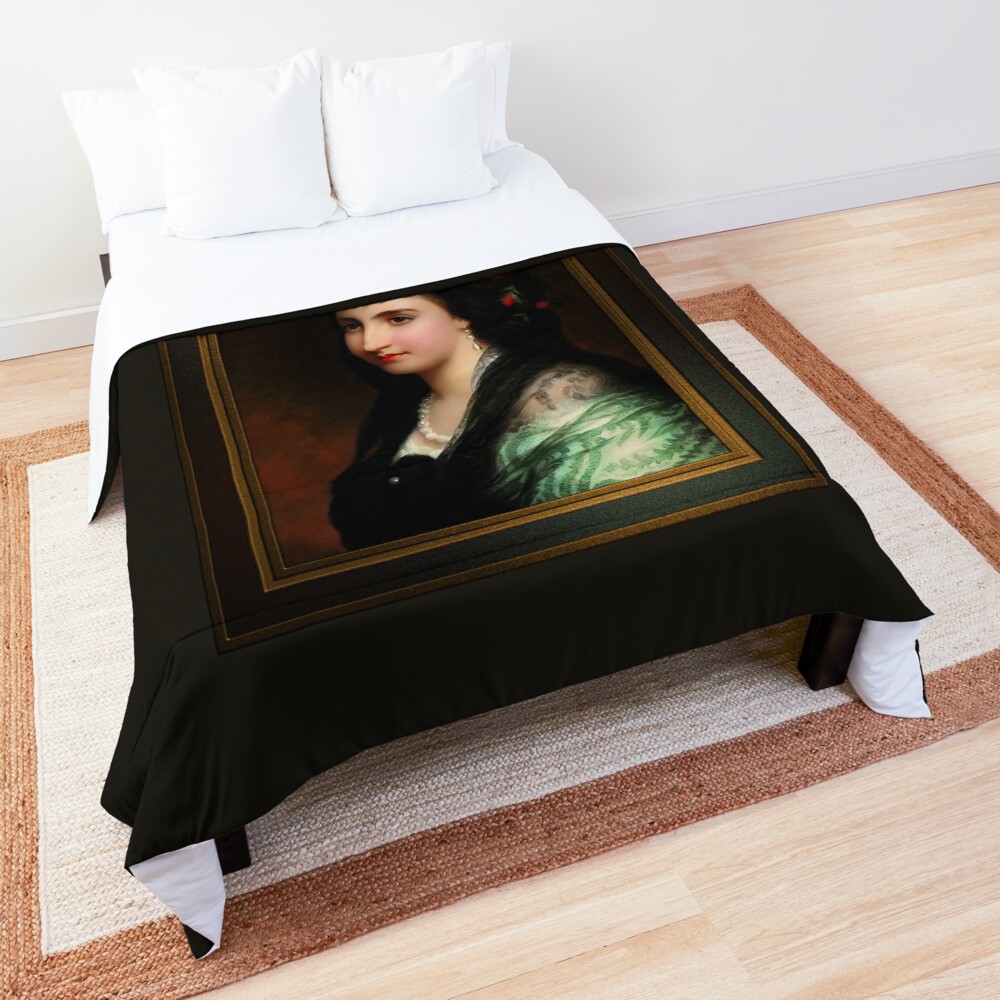
She is presented in three quarter view facing to the left of the viewer, looking off into the distance with a minute smile on her face.
She is wearing a white dress with ruffled trim along its borders, a green embroidered sheer shawl and on top of that a black embroidered kerchief.
Placed withing her black hair is a large red flower, and two smaller red flowers with green leaves that are attached to there stems.
She is also wearing a set of earrings that are composed of a round pearl at the top and a tear drop pearl on the bottom; that compliment the pearl necklace around her neck and the pearl pin that holds the ends of her black kerchief to the chest portion of her dress.
Dit is een remastered reproductie van digitale kunst oude meesters van een openbaar domeinafbeelding dat beschikbaar is als a canvas print online.
Info hieronder afgeleid van Wikipedia.org
Hermann Winterhalter werd geboren in het kleine dorpje Menzenschwand, (nu onderdeel van Sankt Blasien), in het Duitse Zwarte Woud in het keurvorstendom Baden, in april 20, 1805.

Hij was het zevende kind van Fidel Winterhalter (1773 – 1863), een boer en harsproducent in het dorp, en zijn vrouw Eva Meyer (1765 – 1838), een lid van een lang gevestigde Menzenschwand-familie.
Zijn vader was van boerenfamilie en had een krachtige invloed in zijn leven, waardoor hij in de voetsporen trad van zijn oudere broer Franz Winterhalter, met wie Hermann heel dicht bij stond.. Van de acht broers en zussen, slechts vier overleefden de kindertijd.
Hermann begon zijn artistieke carrière, toen hij voor het eerst werd opgeleid als lithograaf (Lithografie is een drukmethode die oorspronkelijk was gebaseerd op de onmengbaarheid van olie en water. De bedrukking is van een steen (lithografische kalksteen) of een metalen plaat met een glad oppervlak. Het is uitgevonden in 1796 by German author and actor Alois Senefelder (1771 – 1834) as a cheap method of publishing theatrical works.).
From there he later went on to study painting in Munich, Germany and Rome, Italië; after which he moved to Paris, France where he worked with his brother Franz and exhibited at the Salon from 1838 – 1841, 1847 en 1869.
In th 1850s Hermann independently started a small portrait practice of his own, creating respected works such as Young Girl from Ariccia and the portrait of his Parisian patron Nicolas-Louis Planat de la Faye.
After the fall of the Second French Empire (which was the 18-year Imperial Bonapartist regime of Napoleon III from January 14, 1852 to September 4, 1870, between the Second Republic and Third Republic, of France.); Hermann and his brother Franz decided to retire to Baden; a historical territory in South Germany and North Switzerland, on both sides of the Upper Rhine.
Where Franz died in 1873; while Hermann for almost 20 more years, passing away on February 24, 1891 in Karlsruhe – the second-largest city of the German federal state of Baden-Württemberg.