

Entry of Napoleon I into Berlin, Ottobre, 27th 1806 is a masterpiece by the French painter Charles Meynier (1763 o 68 – 1832), created around 1810. This monumental work captures the historical moment of Napoleon Bonaparte’s entry into Berlin, following the victory at the Battle of Jena-Auerstedt during the Napoleonic Wars. U pittura, executed in the neoclassical style, is a grand depiction of Napoleon’s triumph and the power he wielded at the height of his empire. The artwork is rich in both narrative and visual grandeur, combining elements of military spectacle with a portrayal of the dramatic atmosphere of the time.
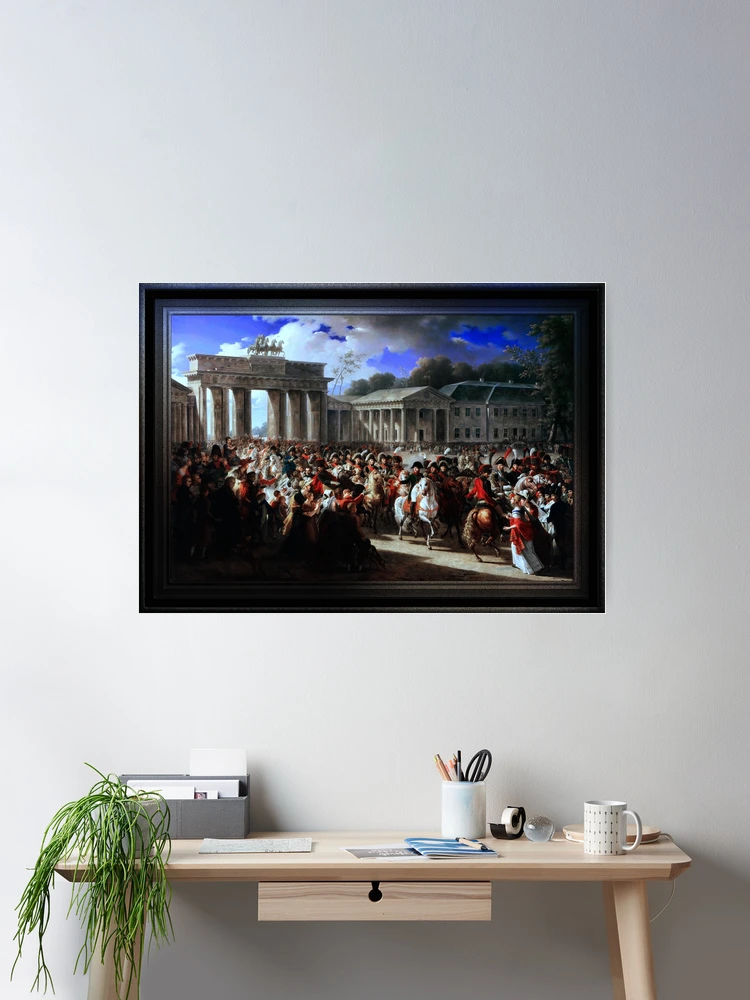
Table of Contents
Sugettu principale è cumpusizioni
At the heart of the composition is the figure of Napoleon himself, mounted on a white horse and positioned at the forefront of the scene. He is flanked by his generals and soldiers, who all share the same air of triumph and discipline. The emperor is portrayed with a commanding presence, his gaze fixed and his posture upright, exuding authority and confidence. He is dressed in a grand military uniform, featuring the iconic red coat and golden epaulettes, symbolizing his imperial status. His face, while slightly softened, remains a testament to his power and resolve.
The crowd surrounding Napoleon is varied and dynamic, composed of soldiers, civilians, and nobility, all observing his entry into Berlin. The diverse array of figures, their facial expressions ranging from admiration to awe, provides a sense of the widespread reverence for the emperor. Among the crowd, many figures stand at attention, saluting their emperor, while others gather in groups, forming a living mass that surrounds the procession. The interaction between the figures is well-executed, showcasing Meynier’s talent for rendering human emotion in a collective context.
Architecture and Terrain
The backdrop of the painting features the architectural grandeur of Berlin, with notable buildings and structures representing the city’s 18th-century neoclassical architecture. The Brandenburg Gate – an 18th Century Neoclassical monument built on the orders of the Prussian King Frederick William II, after the temporary restoration of order during the Batavian Revolution January 18, 1795, is iconic in its design. Is seen towering in the distance, symbolizing Berlin’s importance as a capital city and Napoleon’s military dominance over it. The columns of the gate rise with a sense of formality and monumental scale, echoing the strength and power of Napoleon’s army.
In u primu pianu, the terrain is bustling with activity, with soldiers on horseback, infantrymen, and civilians filling the wide avenue that leads into the city. The sweeping motion of the crowd and the movement of the horses convey a sense of dynamism, as if the viewer is witnessing the event in real-time. The ground appears dusty and trampled underfoot, indicative of the many soldiers that had passed through this route before. The street’s wide expanse allows for a clear view of the emperor and his entourage, making them the undeniable focal point of the composition.
Materiali è Stile
Meynier’s choice of materials and technique demonstrates his mastery of neoclassical painting. The artist uses oil paints to achieve a rich, vivid representation of the scene, employing both light and shadow to enhance the dramatic effect of the moment. The contrast between the dark sky and the illuminated figures in the foreground creates a stark division that emphasizes Napoleon’s central role in the composition. The lighting effect suggests both the grandeur of the event and the imminent shift in European power.
The use of light plays a central role in setting the mood of the painting. The figures of Napoleon and his generals are bathed in bright, almost ethereal light, while the darker shadows cast on the crowd suggest a sense of distance and subjugation. The contrast highlights Napoleon’s central role in the scene, while the surrounding figures appear as mere onlookers in awe of his power.
The neoclassical style of the painting is characterized by its attention to detail, realism, and idealization of the figures. The precision in the depiction of clothing, horses, and architecture all point to Meynier’s rigorous training and adherence to classical ideals. His use of space and form, as well as his ability to convey movement, creates a harmonious balance within the composition. U pittura, while rooted in historical realism, also embodies a sense of grandeur and heroism, characteristic of the Romantic period that would soon follow.
Umore è Atmosfera
The mood of the painting is one of triumph, reverence, and awe. The crowd’s overwhelming focus on Napoleon, coupled with the formal, almost ceremonial procession, suggests the emperor’s absolute control over the moment. The scene is imbued with a sense of monumental importance, as the viewer is invited to contemplate the historical significance of the event.
In listessu tempu, there is a palpable tension in the air. While the soldiers and civilians show deference to Napoleon, the shadow of war and conquest lingers in the background. The stark contrast between the bright light surrounding Napoleon and the darkening skies hints at the fleeting nature of his empire, as well as the impending changes that would soon unfold across Europe. U pittura, dunque, captures both the glory of Napoleon’s reign and the weight of the forces that would eventually lead to his downfall.
Cunclusione
Charles Meynier’s “Entry of Napoleon I into Berlin” is a powerful historical narrative rendered in exquisite detail. Through his mastery of composition, luce, è forma, Meynier encapsulates the moment of Napoleon’s triumph while also hinting at the complexities of his reign. The painting stands as a testament to the neoclassical ideals of the time, celebrating the heroism and grandeur of one of history’s most controversial figures.
Charles Meynier is a retouched digital art old masters reproduction of a public domain image.
Questa creazione d'arte digitale, cum'è cù tutte l'opere d'arte chì ponu esse truvate nantu à u situ web di Xzendor7 hè dispunibule per cumprà in linea in una varietà di formati di materiale cumprese stampe di tela., stampe acriliche, stampe metalliche, stampe di lignu, stampe in cornice, manifesti, è cum'è stampe su tela arrotolata in una varietà di dimensioni da 12 centimetri à 72 centimetri secondu a dimensione di l'opera d'arte attuale è a stampa nantu à a tenda chì sceglite di cumprà l'arte da.
L'opera d'arte hè ancu dispunibule nantu à una larga gamma di vestiti di l'omi è di e donne, mugs, tote, sciarpe, quaderni è ghjurnali è parechji prudutti di decoru di casa.
À propositu di l'artista
Info sottu Derivatu da Wikipedia.org
Meynier era u figliolu di un sartu; è una ghjovana età dimustrava un talentu per l'arti, è hà iniziatu a so furmazione sottu a tutela di u disegnatore è incisore francese Pierre-Philippe Choffard. *1731 – 1809).
Cum'è un studiente di u pittore neoclassicu è storicu francese François-André Vincent (1746 – 1816), Meynier hà vintu u secondu premiu in u 1789 prezzu di cuncorsu di Roma; mentre Anne-Louis Girodet de Roussy-Trioson hà pigliatu u primu premiu. Quattru anni dopu in 1793 Meynier tornò a Parigi.
In 1815 Meynier diventò membru di l'Accademia francese in Roma; è durante u periodu trà 1819 à 1822, hà criatu a grande decoru per u tettu di u Louvre; oltri a crià numarosi opari chì glurificavanu a legenda napulione, chì per a maiò parte ferma in u Château de Versailles.
Hà fattu ancu disegni per i bassorilievi è statue nantu à l'Arc de Triomphe du Carrousel è a Borsa di Parigi.. Da 1816 avanti, Meynier era un membru di l'Accademia di Belle Arti; è in 1819 fu numinatu insegnante à l'École des Beaux-Arts.