

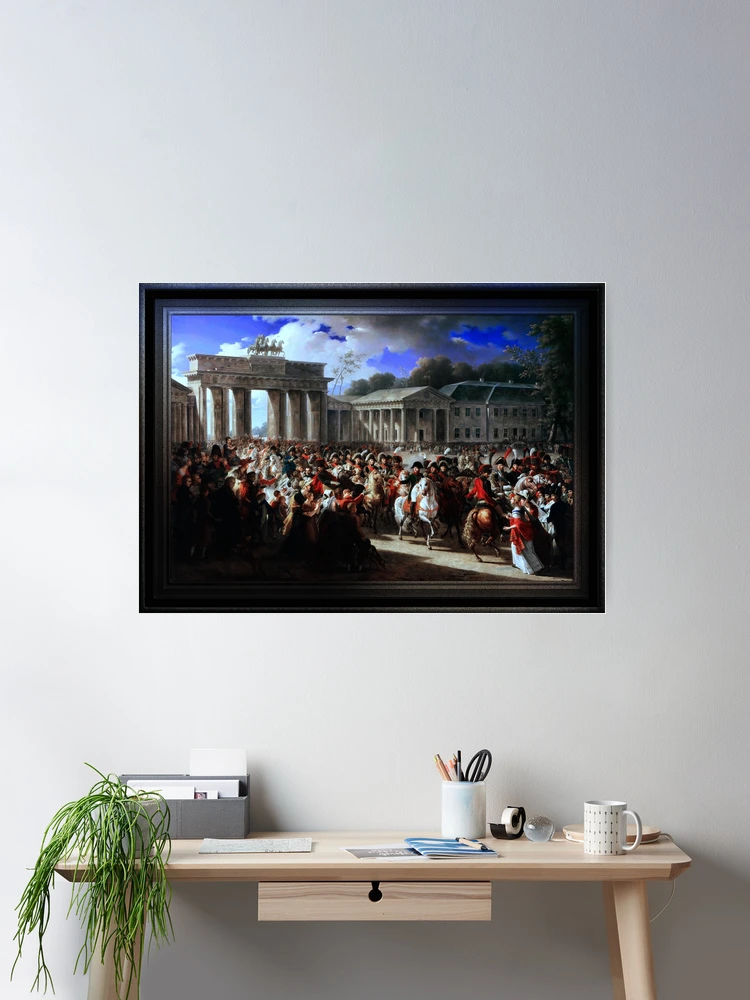
나폴레옹 1세의 베를린 입성, 십월, 27일 1806 is a masterpiece by the French painter Charles Meynier (1763 또는 68 – 1832), 주위에 만들어졌습니다 1810. This monumental work captures the historical moment of Napoleon Bonaparte’s entry into Berlin, following the victory at the Battle of Jena-Auerstedt during the Napoleonic Wars. 그림, executed in the neoclassical style, is a grand depiction of Napoleon’s triumph and the power he wielded at the height of his empire. The artwork is rich in both narrative and visual grandeur, combining elements of military spectacle with a portrayal of the dramatic atmosphere of the time.
목차
주요 주제 및 구성
At the heart of the composition is the figure of Napoleon himself, mounted on a white horse and positioned at the forefront of the scene. He is flanked by his generals and soldiers, who all share the same air of triumph and discipline. The emperor is portrayed with a commanding presence, his gaze fixed and his posture upright, exuding authority and confidence. He is dressed in a grand military uniform, featuring the iconic red coat and golden epaulettes, symbolizing his imperial status. 그의 얼굴, while slightly softened, remains a testament to his power and resolve.
The crowd surrounding Napoleon is varied and dynamic, composed of soldiers, civilians, and nobility, all observing his entry into Berlin. The diverse array of figures, their facial expressions ranging from admiration to awe, provides a sense of the widespread reverence for the emperor. Among the crowd, many figures stand at attention, saluting their emperor, while others gather in groups, forming a living mass that surrounds the procession. The interaction between the figures is well-executed, showcasing Meynier’s talent for rendering human emotion in a collective context.
Architecture and Terrain
The backdrop of the painting features the architectural grandeur of Berlin, with notable buildings and structures representing the city’s 18th-century neoclassical architecture. The Brandenburg Gate – 프로이센 왕의 명령에 따라 지어진 18세기 신고전주의 기념물 프레데릭 윌리엄 2세, 바타비아 혁명 1월 동안 일시적인 질서 회복 후 18, 1795, is iconic in its design. Is seen towering in the distance, symbolizing Berlin’s importance as a capital city and Napoleon’s military dominance over it. The columns of the gate rise with a sense of formality and monumental scale, echoing the strength and power of Napoleon’s army.
전경에서, the terrain is bustling with activity, with soldiers on horseback, infantrymen, and civilians filling the wide avenue that leads into the city. The sweeping motion of the crowd and the movement of the horses convey a sense of dynamism, as if the viewer is witnessing the event in real-time. The ground appears dusty and trampled underfoot, indicative of the many soldiers that had passed through this route before. The street’s wide expanse allows for a clear view of the emperor and his entourage, making them the undeniable focal point of the composition.
재료와 스타일
Meynier’s choice of materials and technique demonstrates his mastery of neoclassical painting. 예술가는 풍부한 느낌을 얻기 위해 유성 페인트를 사용합니다., vivid representation of the scene, employing both light and shadow to enhance the dramatic effect of the moment. The contrast between the dark sky and the illuminated figures in the foreground creates a stark division that emphasizes Napoleon’s central role in the composition. The lighting effect suggests both the grandeur of the event and the imminent shift in European power.
The use of light plays a central role in setting the mood of the painting. The figures of Napoleon and his generals are bathed in bright, 거의 미묘한 빛, while the darker shadows cast on the crowd suggest a sense of distance and subjugation. The contrast highlights Napoleon’s central role in the scene, while the surrounding figures appear as mere onlookers in awe of his power.
The neoclassical style of the painting is characterized by its attention to detail, realism, and idealization of the figures. The precision in the depiction of clothing, 말, and architecture all point to Meynier’s rigorous training and adherence to classical ideals. His use of space and form, as well as his ability to convey movement, creates a harmonious balance within the composition. 그림, while rooted in historical realism, also embodies a sense of grandeur and heroism, characteristic of the Romantic period that would soon follow.
분위기와 분위기
The mood of the painting is one of triumph, reverence, 그리고 경외심. The crowd’s overwhelming focus on Napoleon, coupled with the formal, almost ceremonial procession, suggests the emperor’s absolute control over the moment. The scene is imbued with a sense of monumental importance, as the viewer is invited to contemplate the historical significance of the event.
동시에, there is a palpable tension in the air. While the soldiers and civilians show deference to Napoleon, the shadow of war and conquest lingers in the background. The stark contrast between the bright light surrounding Napoleon and the darkening skies hints at the fleeting nature of his empire, as well as the impending changes that would soon unfold across Europe. 그림, 그러므로, captures both the glory of Napoleon’s reign and the weight of the forces that would eventually lead to his downfall.
결론
Charles Meynier’s “나폴레옹 1세의 베를린 입성” is a powerful historical narrative rendered in exquisite detail. Through his mastery of composition, 빛, 그리고 형태, Meynier encapsulates the moment of Napoleon’s triumph while also hinting at the complexities of his reign. The painting stands as a testament to the neoclassical ideals of the time, celebrating the heroism and grandeur of one of history’s most controversial figures.
Charles Meynier는 퍼블릭 도메인 이미지의 수정된 디지털 아트 올드 마스터 복제품입니다..
이 디지털 아트 창작, Xzendor7 웹사이트에서 찾을 수 있는 모든 예술 작품과 마찬가지로 캔버스 인쇄를 포함한 다양한 재료 형식으로 온라인에서 구매할 수 있습니다., 아크릴 프린트, 금속 지문, 목판화, 액자 인쇄, 포스터, 그리고 압연 캔버스 인쇄 부터 다양한 사이즈로 12 인치에 72 실제 작품의 크기와 작품을 구매하기로 선택한 주문형 인쇄소에 따라 인치.
이 작품은 다양한 남성복과 여성복에서도 볼 수 있습니다., 머그, 토트백, 스카프, 노트북, 저널 및 다양한 홈 데코 제품.
아티스트 소개
아래에서 파생 된 정보 Wikipedia.org
Meynier는 재단사의 아들이었습니다.; 그리고 어린 나이는 예술에 재능을 보였다, 프랑스 드래프트맨과 조각가인 피에르 필립 쇼파드의 멘토링 하에 훈련을 시작했습니다. *1731 – 1809).
프랑스 신고전주의 및 역사 화가 François-André Vincent의 학생으로서 (1746 – 1816), Meynier는 2등상을 수상했습니다. 1789 로마 경쟁의 가격; Anne-Louis Girodet de Roussy-Trioson이 1위를 차지한 동안. 4년 후 1793 Meynier는 파리로 돌아왔다.
에 1815 Meynier는 로마에 있는 프랑스 아카데미 회원이 되었습니다.; 그리고 그 사이의 기간 동안 1819 NS 1822, 그는 루브르 박물관의 천장을 위한 웅장한 장식을 만들었습니다.; 뿐만 아니라 나폴레옹의 전설을 영화롭게 한 수많은 작품을 만들었습니다., 대부분 Château de Versailles에 남아 있습니다..
그는 또한 개선문과 파리 증권 거래소의 부조와 동상을 디자인했습니다.. 에서 1816 앞으로, Meynier는 Academy of Fine Arts의 회원이었습니다.; 그리고 1819 그는 École des Beaux-Arts의 교사로 임명되었습니다..