

Esther
Esther c1885 by French Painter Hugues Merle (1823 – 1881); who specialized in scenes of maternal affection, childhood innocence and moral consequence.
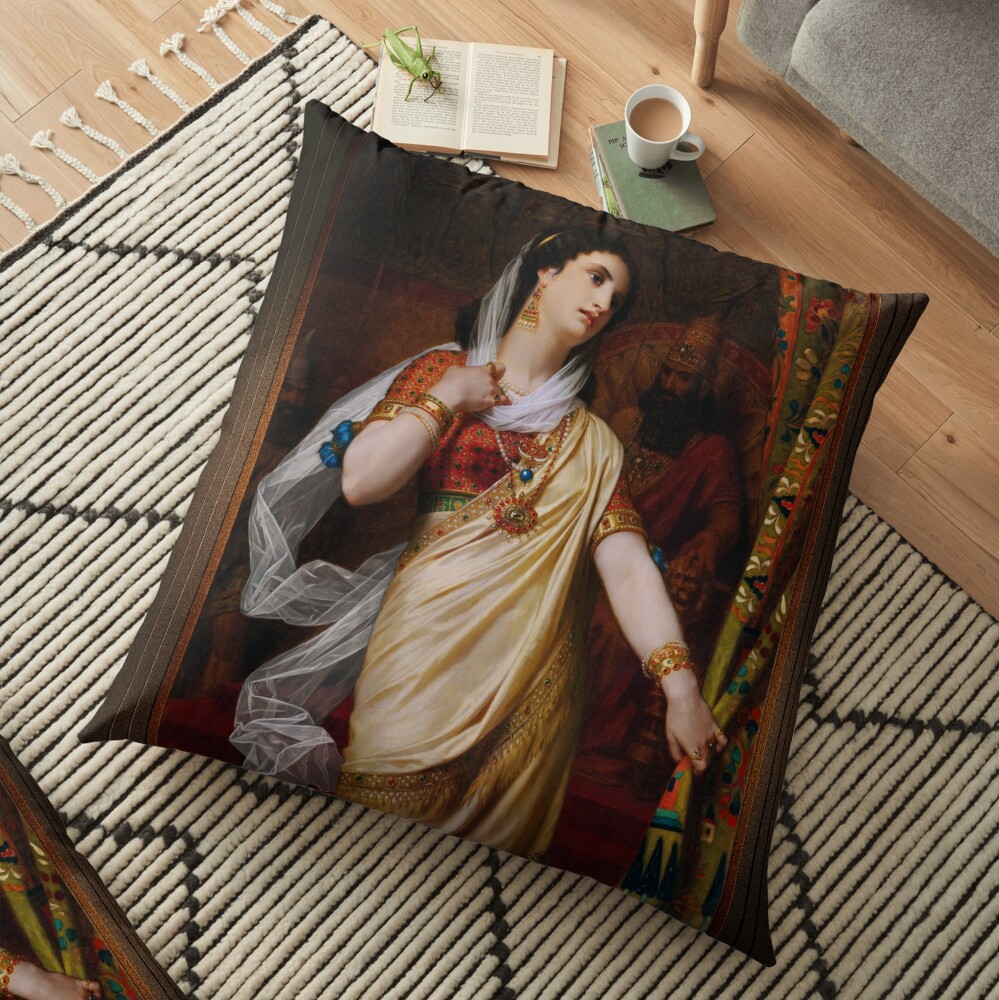
Tento náboženský portrait is based on the Biblical tale from the book of Esther; in which a beautiful young Jewish woman becomes Queen to the Persian King Ahasuerus, after he banishes his queen Vashti; and later is able to avert the slaughter of her people throughout the Persian Empire.
The painting shows Esther in beautiful attire of fine silks and adorned jewels, precious stones and gold as she holds onto a decorative light green drape with her left hand; while in the background we see the king seated on his throne, finely dressed and adorned with jewels on his crown and chest plate, with a guard holding a spear to his right.
Esther is wearing a gold band around her long black hair, that is partially covered by a sheer white silk scarf that loops across the lower portion of her neck and around her back.
Esther’s dress which is composed of three different materials, starts with a red top portion that in embellished gold squares that have pearls at each corner and emeralds at the center of each square surrounded by another gold square rotated 90 stupně, creating and eye like appearance.
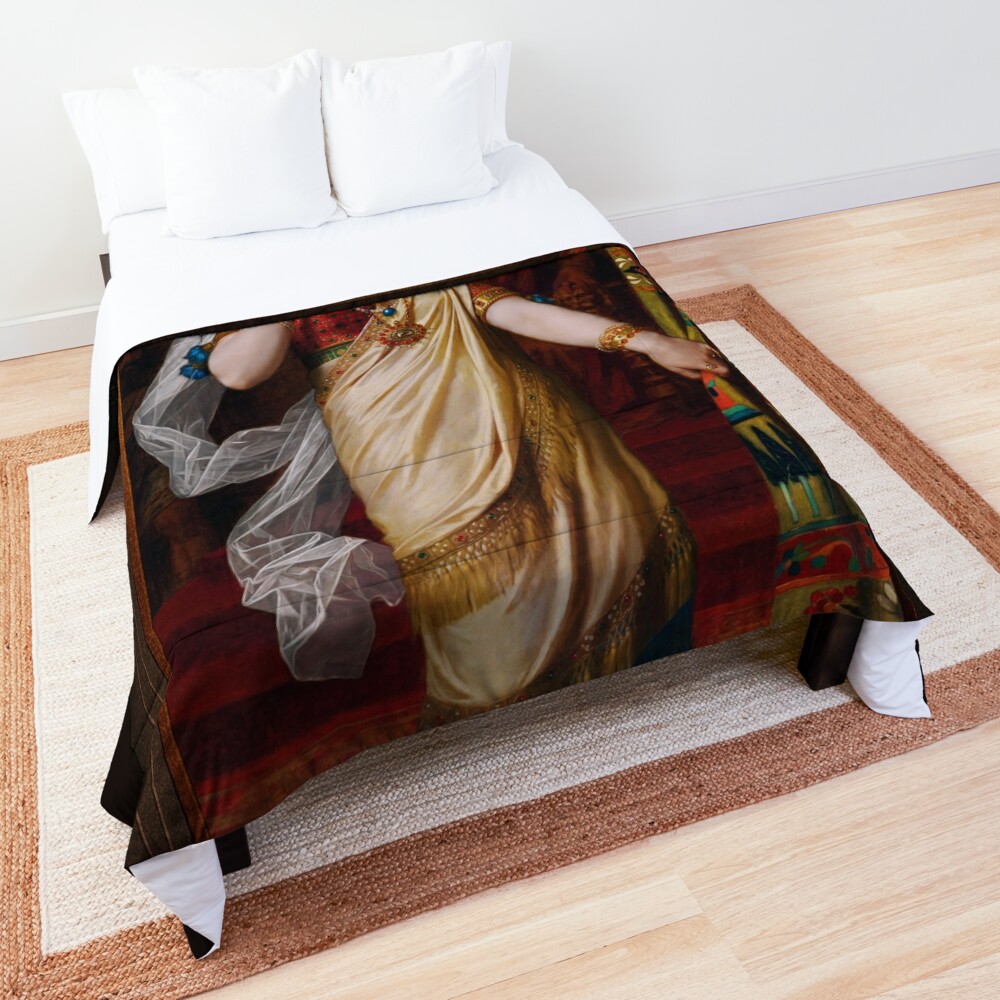
Then around her waist is a gold like sash that is overlaid with a bright green geometric design; and this transitions to the green full length portion of the dress.
She is then covered in a light gold tone wrap that has dark gold tone tassels along the edges, with a wide dark band that is sectioned into squares that have alternate clusters of four pearls, round rubies and emeralds.
Around her neck is a large loop necklace, a ruby necklace from which a gold and ruby amulet hands along with blue opal connected to silver wing like elements.
Around her upper arms of the short sleeve dress she is wearing are wide band arm bracelets made of gold with alternating squares of rubies and diamonds, that match the triangular square earrings she wearing comprised of gold, smaragdy, rubies, diamonds and pearls.
On her wrist she is wearing gold bracelets that are embellished with rubies and emeralds, pearl bracelets and a single ruby bracelet on her left wrist; while most of her fingers are adorned with gold rings that have precious stones embedded in them.
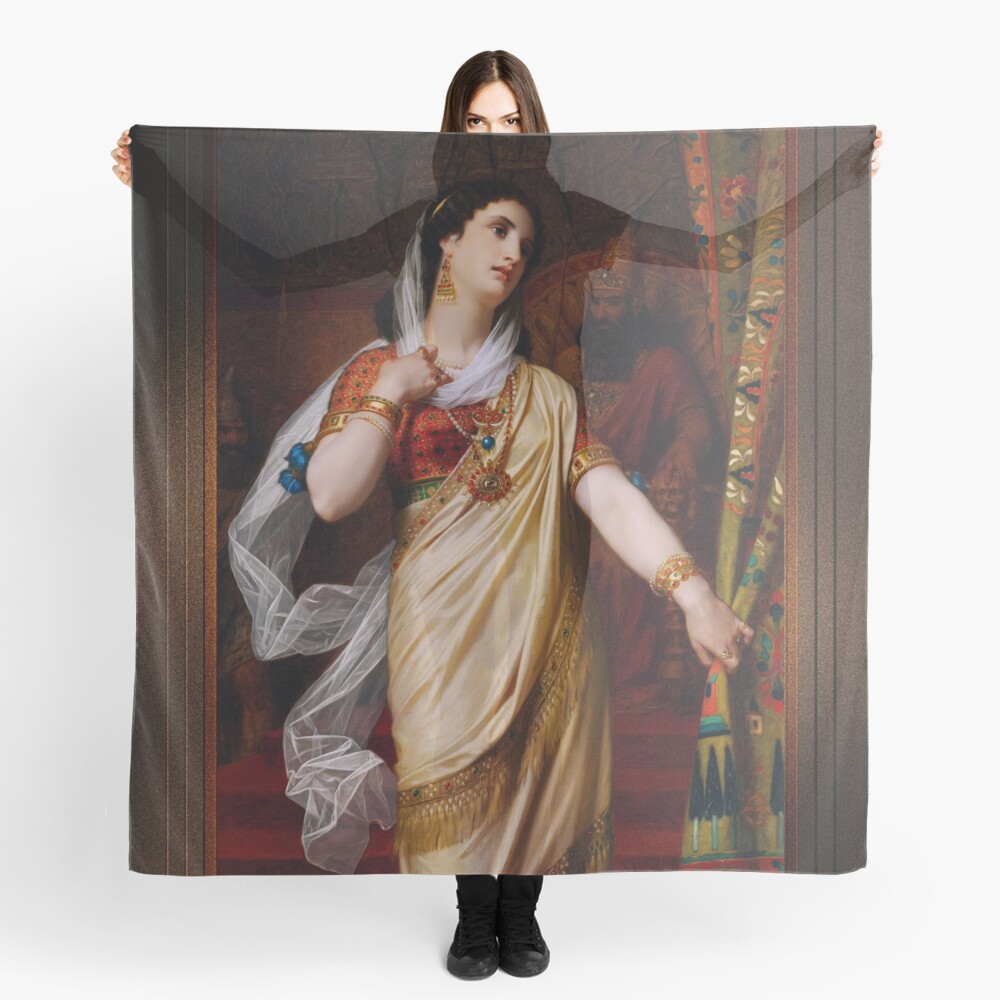
Toto je remasterovaná reprodukce starých mistrů digitálního umění obrázku ve veřejné doméně, který je dostupný jako a tisk na plátno online.
Níže uvedené informace jsou odvozeny z Wikipedia.org a Rehs.com
Hugues Merle se narodil v 1822 nebo 1823 v LA zóně, Francii a kolem let 21 dorazil do Paříže, Francie, kde studoval malbu u francouzského historického a portrétního malíře Léona Cognieta (1794 – 1880).
Ačkoli se o Huguesově raném životě ví jen málo, předpokládá se, že před příjezdem do Paříže získal určitý stupeň uměleckého vzdělání. 1843; protože začal vystavovat na pařížském salonu v r 1847 se svým dílem Portrét autora a in 1848 vystavil dílo Légende des Willis.
Jak šel čas, Huguesova reputace jako portrétisty během 50. let 19. století podstatně vzrostla; a jako úspěšný a prominentní malíř dokázal přilákat vážné milovníky umění, kteří hledali budování svých uměleckých sbírek.
One of these early collectors of art was the 4th Marquess of Hertford, Richard Seymour-Conway (1800-1870); který si zakoupil jeho salónní podání Reading the Bible in 1859.
Během 60. let 19. století, Obrovský klientský seznam sběratelů zahrnoval nejen jednotlivce z evropského kontinentu, ale i američtí sběratelé, jako William Walters z Baltimoru, který si objednal Šarlatové písmeno.