

Esther
Esther c1885 by French Painter Hugues Merle (1823 – 1881); who specialized in scenes of maternal affection, childhood innocence and moral consequence.
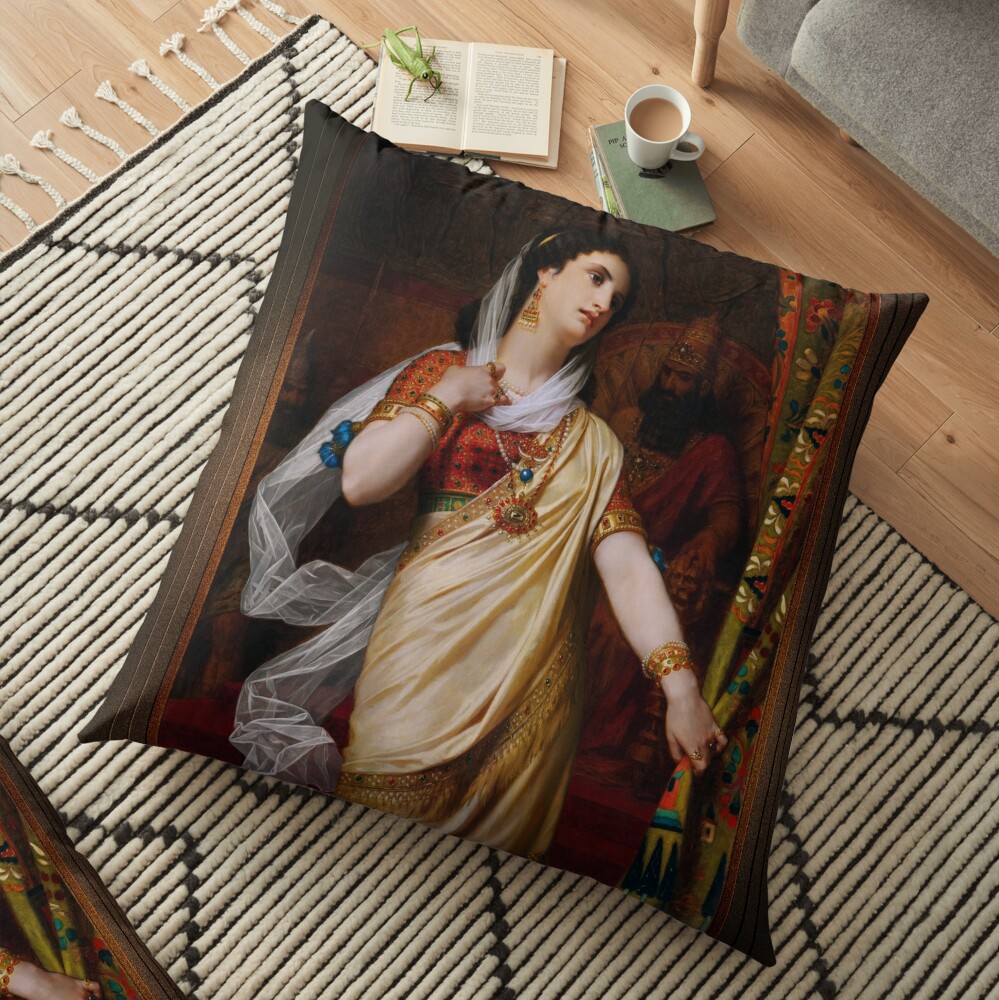
Ĉi tio religia portrait is based on the Biblical tale from the book of Esther; in which a beautiful young Jewish woman becomes Queen to the Persian King Ahasuerus, after he banishes his queen Vashti; and later is able to avert the slaughter of her people throughout the Persian Empire.
The painting shows Esther in beautiful attire of fine silks and adorned jewels, precious stones and gold as she holds onto a decorative light green drape with her left hand; while in the background we see the king seated on his throne, finely dressed and adorned with jewels on his crown and chest plate, with a guard holding a spear to his right.
Esther is wearing a gold band around her long black hair, that is partially covered by a sheer white silk scarf that loops across the lower portion of her neck and around her back.
Esther’s dress which is composed of three different materials, starts with a red top portion that in embellished gold squares that have pearls at each corner and emeralds at the center of each square surrounded by another gold square rotated 90 degrees, creating and eye like appearance.
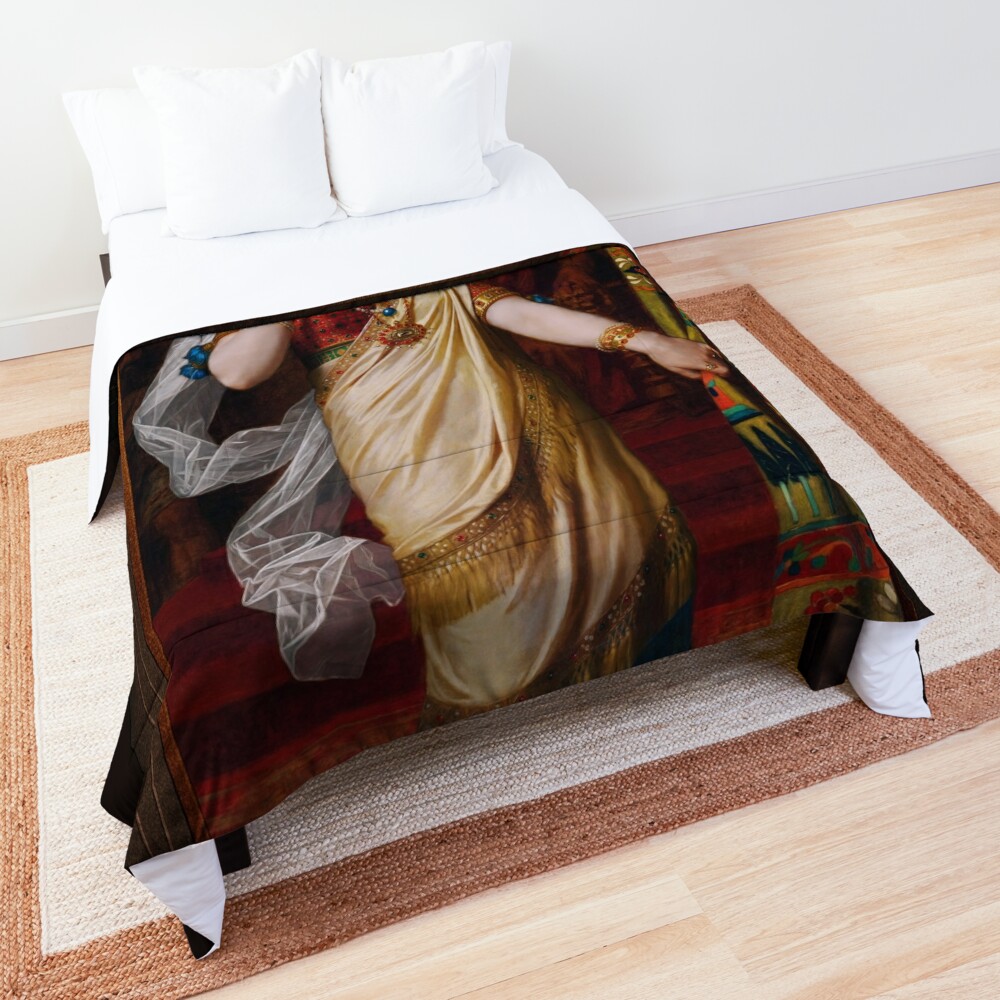
Then around her waist is a gold like sash that is overlaid with a bright green geometric design; and this transitions to the green full length portion of the dress.
She is then covered in a light gold tone wrap that has dark gold tone tassels along the edges, with a wide dark band that is sectioned into squares that have alternate clusters of four pearls, round rubies and emeralds.
Around her neck is a large loop necklace, a ruby necklace from which a gold and ruby amulet hands along with blue opal connected to silver wing like elements.
Around her upper arms of the short sleeve dress she is wearing are wide band arm bracelets made of gold with alternating squares of rubies and diamonds, that match the triangular square earrings she wearing comprised of gold, emeralds, rubies, diamonds and pearls.
On her wrist she is wearing gold bracelets that are embellished with rubies and emeralds, pearl bracelets and a single ruby bracelet on her left wrist; while most of her fingers are adorned with gold rings that have precious stones embedded in them.
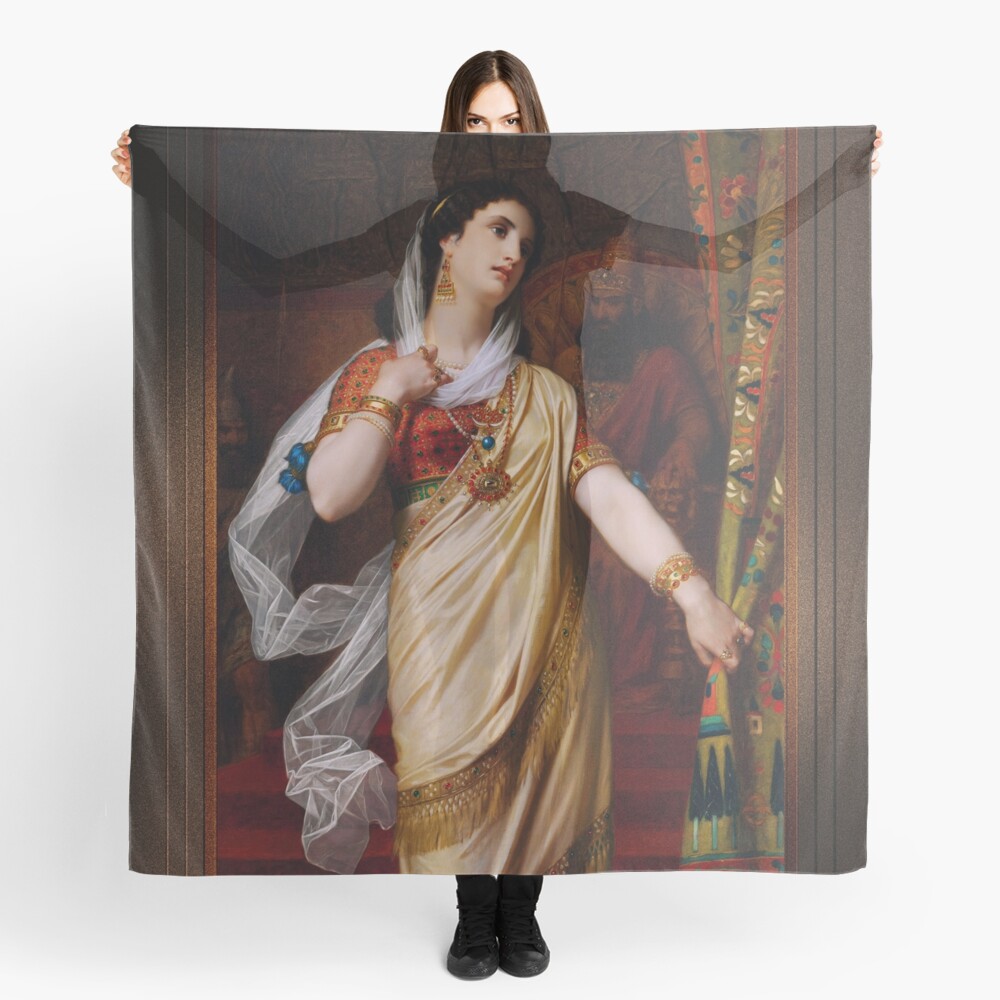
Ĉi tio estas readaptita cifereca arta reproduktaĵo de malnovaj majstroj de publika domajna bildo disponebla kiel a tolo presaĵo rete.
La Subaj Informoj Devenas Vikipedio.org kaj Rehs.com
Hugues Merle estis naskita en 1822 aŭ 1823 en La Zono, Francio kaj ĉirkaŭ la aĝo de 21 alvenis Parizon, Francio kie li studis pentraĵon sub la franca Historia kaj Portretfarbisto Léon Cogniet (1794 – 1880).
Kvankam oni scias malmulte pri la frua vivo de Hugues, oni supozas, ke li ricevis iom da arta edukado antaŭ ol li alvenis en Parizo en 1843; ĉar li komencis ekspozicii ĉe la Pariza Salono en 1847 kun sia peco Portreto de la aŭtoro kaj en 1848 li ekspoziciis la pecon Légende des Willis.
Ĉar tempo daŭris Hugues reputacio kiel portretisto kreskis sufiĉe dum la 1850-aj jaroj; kaj kiel sukcesa kaj elstara farbisto li povis altiri seriozajn artamantojn kiuj serĉis konstrui siajn artkolektojn..
One of these early collectors of art was the 4th Marquess of Hertford, Richard Seymour-Conway (1800-1870); kiu aĉetis sian salonsubmetaĵon Reading the Bible in 1859.
Dum la 1860-aj jaroj, Hugues-klientlisto de kolektantoj inkludis ne nur individuojn de la eŭropa kontinento, sed ankaŭ usonaj kolektantoj, kiel ekzemple William Walters de Baltimoro kiu komisiis La Skarlatan Leteron.