

Esther
Esther c1885 by French Painter Hugues Merle (1823 – 1881); qui s'est spécialisé dans les scènes d'affection maternelle, innocence de l'enfance et conséquences morales.
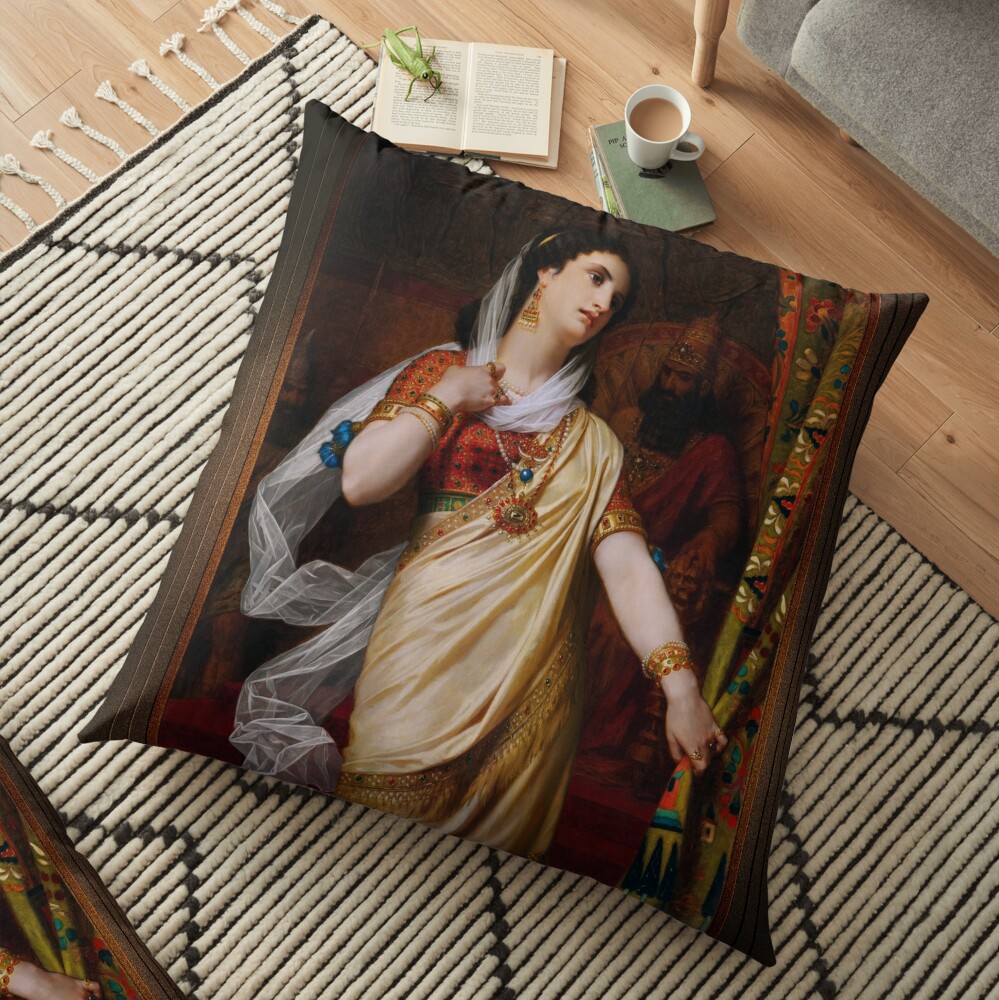
Ce religieux portrait is based on the Biblical tale from the book of Esther; in which a beautiful young Jewish woman becomes Queen to the Persian King Ahasuerus, after he banishes his queen Vashti; and later is able to avert the slaughter of her people throughout the Persian Empire.
The painting shows Esther in beautiful attire of fine silks and adorned jewels, precious stones and gold as she holds onto a decorative light green drape with her left hand; while in the background we see the king seated on his throne, finely dressed and adorned with jewels on his crown and chest plate, with a guard holding a spear to his right.
Esther is wearing a gold band around her long black hair, that is partially covered by a sheer white silk scarf that loops across the lower portion of her neck and around her back.
Esther’s dress which is composed of three different materials, starts with a red top portion that in embellished gold squares that have pearls at each corner and emeralds at the center of each square surrounded by another gold square rotated 90 degrés, creating and eye like appearance.
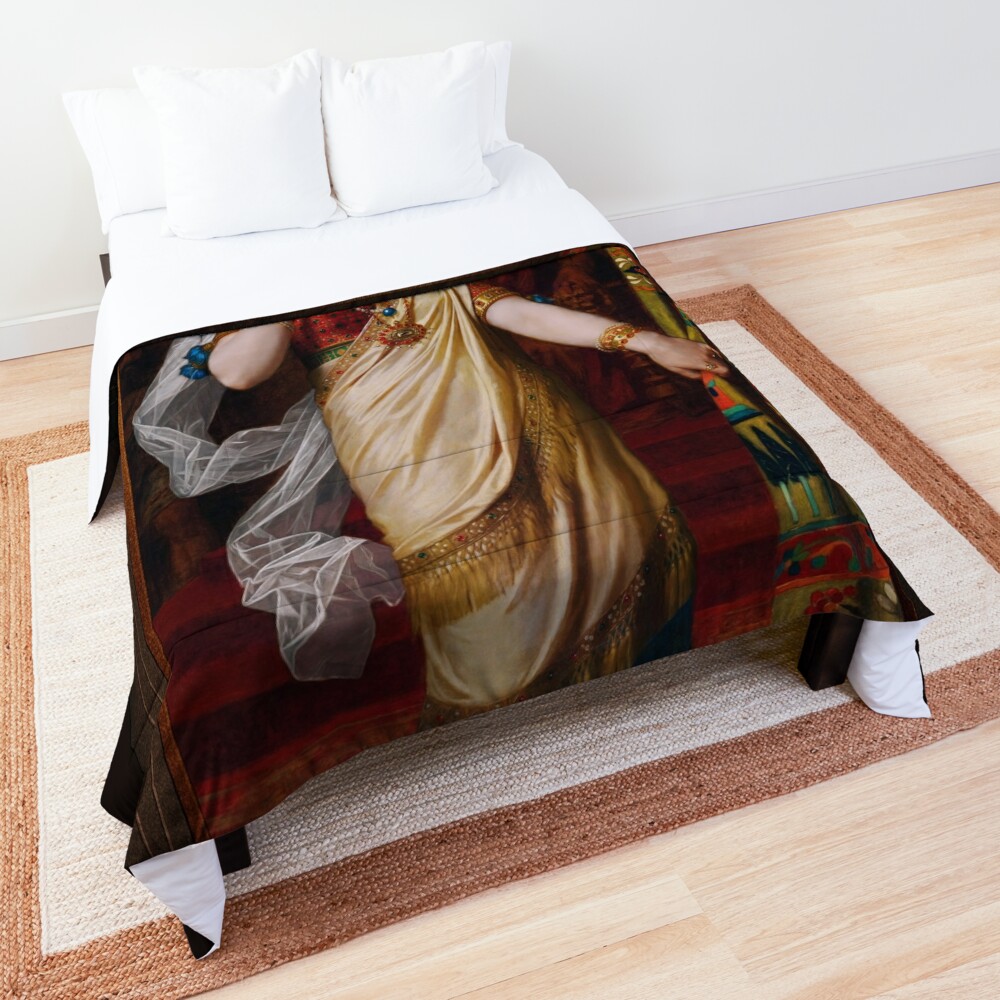
Then around her waist is a gold like sash that is overlaid with a bright green geometric design; and this transitions to the green full length portion of the dress.
Elle est ensuite recouverte d'une enveloppe de couleur or clair avec des pompons de couleur or foncé le long des bords., avec une large bande sombre divisée en carrés comportant des grappes alternées de quatre perles, rubis ronds et émeraudes.
Autour de son cou se trouve un grand collier à boucle, un collier de rubis à partir duquel une amulette en or et rubis est accompagnée d'une opale bleue reliée à des éléments en forme d'aile d'argent.
Autour des bras de la robe à manches courtes qu'elle porte se trouvent de larges bracelets en or avec des carrés alternés de rubis et de diamants., qui correspondent aux boucles d'oreilles carrées triangulaires qu'elle porte, composées d'or, émeraudes, rubis, diamants et perles.
À son poignet, elle porte des bracelets en or ornés de rubis et d'émeraudes., des bracelets de perles et un seul bracelet de rubis à son poignet gauche; tandis que la plupart de ses doigts sont ornés d'anneaux en or sur lesquels sont incrustées des pierres précieuses..
Il s'agit d'une reproduction de maîtres anciens d'art numérique remasterisée d'une image du domaine public qui est disponible en tant que impression sur toile.
Les informations ci-dessous sont dérivées de Wikipedia.org et Rehs.com
Hugues Merle est né en 1822 ou alors 1823 à La Sône, France et vers l'âge de 21 arrivé à Paris, France où il a étudié la peinture auprès du peintre historique et portraitiste français Léon Cogniet (1794 – 1880).
Bien que l'on sache peu de choses sur les débuts de Hugues, on suppose qu'il a reçu un certain degré d'éducation artistique avant d'arriver à Paris en 1843; car il a commencé à exposer au Salon de Paris en 1847 avec sa pièce Portrait de L’auteur et dans 1848 il expose la pièce Légende des Willis.
Au fil du temps, la réputation d'Hugues en tant que portraitiste s'est considérablement accrue au cours des années 1850.; et en tant que peintre à succès et éminent, il a pu attirer des amateurs d'art sérieux qui cherchaient à constituer leurs collections d'art.
L'un de ces premiers collectionneurs d'art était le 4e marquis de Hertford, Richard Seymour-Conway (1800-1870); qui a acheté sa soumission de salon Lire la Bible dans 1859.
Au cours des années 1860, La liste des clients Hugues des collectionneurs ne comprenait pas seulement des particuliers du continent européen, mais aussi des collectionneurs américains, comme William Walters de Baltimore qui a commandé The Scarlet Letter.