

Esther
Esther c1885 by French Painter Hugues Merle (1823 – 1881); who specialized in scenes of maternal affection, childhood innocence and moral consequence.
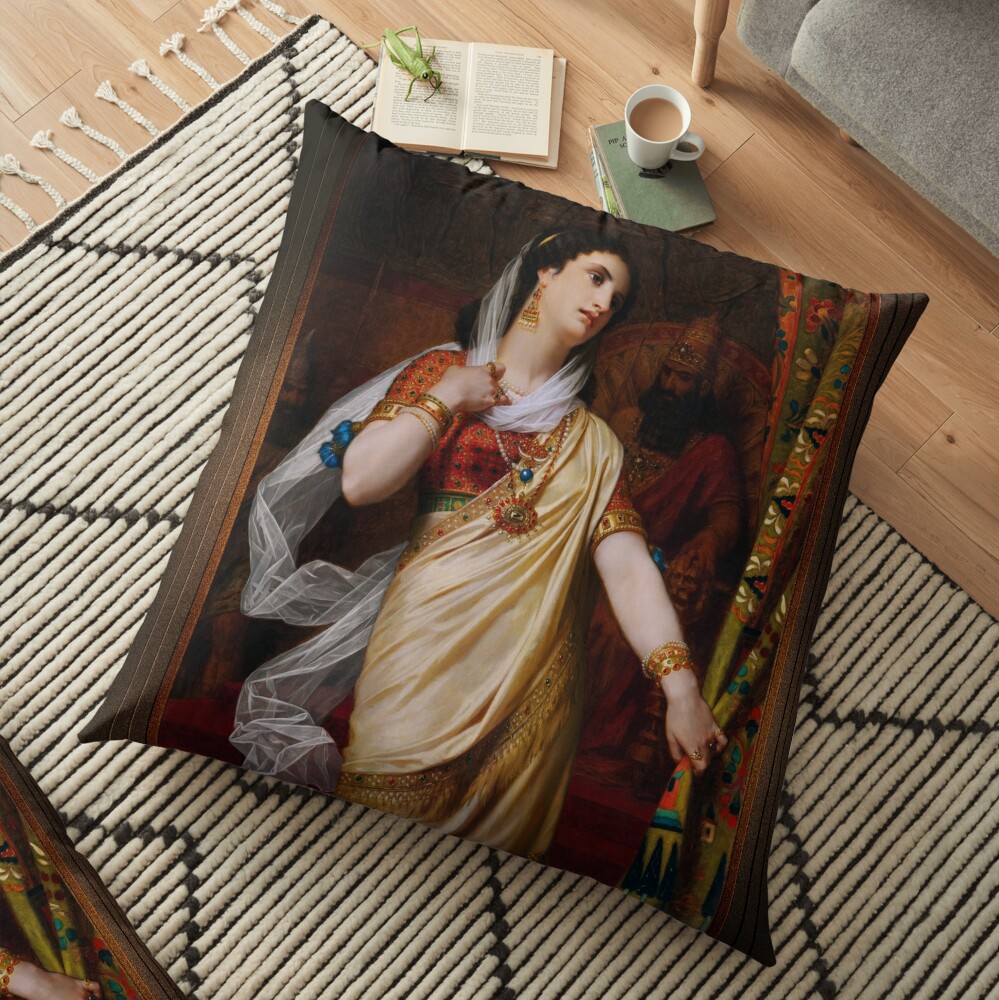
Seo religious portrait is based on the Biblical tale from the book of Esther; in which a beautiful young Jewish woman becomes Queen to the Persian King Ahasuerus, after he banishes his queen Vashti; and later is able to avert the slaughter of her people throughout the Persian Empire.
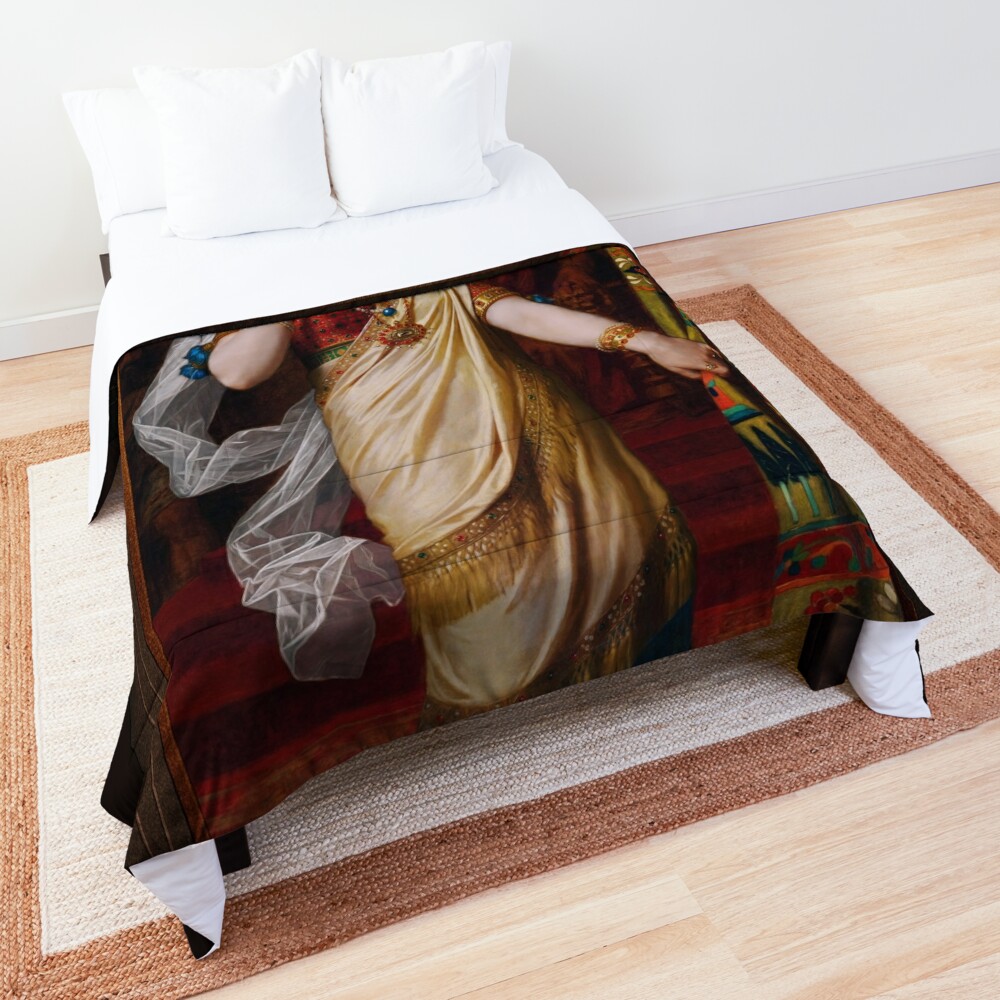
The painting shows Esther in beautiful attire of fine silks and adorned jewels, precious stones and gold as she holds onto a decorative light green drape with her left hand; while in the background we see the king seated on his throne, finely dressed and adorned with jewels on his crown and chest plate, with a guard holding a spear to his right.
Esther is wearing a gold band around her long black hair, that is partially covered by a sheer white silk scarf that loops across the lower portion of her neck and around her back.
Esther’s dress which is composed of three different materials, starts with a red top portion that in embellished gold squares that have pearls at each corner and emeralds at the center of each square surrounded by another gold square rotated 90 céimeanna, creating and eye like appearance.
Then around her waist is a gold like sash that is overlaid with a bright green geometric design; agus aistríonn sé seo go dtí an chuid glas fad iomlán den gúna.
Clúdaítear ansin í le cumhdach ton óir éadrom a bhfuil tassels ton óir dorcha feadh na himill, le banna leathan dorcha atá roinnte ina chearnóga a bhfuil cnuasaigh mhalartacha de cheithre phéarla acu, rubies cruinn agus emeralds.
Timpeall a muineál tá muince lúb mór, muince ruby as a lámha amulet óir agus ruby mar aon le opal gorm ceangailte le heilimintí cosúil le sciathán airgid.
Timpeall a cuid lámha uachtair den gúna muinchille gearr atá á chaitheamh aici tá bráisléid láimhe leathanbhanda déanta as óir le cearnóga ailtéarnacha de rubies agus diamonds, a mheaitseálann na cluaise cearnacha triantánacha a chaith sí comhdhéanta d'ór, emeralds, rubies, diamaint agus péarlaí.
On her wrist she is wearing gold bracelets that are embellished with rubies and emeralds, pearl bracelets and a single ruby bracelet on her left wrist; while most of her fingers are adorned with gold rings that have precious stones embedded in them.
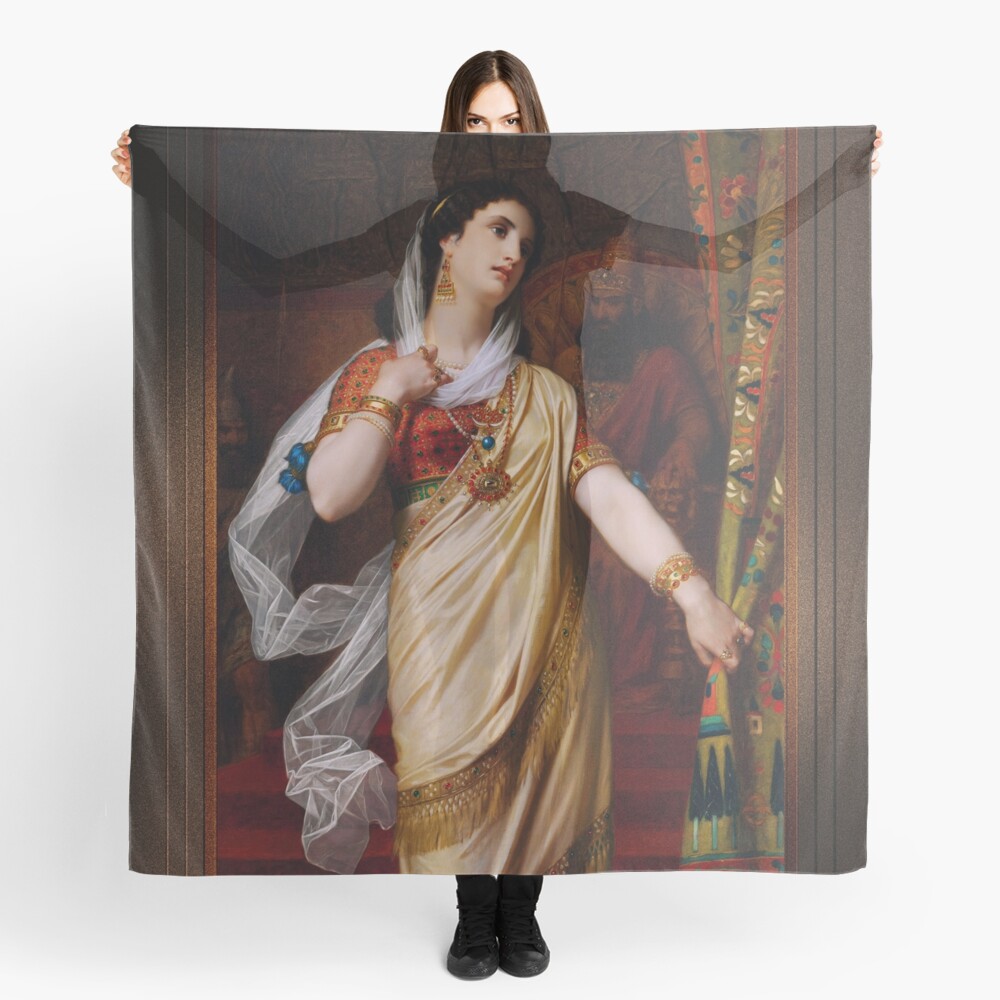
Seo atáirgeadh seanmháistrí ealaíne digiteach athmháistrithe d’íomhá fearainn phoiblí atá ar fáil mar a priontáil chanbhás ar líne.
Tá an tEolas Thíos Díorthaithe Ó Wikipedia.org agus Rehs.com
Rugadh Hugues Merle i 1822 nó 1823 i La Sône, Fhrainc agus timpeall na bliana d'aois 21 tháinig i bPáras, An Fhrainc áit a ndearna sé staidéar ar phéintéireacht faoin bPéintéir Stairiúil agus Portráidí Francach Léon Cogniet (1794 – 1880).
Cé nach bhfuil mórán eolais ar shaol na hUgues glactar leis go bhfuair sé oideachas ealaíne de shaghas éigin sular shroich sé Páras i bPáras. 1843; toisc gur thosaigh sé ag taispeáint ag Salon Paris i 1847 lena phíosa Portráid den údar agus i 1848 thaispeáin sé an píosa Légende des Willis.
De réir mar a chuaigh an t-am ar aghaidh, tháinig méadú suntasach ar cháil na nUgues mar phortráidí le linn na 1850idí; agus mar phéintéir rathúil agus feiceálach bhí sé in ann daoine mór le rá san ealaín a mhealladh a bhí ag iarraidh a gcuid bailiúcháin ealaíne a thógáil.
One of these early collectors of art was the 4th Marquess of Hertford, Richard Seymour-Conway (1800-1870); a cheannaigh a aighneacht salon Reading the Bible in 1859.
I rith na 1860idí, Hugues client list of collectors included not only individuals from the European continent, ach freisin bailitheoirí Meiriceánacha, leithéidí William Walters ó Baltimore a choimisiúnaigh The Scarlet Letter.