

Exposition
“Exposition – Les articles d'exportation chez Minatogawa Boeki Seisanhin Kyoshin-Kai” (1880 – 1947) par Kitano Tsunetomi est un exemple captivant de l'art de l'affiche japonaise du début du XXe siècle, mélangeant des éléments de conception complexes avec un symbolisme culturel pour créer une expérience visuelle durable. Kitano Tsunetomi, un artiste japonais réputé, a imprégné cette œuvre d'un sentiment d'élégance, combinant à la fois l'esthétique japonaise traditionnelle et les influences occidentales qui devenaient plus importantes au cours des périodes Meiji et Taisho. L'œuvre d'art a été créée dans le cadre d'une pièce promotionnelle pour une exposition à Minatogawa., Kobé, et représente l’engagement dynamique du Japon dans le commerce international et les échanges culturels à l’époque.
La scène représentée sur l'affiche est hautement symbolique, rempli de couleurs vives et de motifs de conception complexes. The artist uses these elements not only to advertise the exhibition but also to convey a deeper narrative about Japan’s place in the global economy during a period of rapid modernization. The artwork embodies the mood of optimism and national pride that characterized Japan’s era of industrial expansion and cultural resurgence.
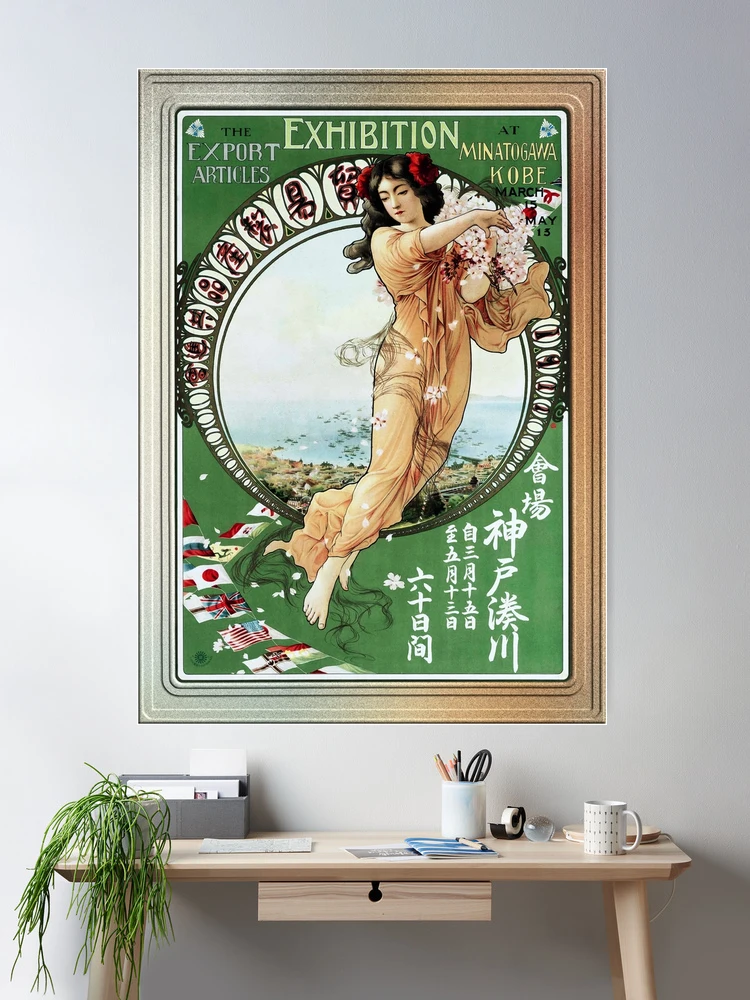
Table des matières
Sujet principal: The Central Female Figure
At the heart of the artwork is a graceful female figure, exuding a sense of calm beauty and elegance. She is dressed in a flowing, soft-toned gown that catches the light with an almost ethereal quality. The gown’s fabric appears to flutter, as if in motion, symbolizing the gentle yet constant forward movement of Japan into the global stage. Sa longue, dark hair cascades around her shoulders and flows effortlessly into the space around her, amplifying the feeling of fluidity and grace.
The figure’s gentle, outstretched arm holds a cluster of cherry blossoms, which seem to be scattering in the breeze. This delicate detail serves as a symbol of both the fragility and beauty of nature, as well as a representation of Japan’s cultural heritage. The cherry blossom, a quintessential symbol of Japan, evokes themes of transience and renewal. Le visage de la femme est doux et serein, gazing downward in contemplation, reinforcing the tranquil, yet powerful mood that pervades the piece.
The Surrounding Design and Landscape
The backdrop of the artwork includes a sweeping panoramic view of the port city of Kobe, with its bustling docks, ships, and the distant hills. The city is depicted with a level of detail that showcases the busy commerce of the time, reflecting Japan’s growing prominence in international trade. The ships in the harbor are clearly intended to represent Japan’s expanding reach in global markets, particularly the exportation of goods.
Around the central figure, a decorative floral border frames the scene. The circular design evokes both traditional Japanese patterns and Western Art Nouveau influences, with flowing lines and intricate geometric shapes. This fusion of Eastern and Western artistic elements is emblematic of the period’s cultural blend. The design also includes various national flags at the bottom, representing the international nature of the exhibition and highlighting the country’s connection to the global community.
Color Palette and Mood
The color palette of the poster is rich and vibrant, dominated by shades of green, which are seen in the background and surrounding elements, suggesting fertility, croissance, and prosperity. The light cream-colored tones of the woman’s gown contrast beautifully with the darker greens and blues of the backdrop, emphasizing her as the focal point of the artwork. The pink hues of the cherry blossoms add a touch of softness, their delicate petals drifting through the air, symbolisant la beauté, paix, and the fleeting nature of life.
The overall mood of the artwork is one of serene confidence and national pride. There is a sense of forward-looking optimism, car la figure féminine représente non seulement la beauté culturelle et naturelle du Japon, mais aussi la volonté du pays de s’engager sur le marché mondial.. Le doux, lignes fluides, combiné avec le fort, présence presque monumentale de la femme, imprégner l'affiche d'un sentiment de grâce et de puissance, mettant en valeur à la fois les valeurs traditionnelles du Japon et son ouverture vers l’avenir.
Typography and Text Elements
Le texte de l'affiche est disposé de manière harmonieuse mais affirmée, situé en haut et en bas de l'œuvre. Les mots “Exposition à Minatogawa Kobe” sont rendus en gras, Police serif de style occidental qui se détache sur un arrière-plan plus complexe, soulignant encore davantage le caractère international de l'événement. L'autre texte, écrit en caractères japonais, est soigneusement placé autour de la bordure circulaire, offering additional details about the exhibition dates and location. These textual elements are carefully integrated into the overall composition, adding to the poster’s function as both an advertisement and a piece of art.
Symbolism and Cultural Context
Kitano Tsunetomi’s poster is not just a visual promotion of the exhibition but also a celebration of Japan’s participation in the global community. The use of the cherry blossoms can be seen as a metaphor for the transient beauty of both nature and culture, a reflection of the nation’s deep connection to its natural environment and history. The woman’s graceful posture and serene expression further symbolize Japan’s poised and composed interaction with the rest of the world.
The inclusion of national flags, with their various designs, suggests a welcoming of foreign influences and recognition of Japan’s growing role in the global sphere. The exhibition itself, housed in the port city of Kobe, underscores the importance of international trade during the period, while the vibrant colors and strong design evoke a sense of national pride and optimism for the future.
Conclusion
En conclusion, “Exposition – Les articles d'exportation chez Minatogawa Boeki Seisanhin Kyoshin-Kai” by Kitano Tsunetomi is a masterful work of art that blends both artistic beauty and cultural significance. The artist’s careful use of symbolism, intricate design elements, and a harmonious color palette brings forth a sense of cultural pride and optimism. A travers cette oeuvre, Tsunetomi captures the essence of a transformative period in Japanese history, illustrating the nation’s blossoming role on the world stage and its deep connection to both tradition and progress.
Il s'agit d'une reproduction de maîtres anciens d'art numérique retouchée d'une image du domaine public.
Biographie de l'artiste
Info ci-dessous de Wikipedia.org
Kitano Tsunetomi a d'abord réalisé des plaques d'impression pour les illustrations dans les journaux. À 17 il est allé à Osaka pour devenir peintre.
Il a maintenant conçu des illustrations pour des histoires parues dans les journaux. Ses affiches publicitaires grand format avec de belles femmes ont également trouvé une reconnaissance.
Dans 1910 sa photo « Assemblée des scarabées » (Insectes, Sudaku mushi) et l'année suivante la photo "Sunshine in the Rain" (pluie de soleil, soba) ont reçu un 3e prix à l'exposition Bunter.
Avec cela, il s'était imposé comme un peintre dans le style Nihonga.
Dans 1914 Kitano a exposé l'image « Le fil de la demande » (Fil de souhait, Negai no ito) à l'exposition Inten ressuscitée .
Dès lors, il est resté connecté à cette série d'expositions et a appartenu, avec le Tokyo Kaburagi Kiyokata et Uemura Shōen à Kyoto, aux peintres éminents de belles femmes.
Depuis que Kitano a initialement dépeint de belles femmes « magiques », il a été compté parmi l'aile de la peinture qui traitait de l'insolite, le « Gadan no Akuma-ha » (Secte maléfique du peintre).
Du milieu de la période Taishō, l'image du Yodogimi doit être soulignée, qui a une nouvelle profondeur de représentation.
Avec la période Shōwa, Kitano a capturé le Japon moderne d'une manière nouvelle.
Kitano a été montré dans 1931 au « Salon de la peinture japonaise » à Berlin. Dans 1989 la poste japonaise a émis deux timbres-poste pour 62 yen chacun avec un danseur de la « Awa Odori », la procession festive dans la préfecture de Tokushima (historiquement la province d'Awa).