

Feline Entre-Act c1919
“Feline Entre-Act c1919” is a captivating artwork created by Peruvian artist Tijdelijke afbeelding voor Alberto Vargas, who was known for his illustrations of sensual, glamorous women and vivid portrayals of the human form. Vargas, geboren in 1896 en passeren 1982, became a renowned figure in the world of art, particularly for his pin-up girl illustrations, which have continued to influence the artistic community. In dit stuk, Vargas skillfully blends realism with a hint of fantasy, evoking a mood of playfulness and intrigue while capturing the intense allure of the female form.
Inhoudsopgave
Onderwerp en compositie
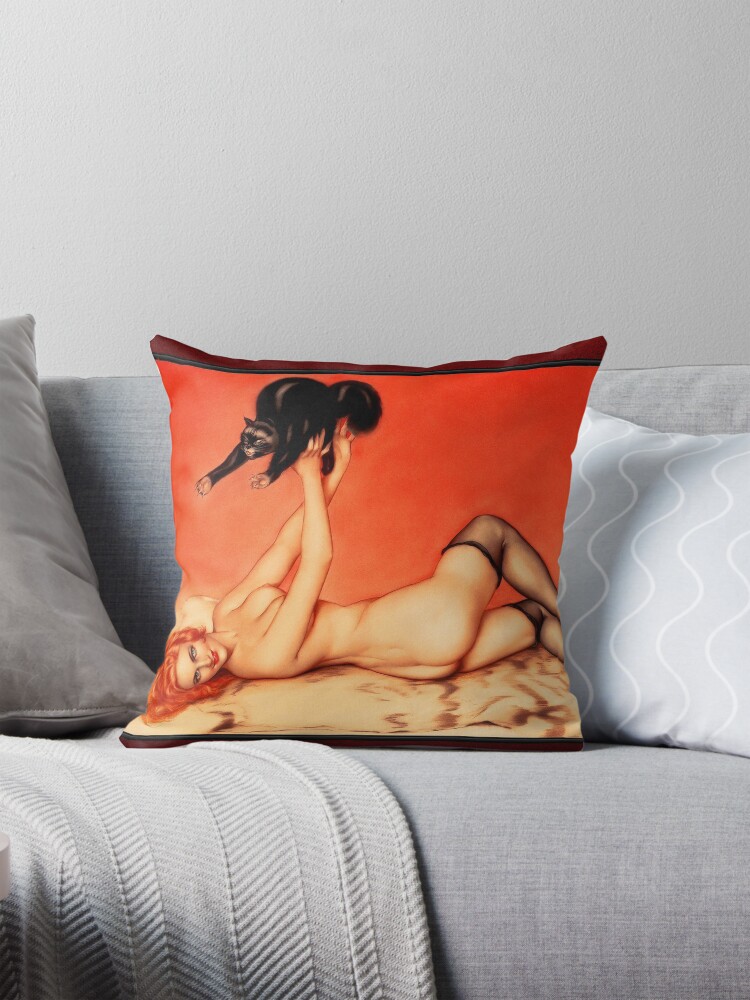
The central subject of “Feline Entre-Act” is a nude woman reclining sensually on a smooth, almost ethereal surface. Haar lichaam, smooth and curvaceous, is contrasted with the sharp, muscular form of a large tiger lying beside her. Her body is draped in nothing but a pair of delicate black stockings that emphasize her long, elegant legs.
The tiger’s presence is striking, with its powerful jaws open in a snarl, displaying both strength and danger. In the woman’s hands, she holds a black cat by its tail, which seems to be playfully perched above her. The contrast between the two animals, the dangerous tiger and the playful cat, adds a layer of intrigue and symbolism to the piece.
The composition of the piece is centered around the woman’s figure. The tiger, almost positioned as a guardian or companion to the woman, balances the overall composition with its fierce, menacing gaze. The black cat, a symbol often associated with mystery and femininity, contrasts the tiger, perhaps representing the woman’s playful, more whimsical side.
The tiger’s powerful stance and vivid gaze suggest that while the woman is in a position of repose, she is not passive. The tiger, which symbolizes strength and danger, is softened by the woman’s confident pose and her intimate interaction with the smaller, more mischievous feline.
Materialen en techniek
Vargas, known for his delicate attention to detail and mastery of color, employed a technique that blends soft and vibrant hues to bring his subjects to life. The background of the piece is dominated by an intense gradient of red, which creates a warm, almost surreal atmosphere, enveloping the figures in a dreamlike aura.
The shading of the woman’s body, especially in the lower torso and thighs, showcases Vargas’s ability to highlight the natural curves and contours of the human form. This rendering of light and shadow adds depth and dimension to her figure, making her appear almost lifelike against the smooth, vibrant background.
The woman’s fiery red hair is another focal point of the piece, its bold color drawing the viewer’s eye toward her head and face. The intensity of the red hair contrasts beautifully with the darker tones of her stockings, the cat, and the tiger. Haar blik, soft yet confident, adds to the sensual nature of the piece, inviting the viewer to linger on her expression.
Vargas’s use of line work is also worth noting; he employs a fluid, almost sensuous quality to the contours of the woman’s body and the animals that surround her. The sleekness of the tiger’s form and the softness of the woman’s body are drawn with fine, sweeping lines that convey the natural grace and elegance of both subjects. The textures are soft, with no harsh contrasts, allowing the viewer to focus on the interplay between the figures and their environment.
Stemming en thema
De algemene stemming van “Feline Entre-Act” is one of intense sensuality, yet there is an undercurrent of mystery and danger. The juxtaposition of the graceful, poised woman with the fierce tiger suggests a theme of duality—strength and vulnerability, elegance and ferocity.
The black cat, smaller in size, yet equally as mysterious, reinforces the theme of contrasting elements. The playful nature of the cat juxtaposes the tiger’s aggression, creating an intriguing dynamic that keeps the viewer’s gaze shifting between the two animals and the woman.
Vargas captures the delicate balance between the female figure’s beauty and the animalistic strength of the tiger. The piece speaks to the allure of femininity, with the tiger acting as a metaphor for both the danger and the power that can lie in a woman’s gaze and presence.
The setting is intimate and dreamlike, enhancing the themes of sensuality and mystery. The red background suggests warmth, passie, and even danger, heightening the tension between the woman and the tiger.
The inclusion of animals, particularly the tiger and the cat, introduces an element of the wild into an otherwise serene scene, suggesting that the woman, though in a relaxed state, holds an untamed strength within her. The red color, symbolic of passion and strength, further emphasizes this idea, as it surrounds the woman and the animals, enveloping them in an environment that is both luxurious and dangerous.
Conclusie
“Feline Entre-Act c1919” by Alberto Vargas is a masterpiece that showcases the artist’s skill in blending sensuality with strength, capturing the timeless allure of the female form while incorporating elements of the wild that both complement and contrast with her.
The vivid use of color, the interplay between light and shadow, and the contrast between the animals and the woman create a composition that is both visually striking and thematically rich. Vargas’s ability to convey beauty, stroom, and mystery in a single piece of art is what makes “Feline Entre-Act” a true example of his mastery as an artist. The artwork is not just a depiction of a woman and her animals; it is a meditation on the complex, multifaceted nature of femininity itself.
Feline Entre-Act is een geretoucheerde digitale kunst oude meesters reproductie van een afbeelding uit het publieke domein.
Bio -kunstenaar
Info hieronder van Wikipedia.org
Geboren in Arequipa, Peru, hij was de zoon van de bekende Peruaanse fotograaf Max T. Vargas. Alberto Vargas verhuisde in 2004 naar de Verenigde Staten 1916 na een studie kunst in Europa, Zürich, en Genève voorafgaand aan de Eerste Wereldoorlog.
Terwijl hij in Europa was, stuitte hij op het Franse tijdschrift La Vie Parisienne, met een omslag van Raphael Kirchner, waarvan hij zei dat het een grote invloed had op zijn werk.
Zijn vroege carrière in New York omvatte werk als kunstenaar voor de Ziegfeld Follies en voor veel Hollywood-studio's. Ziegfeld hing zijn schilderij van Olive Thomas in het theater, en ze werd gezien als een van de eerste Vargas Girls.
Vargas’ meest bekende stuk filmwerk was voor de poster van de 1933 film De zonde van Nora Moran, die een bijna naakte Zita Johann toont in een wanhoopshouding. De poster wordt vaak genoemd als een van de beste filmposters ooit gemaakt.
Hij werd in de jaren veertig algemeen bekend als de maker van iconische pin-ups uit de Tweede Wereldoorlog voor het tijdschrift Esquire, bekend als “Vargas-meisjes.” Tussen 1940 en 1946 Vargas geproduceerd 180 schilderijen voor het tijdschrift.
De neuskunst van veel Amerikaanse en geallieerde vliegtuigen uit de Tweede Wereldoorlog is geïnspireerd en aangepast van deze Esquire-pin-ups, evenals die van George Petty, en andere artiesten.