

Femme Dans Un Manteau c1871
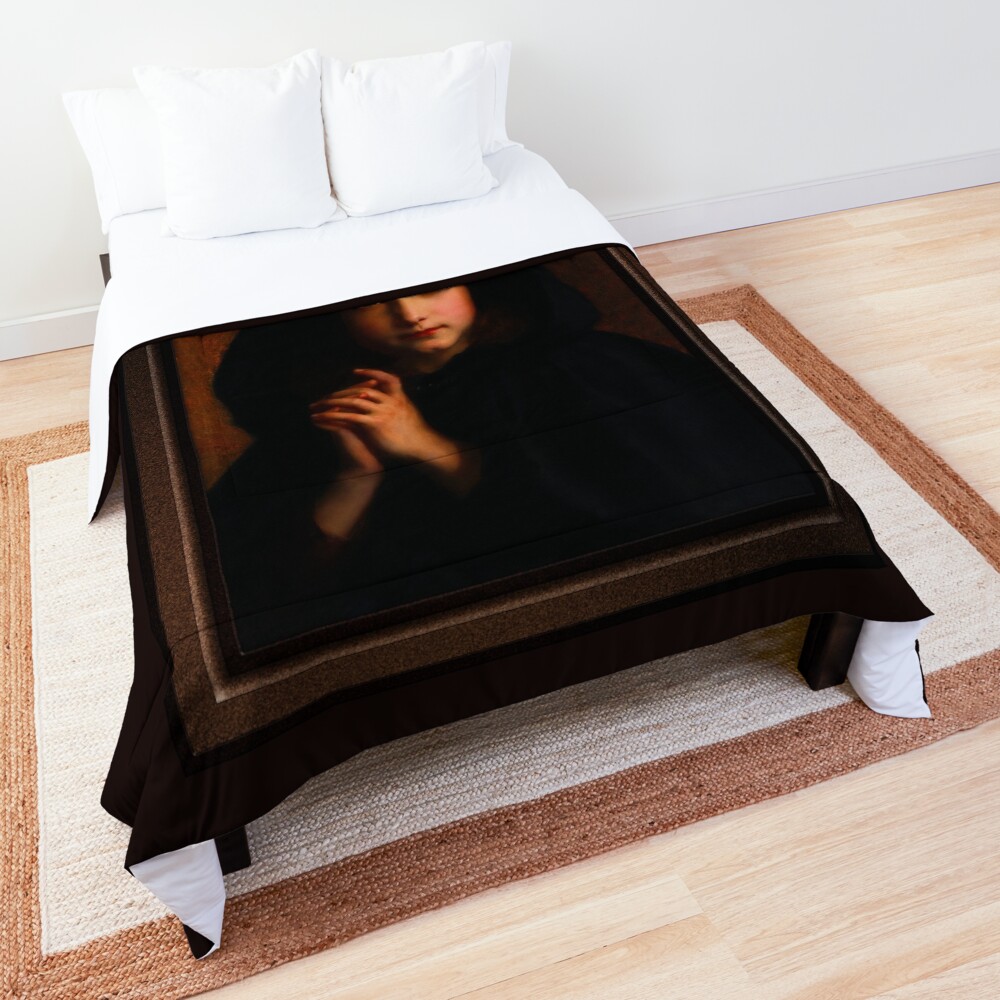
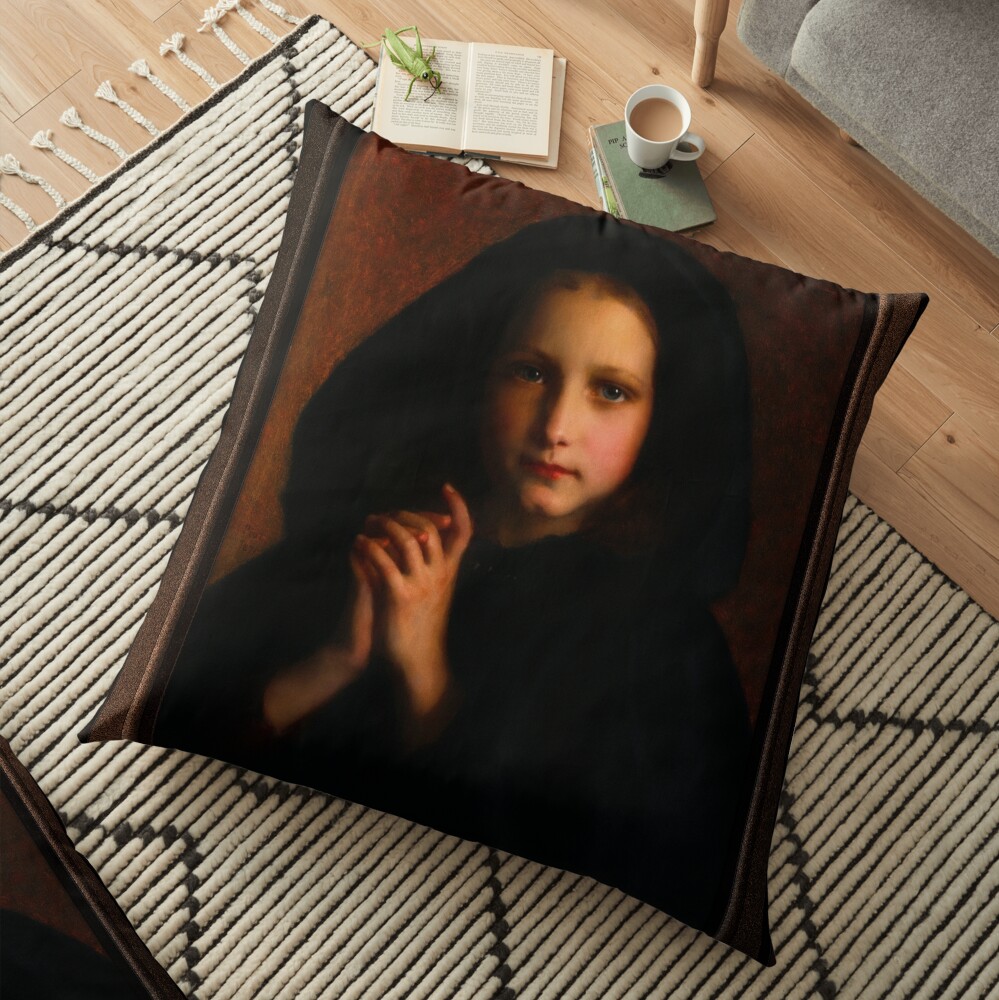
“Femme Dans Un Manteau,” erin geschilderd 1871 by French artist Adolphe Piot (1825 – 1910), is an exquisite work that captures the essence of classical portraiture with remarkable finesse. This painting depicts a young girl, shrouded in a black hooded cloak, with her hands gently clasped before her, the delicate softness of her face and hands contrasting with the weight of her attire.
Adolphe Piot was known for his sensitive approach to portraiture, often focusing on detailed depictions of figures in reflective or contemplative states, and this piece is a prime example of his skill. Through his meticulous brushwork and rich use of light and shadow, Piot evokes a mood of quiet introspection.
Inhoudsopgave
Hoofdonderwerp: The Woman in the Cloak
The central figure of the painting is a young girl, whose innocence and quiet beauty are conveyed through her gentle posture and expression. She stands still, as though caught in a moment of serene contemplation. The dark cloak that envelops her not only shields her from the world but also highlights the vulnerability of the subject.
The hooded cape, which covers her head, is a classic motif often used in portraiture to signify modesty or mystery, lending an air of quiet dignity to the subject. Her hands are delicately positioned before her chest, folded in a gesture that could signify prayer, reflection, or quiet repose. This small, yet intimate, gesture invites the viewer to consider the subject’s emotional and spiritual state.
The facial features of the woman are finely detailed, with her smooth, pale skin and delicate lips evoking a sense of innocence. Her eyes are large, soulful, and deeply expressive, drawing the viewer’s attention as they seem to look directly into the soul of the observer. The eyes are perhaps the most poignant part of the composition, conveying a mixture of introspection and an almost melancholic sense of longing or thoughtfulness.
De achtergrond en setting
The background of the painting is rendered with a soft, warm glow that contrasts with the dark tones of the cloak. The use of deep, muted browns and reds in the background emphasizes the subject’s figure, allowing the girl to stand out as the focal point of the composition. The blurred nature of the background creates a sense of depth, making the viewer’s gaze naturally shift toward the central figure. There are no specific objects or landscape elements in the background, which further draws attention to the purity and stillness of the subject. The absence of extraneous details keeps the focus firmly on the woman, her posture, and her expression.
Stijl en techniek
Piot’s technique in this piece reflects his classical training, and he adheres closely to the traditions of 19th-century portraiture. His use of soft brushstrokes to define the textures of the fabric and the smoothness of the skin demonstrates his keen attention to detail. The folds of the cloak are rendered in soft, vloeiende lijnen, creating a sense of motion within the stillness of the portrait.
The light is carefully controlled, creating gentle shadows on the woman’s face, enhancing the dimensionality and realism of the piece. Piot’s use of chiaroscuro, employing contrasts between light and dark, serves to emphasize the form of the subject, giving the figure a lifelike quality while also imparting a quiet, contemplative mood to the overall composition.
The tonal qualities of the painting—deep, rich darks against subtle, warm highlights—speak to Piot’s expertise in using color to build atmosphere. The limited palette serves to enhance the subject’s isolation, as the dark cloak and the somber background create a sense of personal introspection that is not disturbed by external forces. There is an elegant simplicity in Piot’s approach, yet it is an approach that speaks volumes about the emotional world of the subject.
Stemming en thema
De stemming van “Femme Dans Un Manteau” is one of quiet reflection, if not solitude. There is an air of mystery surrounding the subject, as the artist does not reveal much about her identity. The woman is left alone in a dark, nearly barren space, and the lack of context only heightens the sense of emotional depth. The viewer is left to wonder about her inner world, what is she thinking? Is she lost in prayer, sorrow, or simply reflective? The painting’s atmosphere evokes a profound sense of stillness and introspection, inviting the viewer to share in the subject’s quiet moment.
The theme of solitude is central to this piece, as the figure is physically isolated, not only by her hooded cloak but also by her distance from the world around her. This solitude can be interpreted in a variety of ways: it may represent the isolation of a specific individual or a more universal contemplation of human introspection. The focus on the woman’s hands, clasped and resting gently in front of her chest, further emphasizes this theme of quiet internal reflection.
This painting reflects Piot’s sensitivity to the emotional resonance of a solitary moment. The woman’s composed yet fragile demeanor suggests a sense of personal strength, but also vulnerability. It is a beautiful and poignant portrayal of a girl’s emotional and intellectual world, captured in a fleeting moment of time.
Conclusie
“Femme Dans Un Manteau” by Adolphe Piot is a powerful example of 19th-century portraiture that combines technical mastery with emotional depth. Through his careful rendering of the subject’s figure and the thoughtful use of light and shadow, Piot captures the quiet, reflective nature of the woman in the painting. The piece speaks to themes of solitude, introspection, en stille contemplatie, offering the viewer a glimpse into the inner world of the subject. Piot’s skillful use of chiaroscuro and his attention to detail in both the figure and the cloak elevate this portrait beyond a mere representation of a woman; it becomes a meditation on the nature of emotional and spiritual solitude.
This is a retouched digital art old masters reproduction of a public domain image that is available online as a rolled canvas art print.
Bio -kunstenaar
Info hieronder afgeleid van Wikipedia.org
Étienne-Adolphe Piot werd geboren in Digoin, Saône-et-Loire, Frankrijk. Hij verhuisde naar Parijs en studeerde bij Léon Cogniet, en voor het eerst tentoongesteld op de Parijse Salon in 1850, dus wordt aangenomen dat hij waarschijnlijk in het midden van de jaren 1820 is geboren.
In 1860 hij was een van de schilders wiens werk werd getoond op de Exposition de Bourdeaux, en in 1864 toen hij in New York City woonde, hij exposeerde een portret aan de National Academy of Design.
Tot aan 1876 Piot exposeerde zijn kunstwerken onder de naam Adolphe Piot, daarna begon hij ook de namen Adolphe-Étienne Piot en Étienne-Adolphe Piot op zijn kunstwerken te gebruiken.
Piot was commercieel zeer succesvol, profiteren van de toenemende vraag naar portretten van rijke Parijzenaars. Tijdens de Belle Époque moest elke debutante haar portret laten schilderen, en Piot was bedreven in het maken van de boeiende portretten die jonge dames zochten.
Piot werd lid van de Société des Artistes Français in 1883, en in 1890 kreeg een eervolle vermelding voor het werk dat hij exposeerde op de 1889 Wereldtentoonstelling. Zijn laatste Salon-inzending lijkt te zijn ingediend in 1909, een jaar voor zijn dood.