

Freccia Fiammeggiante
Freccia fiammeggiante c1936 del pittore americano Edward Mason Eggleston (1882 – 1941), uno specializzato in ritratti di calendario femminili alla moda e di fantasia. Era anche conosciuto come illustratore commerciale che lavorava per aziende come la Pennsylvania Railroad, la Fisk Tyre Company, e l'Esposizione dei Grandi Laghi.
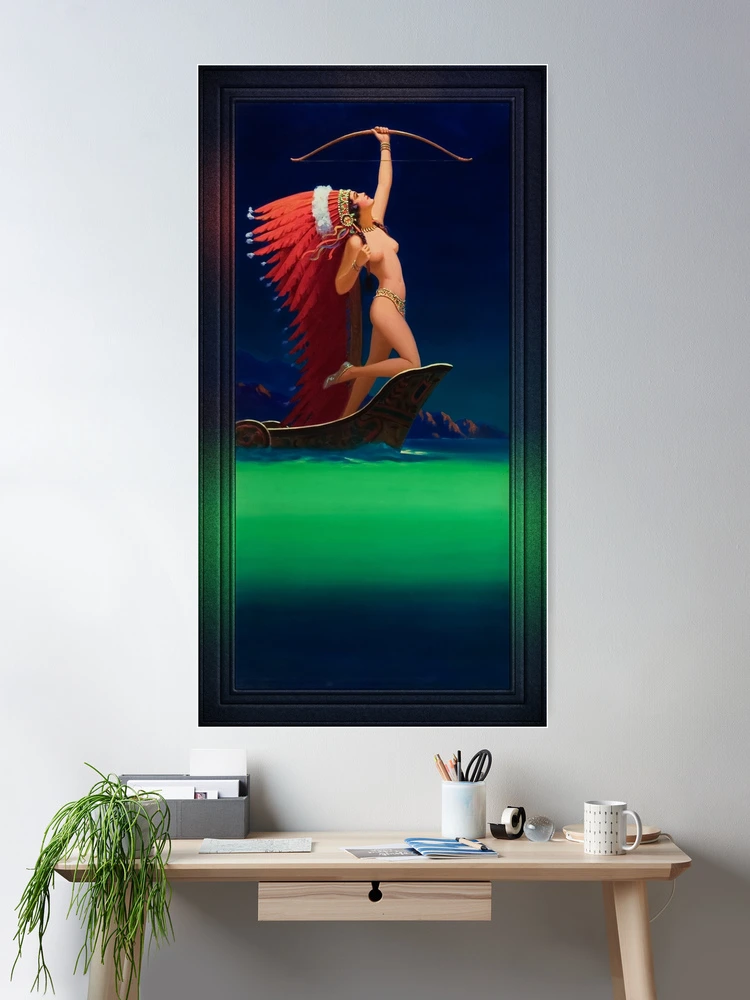
Edward Eggleston era un abile artista americano il cui lavoro abbracciava vari generi, dalla ritrattistica al paesaggio. Uno dei suoi pezzi più iconici, Freccia Fiammeggiante, dipinto in giro 1936, racchiude il fascino dell'inizio del XX secolo per i temi e le immagini eroiche dei nativi americani. Questa opera d'arte, ricco sia di fascino visivo che di risonanza storica, rappresenta una testimonianza dell’abile abilità di Eggleston nel combinare realismo e astrazione simbolica.
La scena raffigurata in Freccia Fiammeggiante è una rappresentazione evocativa di una donna nativa americana in bilico come una guerriera, un archetipo di forza e coraggio. È posizionata su una nave simile a una canoa, traendo una freccia dal suo arco con un senso di intensità e scopo. Her arm is extended fully, the taut bowstring indicating the imminent release of the arrow, which appears as though it might burst forth in a brilliant, fiery arc.
This action is heightened by the woman’s powerful stance—her back arched with her chest thrust forward in perfect harmony with the energy of the moment. The long feathered headdress she wears, vibrant and in rich hues of crimson and white, seems to billow behind her like an extension of her resolve and power. Il suo abbigliamento, minimal and composed of a series of tribal adornments, adds to the primal and elemental feel of the artwork, grounding her in nature’s vastness and the epic quest she symbolizes.
The boat upon which she stands is an elongated, slender structure, reminiscent of ancient Native American canoes that were often used for navigation across rivers or lakes. The vessel’s dark hue contrasts with the vibrant elements surrounding it, and its curvature suggests an almost organic flow, as if it is part of the larger landscape, the waters of which lap gently at its base.
The water itself is rendered in soft greens and blues, its surface seeming calm and otherworldly. tuttavia, there’s an underlying current of power and potential, as if the water is part of a larger, untold story that connects the heroine to the unknown. The colors of the water subtly reflect the colors of the sky, reinforcing the symbiosis between the woman and her environment.

The background of the piece is dominated by deep, rich tones of night. The mountains in the distance, visible but faint, rise up out of the mist, their peaks sharp and unyielding. These dark silhouettes provide a stark contrast to the vibrant reds of the woman’s headdress and the warm golds of her body jewelry.
The shadows in the painting are not merely absent light but are infused with texture, hinting at the mysteries and challenges the figure is poised to face. Nel cielo, one can sense the approach of something monumental, perhaps the impending release of the flaming arrow itself, a symbol of action, destino, or impending conquest. The dramatic use of shadows in the painting underscores the sense of anticipation that envelops the scene.
Eggleston’s style in Freccia Fiammeggiante adheres to the principles of realism, yet with a flair for heightened drama. The forms are precise and the colors are rich, allowing the viewer to appreciate the texture and detail of the woman’s attire and the surrounding environment.
The artist’s use of light and shadow is particularly masterful; the illumination of the woman’s form against the darker backdrop of the night sky highlights her strength and central importance within the composition. The light seems to originate from an unseen source, casting a soft glow that subtly emphasizes her lithe and athletic physique.
The mood of the painting is one of solemnity and quiet power, but also one of impending action. The scene is frozen in time just before the release of the arrow, a moment ripe with potential. The viewer is drawn into this moment of pause, where the tension of the woman’s poised archery and the stillness of the surroundings come together in a breathtaking harmony. The mood feels like one of anticipation, and the woman stands as a figure who is prepared to unleash something far greater than herself.
The color palette Eggleston uses in Freccia Fiammeggiante is one of contrast and symbolism. The deep reds, ori, and earthy tones suggest a primal connection to the land and the elements, while the cooler blues and greens of the water and the sky convey serenity and mysticism.

The juxtaposition of these colors not only adds to the aesthetic beauty of the work but also enhances its narrative depth, evoking the complexity of the Native American experience and their historical relationship with nature, survival, and honor.
The painting’s theme could be interpreted as one of strength, resilienza, and the eternal connection between the warrior and the natural world. La donna, with her poised stance, is not just a figure from history but a symbolic representation of the timeless qualities of courage and fortitude. The flaming arrow she draws signifies not only a tool of war but also the idea of a path forward, a choice, or a moment of personal transformation.
In termini di materiali, Eggleston’s use of oil paint is evident in the textural richness and depth of color that characterizes the piece. The brushstrokes are visible in areas such as the feathered headdress and the water, creating a dynamic sense of motion and texture.
The rendering of the water, in particolare, stands out for its translucency and the play of light that gives it an almost ethereal quality. The contrast between the smoothness of the water and the texture of the woman’s body and the canoe adds a layer of contrast that further emphasizes the central figure.
Insomma, Freccia Fiammeggiante by Edward Mason Eggleston is a powerful and captivating work of art. It combines realism with symbolic imagery, creating a narrative that resonates with themes of strength, honor, and the connection to the natural world.
La maestria dell’artista con la luce, colore, e la forma attira lo spettatore in un mondo dove il tempo si ferma, e un singolo momento di potenziale è in bilico. Il dipinto non è solo una rappresentazione storica ma una rappresentazione senza tempo dello spirito guerriero.
Informazioni sotto da Wikipedia.org
Edward Mason Eggleston (22 novembre 1882 – 14 Gennaio 1941) era un pittore americano specializzato in ritratti di donne da calendario, alla moda e fantastico.
Era anche un noto illustratore commerciale che lavorava per aziende come la Fisk Tire Company, la ferrovia della Pennsylvania, e l'Esposizione dei Grandi Laghi.
Ha frequentato la Columbus Art School di Columbus, Ohio e si è trasferito a New York circa 1915, dove ha lavorato per illustrare copertine di riviste, poster di viaggio, pubblicità e calendari.
Ha lavorato principalmente con colori ad olio su tela, e anche con i pastelli, colori ad acqua, e guazzo.
Eggleston ha attinto a una tendenza americana verso la fantasia di evasione durante gli anni della Grande Depressione degli anni '30.
Descritto come “narrativa,” il suo calendario lavora incentrato sulle donne in abiti e cappelli eleganti e alla moda, costumi da bagno, o in costume da donne native americane, “Dee Egizie,” ragazze pirata, e donne nel personaggio di Peter Pan