

Flaming Arrow
Flaming Arrow c1936 by American Painter エドワードメイソンエグレストン (1882 – 1941), ファッショナブルで幻想的な女性のカレンダーの肖像画を専門とする. 彼はまた、ペンシルバニア鉄道などの会社で仕事をしている商業イラストレーターとしても知られていました。, フィスクタイヤカンパニー, そして五大湖博覧会.
Edward Eggleston was a skilled American artist whose work spanned various genres, from portraiture to landscapes. One of his most iconic pieces, Flaming Arrow, 周りに描かれています 1936, encapsulates the early 20th-century fascination with Native American themes and heroic imagery. このアートワーク, rich in both visual allure and historical resonance, stands as a testament to Eggleston’s adept skill in combining both realism and symbolic abstraction.
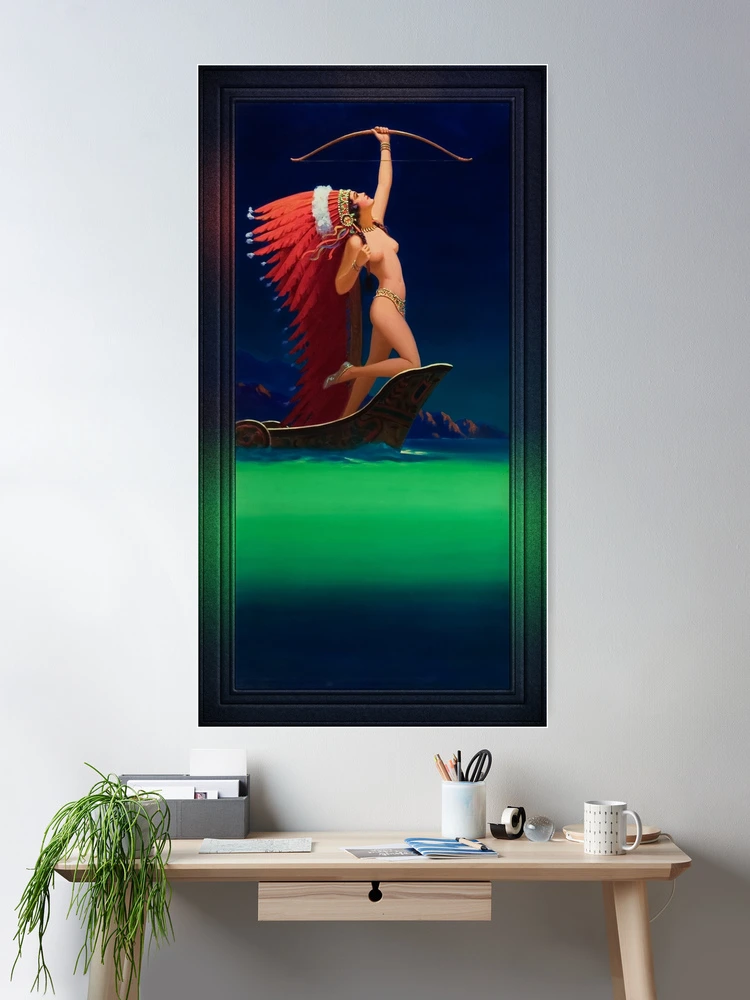
The scene depicted in Flaming Arrow is an evocative representation of a Native American woman poised as a warrior, an archetype of strength and bravery. She is positioned on a canoe-like vessel, drawing an arrow from her bow with a sense of intensity and purpose. Her arm is extended fully, the taut bowstring indicating the imminent release of the arrow, which appears as though it might burst forth in a brilliant, fiery arc.
This action is heightened by the woman’s powerful stance—her back arched with her chest thrust forward in perfect harmony with the energy of the moment. The long feathered headdress she wears, vibrant and in rich hues of crimson and white, seems to billow behind her like an extension of her resolve and power. 彼女の服装, minimal and composed of a series of tribal adornments, adds to the primal and elemental feel of the artwork, grounding her in nature’s vastness and the epic quest she symbolizes.
The boat upon which she stands is an elongated, slender structure, reminiscent of ancient Native American canoes that were often used for navigation across rivers or lakes. The vessel’s dark hue contrasts with the vibrant elements surrounding it, and its curvature suggests an almost organic flow, as if it is part of the larger landscape, the waters of which lap gently at its base.
The water itself is rendered in soft greens and blues, its surface seeming calm and otherworldly. しかしながら, there’s an underlying current of power and potential, as if the water is part of a larger, untold story that connects the heroine to the unknown. The colors of the water subtly reflect the colors of the sky, reinforcing the symbiosis between the woman and her environment.

The background of the piece is dominated by deep, rich tones of night. The mountains in the distance, visible but faint, rise up out of the mist, their peaks sharp and unyielding. These dark silhouettes provide a stark contrast to the vibrant reds of the woman’s headdress and the warm golds of her body jewelry.
The shadows in the painting are not merely absent light but are infused with texture, hinting at the mysteries and challenges the figure is poised to face. In the sky, one can sense the approach of something monumental, perhaps the impending release of the flaming arrow itself, a symbol of action, 運命, or impending conquest. The dramatic use of shadows in the painting underscores the sense of anticipation that envelops the scene.
Eggleston’s style in Flaming Arrow adheres to the principles of realism, yet with a flair for heightened drama. The forms are precise and the colors are rich, allowing the viewer to appreciate the texture and detail of the woman’s attire and the surrounding environment.
The artist’s use of light and shadow is particularly masterful; the illumination of the woman’s form against the darker backdrop of the night sky highlights her strength and central importance within the composition. The light seems to originate from an unseen source, casting a soft glow that subtly emphasizes her lithe and athletic physique.
The mood of the painting is one of solemnity and quiet power, but also one of impending action. The scene is frozen in time just before the release of the arrow, a moment ripe with potential. The viewer is drawn into this moment of pause, where the tension of the woman’s poised archery and the stillness of the surroundings come together in a breathtaking harmony. The mood feels like one of anticipation, and the woman stands as a figure who is prepared to unleash something far greater than herself.
The color palette Eggleston uses in Flaming Arrow is one of contrast and symbolism. The deep reds, 金, and earthy tones suggest a primal connection to the land and the elements, while the cooler blues and greens of the water and the sky convey serenity and mysticism.

The juxtaposition of these colors not only adds to the aesthetic beauty of the work but also enhances its narrative depth, evoking the complexity of the Native American experience and their historical relationship with nature, survival, and honor.
The painting’s theme could be interpreted as one of strength, 回復力, and the eternal connection between the warrior and the natural world. 女性, with her poised stance, is not just a figure from history but a symbolic representation of the timeless qualities of courage and fortitude. The flaming arrow she draws signifies not only a tool of war but also the idea of a path forward, a choice, or a moment of personal transformation.
素材的には, Eggleston’s use of oil paint is evident in the textural richness and depth of color that characterizes the piece. The brushstrokes are visible in areas such as the feathered headdress and the water, creating a dynamic sense of motion and texture.
The rendering of the water, 特に, stands out for its translucency and the play of light that gives it an almost ethereal quality. The contrast between the smoothness of the water and the texture of the woman’s body and the canoe adds a layer of contrast that further emphasizes the central figure.
結論は, Flaming Arrow by Edward Mason Eggleston is a powerful and captivating work of art. It combines realism with symbolic imagery, creating a narrative that resonates with themes of strength, 名誉, and the connection to the natural world.
The artist’s mastery of light, 色, and form draws the viewer into a world where time stands still, and a singular moment of potential hangs in the balance. The painting stands not just as a historical depiction but as a timeless representation of the warrior spirit.
以下の情報から Wikipedia.org
エドワードメイソンエグレストン (22 11月 1882 – 14 1月 1941) 女性のカレンダーの肖像画を専門とするアメリカの画家でした, ファッショナブルで幻想的.
彼はまた、Fisk TireCompanyなどの企業で仕事をしている有名な商業イラストレーターでもありました。, ペンシルバニア鉄道, そして五大湖博覧会.
彼はコロンバスのコロンバス美術学校に通いました, オハイオ州とニューヨークに引っ越しました 1915, 彼は雑誌の表紙を説明するために働いた場所, 旅行ポスター, 広告とカレンダー.
彼は主に帆布の油絵の具を扱っていました, パステルも使って, 水の色, とガッシュ.
エグレストンは、1930年代の大恐慌時代に、現実逃避の空想に向かうアメリカの傾向を利用しました。.
記述 “ストーリーテリング,” 彼のカレンダーは、スタイリッシュでファッショナブルなドレスと帽子をかぶった女性に焦点を当てています。, 水着, またはネイティブアメリカンの女性の衣装を着た, “エジプトの女神,” 海賊の女の子, ピーターパンのキャラクターの女性