

Fleurs De Printemps – Flowers Of Spring
Introduction à l'œuvre
Fleurs De Printemps (“Flowers of Spring”) is an exquisite work painted in 1878 by the renowned French artist William-Adolphe Bouguereau (1825 – 1905). Known for his mastery in rendering human figures with astonishing realism, Bouguereau’s “Fleurs De Printemps” epitomizes his prowess in depicting delicate details and soft textures, capturing the purity of youth and the vibrancy of springtime. This painting is a perfect example of Bouguereau’s signature style, showcasing his ability to merge portraiture with the natural world, offering an intimate glimpse into the innocence of childhood and the richness of nature.
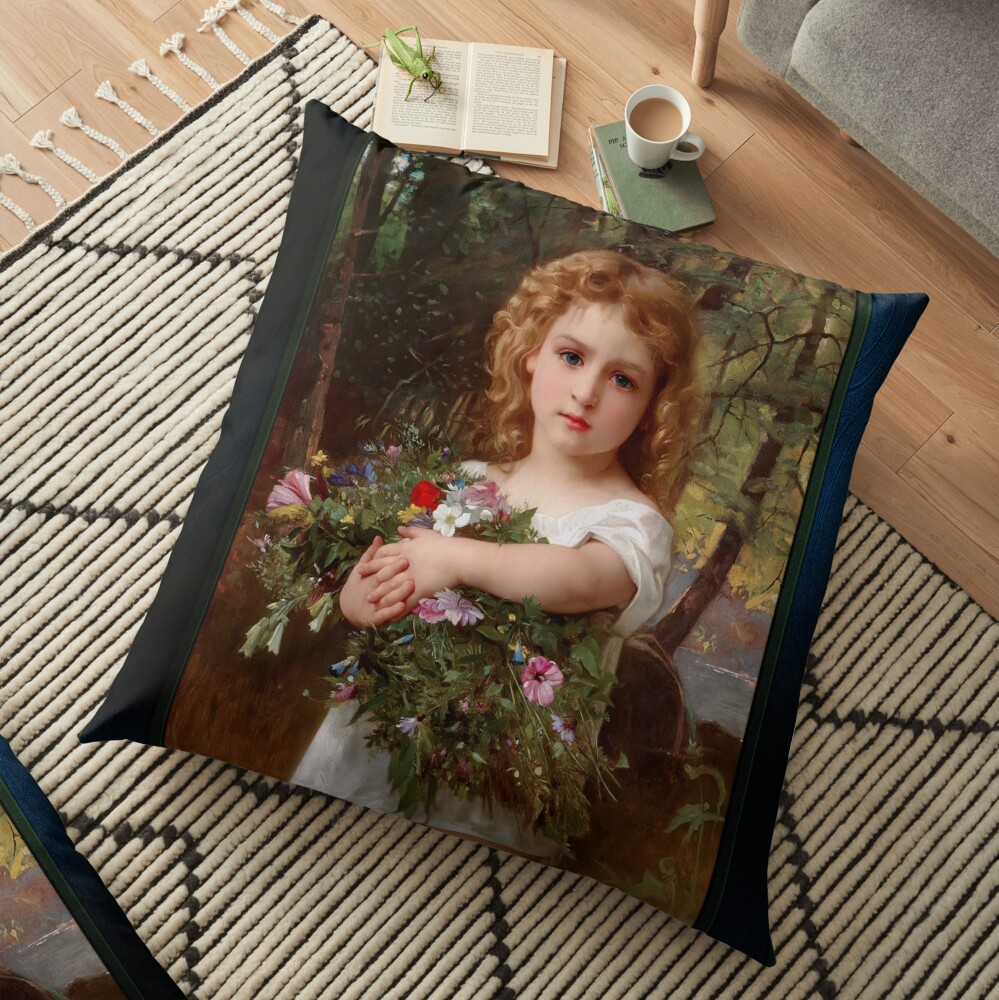
Table des matières
Le sujet
At the heart of the composition is a jeune fille, delicately posed as if she were an embodiment of spring itself. She is dressed in a simple white gown, her bare feet standing on the soft, earthy ground as she cradles an abundant bouquet of wildflowers against her chest. The floral arrangement she holds is a mixture of vibrant colors—deep purples, roses, blancs, et les rouges, evoking the fresh blossoms of the season. Her golden curls tumble down around her shoulders, contrasting against the pure whiteness of her garment. The girl gazes softly at the viewer with a subtle, almost shy expression, her features marked by a youthful innocence and purity that evoke a sense of nostalgia and tranquility.
The girl’s portrayal exudes the timeless theme of childhood innocence, yet it is also a nod to the floral symbolism of spring—a time of renewal, croissance, et la fertilité. The flowers are as much a part of her as she is a part of them, suggesting a harmonious connection between human and nature.
Le cadre
La toile de fond de “Fleurs De Printemps” is equally significant, as it sets the stage for the narrative of the young girl. The artist has chosen a wooded, paysage ensoleillé, with trees partially obscured by a soft mist of morning dew. This ethereal backdrop suggests a tranquil rural setting, possibly near a forest or meadow, and reflects the peaceful serenity of nature. The earthy tones of the surrounding trees, foliage, and ground create a contrast with the purity and brightness of the girl’s figure. The light filters through the foliage, casting dappled shadows on the earth, which enhances the sense of a serene and harmonious relationship between the figure and the environment.
Bouguereau’s attention to detail in the landscape—each leaf, each flower, and each blade of grass—is striking, further elevating the realism of the work. The natural surroundings appear to frame the girl, subtly emphasizing her as the focal point while also suggesting her belonging to the world around her.
Le style et la technique
William-Adolphe Bouguereau was a master of the academic style, which was rooted in the traditions of realism and fine detail. His technique in “Fleurs De Printemps” showcases the soft, almost ethereal quality of light and texture that defined his work. Bouguereau’s use of light is exceptional, with the interplay of soft sunlight across the girl’s face and the flowers accentuating the contours of her delicate features. The fine brushwork creates a smooth surface, almost velvety in appearance, making the girl’s skin seem radiant and lifelike.
The precise modeling of the face and hands is characteristic of Bouguereau’s meticulous approach to human anatomy. The tender folds of the gown, the gentle curve of the child’s arms, and the weightlessness of her pose all reflect a sophisticated understanding of human form. This technique not only gives a sense of realism but also imbues the figure with a sense of inner life, as though the viewer is encountering a moment of real beauty rather than a mere representation.
The flowers themselves are rendered with an almost botanical accuracy. Bouguereau was particularly adept at painting flora and fauna, and the bouquet in this painting is a testament to his skill in capturing the intricate textures and colors of nature. The flowers appear fresh and vibrant, as if plucked from the ground just moments before.
L'ambiance et le thème
L'ambiance de “Fleurs De Printemps” est serein et contemplatif, evoking a sense of nostalgia for a simpler, more innocent time. The young girl’s gaze, bien que doux, carries a depth of emotion that invites the viewer to reflect on themes of purity, jeunesse, and the fleeting nature of time. The softness of the figure, the gentle curvature of her body, and the expression on her face all suggest a sense of vulnerability, yet also an inherent strength. The connection to the natural world further amplifies these emotions, symbolizing life’s transient beauty, much like the blooming of flowers in spring that are destined to wither, only to be replaced by new growth.
The flowers themselves play a symbolic role in this painting. Traditionally, flowers represent the cycle of life, croissance, et la mort, Et ici, they symbolize the innocence and vitality of youth. In spring, the flowers’ bloom mirrors the girl’s own youthful energy and unspoiled beauty. Bouguereau’s careful juxtaposition of the girl’s purity with the vibrant spring flowers suggests an inevitable passage of time, a theme that resonates deeply in the art of the 19th century.
Conclusion
“Fleurs De Printemps” is a quintessential example of William-Adolphe Bouguereau’s mastery in blending realism with emotional depth. The artwork encapsulates the beauty of the natural world and the fragility of youth, themes that were deeply significant to the artist and his contemporaries. Bouguereau’s attention to detail, his gentle rendering of the human form, and his understanding of light and shadow combine to create a painting that is not only visually stunning but also rich with emotional resonance. This work continues to be a testament to Bouguereau’s legacy as one of the finest painters of the 19th century.
À propos de l’œuvre
Fleurs De Printemps est une autre version de la pièce Little Girl With Flowers de William Bouguereau c1878; avec un fond complet.
Alors que l'autre version de cette pièce était coupée juste en dessous des genoux et avait un fond noir; cette version a des paramètres de forêt.
J'ai été obligé de modifier la pièce car l'arrière-plan de cette version était en ruine, la majeure partie de l'arrière-plan de la forêt étant effacée et les parties visibles étant presque complètement noires.
Pour remédier à cela, donnez à l'œuvre un nouveau look, J'ai décidé de remplacer l'arrière-plan par la pièce de paysage Kahnpartie im Spreewald c1910 du peintre allemand Edward Theodore Compton (1849 – 1921).
Cette modification produit un arrière-plan d'arbres et de plantes qui se marie bien avec la jeune fille et les hautes herbes derrière elle; et ajoute une source de lumière supplémentaire et une rivière à l'extrême droite.
Je suis ensuite allé réparer les coupures, fissures, gouttes et salissures de la peinture; ainsi que le mélange du sol qui avait perdu de la peinture et avait juste l'air mauvais, pour qu'il se confond avec le reste de la scène.
Le résultat final est celui d'une adorable petite fille aux pieds nus, aux cheveux dorés châtain clair vêtu d'une robe blanche, avec un regard angélique pour elle; qui se tient sur un chemin forestier portant dans ses bras et près de son corps, un très grand assortiment de fleurs et plantes sauvages qu'elle a cueillies lors de sa sortie en forêt.
Fleurs De Printemps est une reproduction de maîtres anciens d'art numérique remasterisée d'une image du domaine public qui est disponible en tant que toile roulée, acrylique, impressions sur métal et bois.
À propos de l'artiste
Informations ci-dessous dérivées de Wikipedia.org
William-Adolphe Bouguereau est né à La Rochelle, La France, sur 30 novembre 1825, dans une famille de négociants en vins et en huile d'olive. Le fils de parents catholiques Théodore Bouguereau b1800 et Marie Bonnin b1804, dite Adeline.
Il avait un frère aîné, Alfred, et une petite soeur, Marie (connue sous le nom d'Hanna), décédé à l'âge de sept ans. La famille s'installe à Saint-Martin-de-Ré en 1832. Un autre frère est né à 1834, Minou.
À l'âge de 12, Bouguereau est allé à Mortagne chez son oncle Eugène, un prêtre et a développé un amour de la nature, religion et littérature. Dans 1839, il a été envoyé étudier pour la prêtrise dans un collège catholique à Pons.
Au Collège catholique, il a appris à dessiner et à peindre par Louis Sage, qui avait étudié sous Ingres. Bouguereau a quitté à contrecœur ses études pour retourner dans sa famille, résidant maintenant à Bordeaux. A Bordeaux en novembre 1841 il a rencontré un artiste local, Charles Marionneau, et poursuit ses études artistiques à l'école municipale de dessin et de peinture.
Bouguereau a également travaillé comme vendeuse, colorier à la main des lithographies et réaliser de petites peintures reproduites par chromolithographie. Il fut bientôt le meilleur élève de sa classe, et décide de devenir artiste à Paris. Pour financer le déménagement, il a vendu 33 portraits à l'huile non signés en trois mois; et avec l'argent gagné, arrivé à Paris à l'âge de 20 en mars 1846.
Après son arrivée à Paris Bouguereau est devenu élève à l'École des Beaux-Arts; et pour compléter sa formation formelle en dessin, il a assisté à des dissections anatomiques et a étudié les costumes historiques et l'archéologie. Dans 1848 he created Égalité Devant La Mort (Égalité avant la mort), son premier tableau en si majeur.
Plus tard, il a obtenu un poste dans l'atelier de François-Édouard Picot, où il a étudié la peinture dans le style académique; produire Dante et Virgile en enfer c1850, qui est un exemple précoce de son œuvre d'art néo-classique.
Au cours de sa vie, Bouguereau a connu une grande popularité en France et aux États-Unis., et a reçu de nombreux honneurs officiels, tout en s'amusant d'être payé le prix le plus élevé pour son œuvre. En tant que peintre de salon par excellence de sa génération, il était vilipendé par l'avant-garde impressionniste.
Tout au long de sa vie, Bouguereau exécuté 822 peintures finies connues, bien que le sort de beaucoup soit encore inconnu.