

Fiori di primavera – Flowers Of Spring
Introduzione all'opera d'arte
Fiori di primavera (“Flowers of Spring”) is an exquisite work painted in 1878 by the renowned French artist William-Adolphe Bouguereau (1825 – 1905). Known for his mastery in rendering human figures with astonishing realism, Bouguereau’s “Fiori di primavera” epitomizes his prowess in depicting delicate details and soft textures, capturing the purity of youth and the vibrancy of springtime. This painting is a perfect example of Bouguereau’s signature style, showcasing his ability to merge portraiture with the natural world, offering an intimate glimpse into the innocence of childhood and the richness of nature.
Sommario
Il soggetto
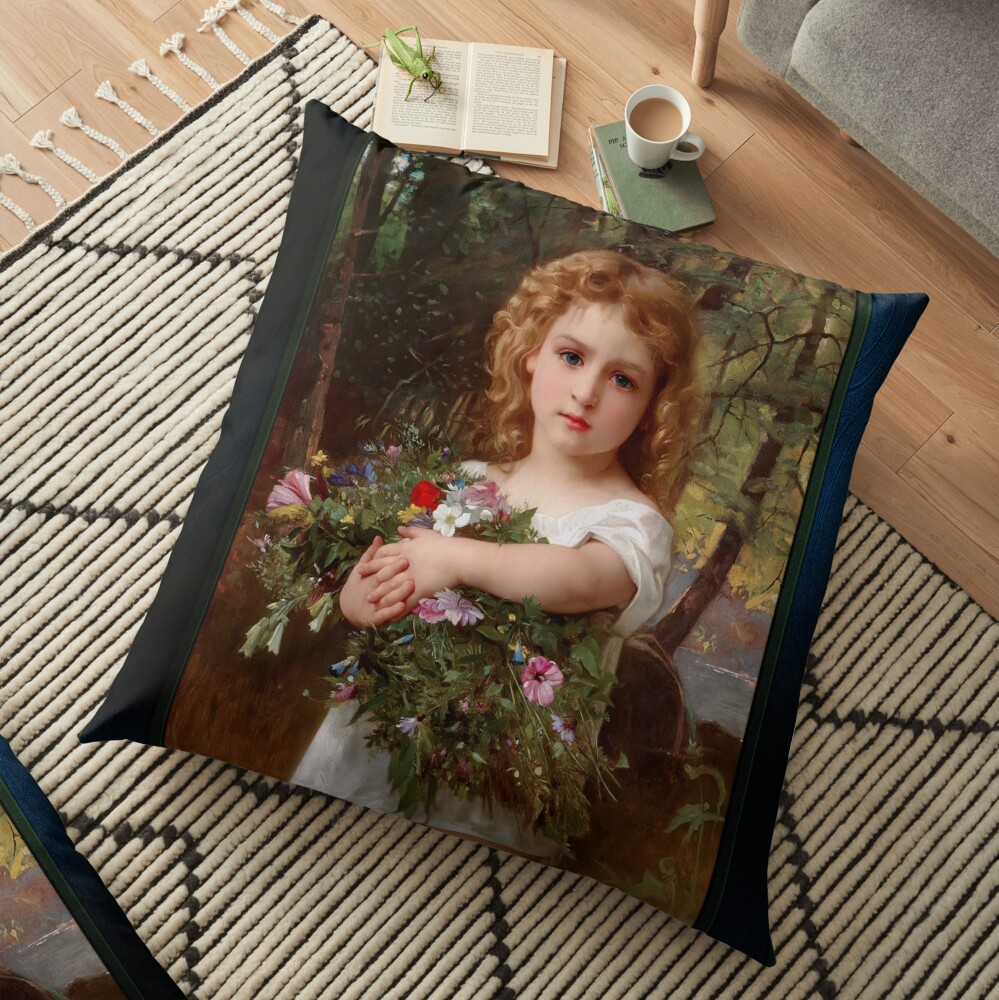
At the heart of the composition is a giovane ragazza, delicately posed as if she were an embodiment of spring itself. She is dressed in a simple white gown, her bare feet standing on the soft, earthy ground as she cradles an abundant bouquet of wildflowers against her chest. The floral arrangement she holds is a mixture of vibrant colors—deep purples, rosa, bianchi, e rossi, evoking the fresh blossoms of the season. Her golden curls tumble down around her shoulders, contrasting against the pure whiteness of her garment. The girl gazes softly at the viewer with a subtle, almost shy expression, her features marked by a youthful innocence and purity that evoke a sense of nostalgia and tranquility.
The girl’s portrayal exudes the timeless theme of childhood innocence, yet it is also a nod to the floral symbolism of spring—a time of renewal, crescita, e fertilità. The flowers are as much a part of her as she is a part of them, suggesting a harmonious connection between human and nature.
L'impostazione
Lo sfondo di “Fiori di primavera” is equally significant, as it sets the stage for the narrative of the young girl. The artist has chosen a wooded, sunlit landscape, with trees partially obscured by a soft mist of morning dew. This ethereal backdrop suggests a tranquil rural setting, possibly near a forest or meadow, and reflects the peaceful serenity of nature. The earthy tones of the surrounding trees, foliage, and ground create a contrast with the purity and brightness of the girl’s figure. The light filters through the foliage, casting dappled shadows on the earth, which enhances the sense of a serene and harmonious relationship between the figure and the environment.
Bouguereau’s attention to detail in the landscape—each leaf, each flower, and each blade of grass—is striking, further elevating the realism of the work. The natural surroundings appear to frame the girl, subtly emphasizing her as the focal point while also suggesting her belonging to the world around her.
Lo stile e la tecnica
William-Adolphe Bouguereau was a master of the academic style, which was rooted in the traditions of realism and fine detail. His technique in “Fiori di primavera” showcases the soft, almost ethereal quality of light and texture that defined his work. Bouguereau’s use of light is exceptional, with the interplay of soft sunlight across the girl’s face and the flowers accentuating the contours of her delicate features. The fine brushwork creates a smooth surface, almost velvety in appearance, making the girl’s skin seem radiant and lifelike.
The precise modeling of the face and hands is characteristic of Bouguereau’s meticulous approach to human anatomy. The tender folds of the gown, the gentle curve of the child’s arms, and the weightlessness of her pose all reflect a sophisticated understanding of human form. This technique not only gives a sense of realism but also imbues the figure with a sense of inner life, as though the viewer is encountering a moment of real beauty rather than a mere representation.
The flowers themselves are rendered with an almost botanical accuracy. Bouguereau was particularly adept at painting flora and fauna, and the bouquet in this painting is a testament to his skill in capturing the intricate textures and colors of nature. The flowers appear fresh and vibrant, as if plucked from the ground just moments before.
L'umore e il tema
L'umore di “Fiori di primavera” is serene and contemplative, evoking a sense of nostalgia for a simpler, more innocent time. The young girl’s gaze, though soft, carries a depth of emotion that invites the viewer to reflect on themes of purity, gioventù, and the fleeting nature of time. The softness of the figure, the gentle curvature of her body, and the expression on her face all suggest a sense of vulnerability, yet also an inherent strength. The connection to the natural world further amplifies these emotions, symbolizing life’s transient beauty, much like the blooming of flowers in spring that are destined to wither, only to be replaced by new growth.
The flowers themselves play a symbolic role in this painting. Traditionally, flowers represent the cycle of life, crescita, and death, and here, they symbolize the innocence and vitality of youth. In spring, the flowers’ bloom mirrors the girl’s own youthful energy and unspoiled beauty. Bouguereau’s careful juxtaposition of the girl’s purity with the vibrant spring flowers suggests an inevitable passage of time, a theme that resonates deeply in the art of the 19th century.
Conclusione
“Fiori di primavera” is a quintessential example of William-Adolphe Bouguereau’s mastery in blending realism with emotional depth. The artwork encapsulates the beauty of the natural world and the fragility of youth, themes that were deeply significant to the artist and his contemporaries. Bouguereau’s attention to detail, his gentle rendering of the human form, and his understanding of light and shadow combine to create a painting that is not only visually stunning but also rich with emotional resonance. This work continues to be a testament to Bouguereau’s legacy as one of the finest painters of the 19th century.
Informazioni sull'opera d'arte
Fleurs De Printemps è un'altra versione del pezzo di William Bouguereau Little Girl With Flowers c1878; con uno sfondo completo.
Mentre l'altra versione di questo pezzo era tagliata appena sotto le ginocchia e aveva uno sfondo nero; questa versione ha le impostazioni della foresta.
Sono stato costretto a modificare il pezzo poiché lo sfondo di questa versione era in disordine con la maggior parte dello sfondo della foresta che veniva spazzato via e le parti visibili erano quasi completamente nere.
Per rimediare a questo, dai all'opera d'arte un aspetto nuovo e fresco, Ho deciso di sostituire lo sfondo con il paesaggio Kahnpartie im Spreewald c1910 del pittore tedesco Edward Theodore Compton (1849 – 1921).
Questa modifica produce uno sfondo di alberi e piante che si fonde piacevolmente con la ragazza e l'erba alta dietro di lei; e aggiunge un'ulteriore fonte di luce e un fiume all'estrema destra.
Poi sono andato a riparare i tagli, crepe, forcellini e sporco dal dipinto; oltre a sfumare il terreno che aveva perso la vernice e sembrava semplicemente brutto, in modo che si fondesse con il resto della scena.
Il risultato finale è quello di un'adorabile bambina a piedi nudi, con capelli castano chiaro dorato vestito di una veste bianca, con uno sguardo angelico a lei; che sta in piedi su un sentiero nel bosco portando tra le sue braccia e vicino al suo corpo, un vasto assortimento di fiori e piante selvatiche che ha raccolto durante la sua gita nella foresta.
Fleurs De Printemps è una riproduzione di vecchi maestri di arte digitale rimasterizzata di un'immagine di dominio pubblico disponibile come tela arrotolata, acrilico, stampe su metallo e legno online.
Informazioni sull'artista
Informazioni di seguito derivate da Wikipedia.org
William-Adolphe Bouguereau è nato a La Rochelle, Francia, sopra 30 novembre 1825, in una famiglia di commercianti di vino e olio d'oliva. Il figlio di genitori cattolici Théodore Bouguereau b1800 e Marie Bonnin b1804, conosciuta come Adeline.
Aveva un fratello maggiore, Alfredo, e una sorella minore, Marie (noto come Hanna), che morì all'età di sette anni. La famiglia si trasferì a Saint-Martin-de-Ré in 1832. Un altro fratello è nato a 1834, Gattino.
All'età di 12, Bouguereau è andato a Mortagne per stare con suo zio Eugène, un prete e sviluppò un amore per la natura, religione e letteratura. Nel 1839, fu mandato a studiare per il sacerdozio in un collegio cattolico a Pons.
Al Catholic College gli fu insegnato a disegnare e dipingere da Louis Sage, che aveva studiato con Ingres. Bouguereau lasciò a malincuore gli studi per tornare dalla sua famiglia, ora residente a Bordeaux. Mentre a Bordeaux a novembre 1841 ha incontrato un artista locale, Carlo Marionneau, e ha proseguito gli studi artistici presso la Scuola Comunale di Disegno e Pittura.
Bouguereau ha lavorato anche come commesso, litografie colorate a mano e piccoli dipinti riprodotti mediante cromolitografia. Divenne presto il miglior allievo della sua classe, e ho deciso di diventare un artista a Parigi. Per finanziare il trasloco, ha venduto 33 ritratti ad olio non firmati in tre mesi; e con i soldi guadagnati, arrivato a Parigi all'età di 20 a marzo 1846.
Dopo essere arrivato a Parigi Bouguereau è diventato uno studente presso l'École des Beaux-Arts; e per completare la sua formazione formale nel disegno, ha frequentato dissezioni anatomiche e ha studiato costumi storici e archeologia. Nel 1848 ha creato l'uguaglianza prima della morte (Uguaglianza prima della morte), il suo primo quadro Bmajor.
Successivamente ha ottenuto un posto nello studio di François-Édouard Picot, dove ha studiato pittura in stile accademico; producendo Dante e Virgilio all'inferno c1850, che è un primo esempio della sua opera d'arte neoclassica.
Durante la sua vita Bouguereau godette di una notevole popolarità in Francia e negli Stati Uniti, e ricevette numerosi riconoscimenti ufficiali, mentre si diverte a essere pagato il prezzo più alto per la sua opera d'arte. Come il pittore da salotto per antonomasia della sua generazione, fu insultato dall'avanguardia impressionista.
Per tutto il corso della sua vita, Bouguereau giustiziato 822 dipinti finiti conosciuti, anche se molti sono ancora sconosciuti.