

Fleurs du Mal c1920
“Fleurs du Mal c1920” is a captivating work created by the Peruvian artist Alberto Vargas, fæddur í 1896 og gengur inn 1982. This iconic painting was completed during a period when Vargas was renowned for his pin-up art, which exuded sensuality and elegance. The piece, titled after Charles Baudelaire’s famed collection of poems, evokes a mix of sensual allure and melancholy, creating an intimate, yet sophisticated narrative. The work reflects Vargas’s characteristic style, marked by the mastery of feminine form, flókin smáatriði, and an impeccable use of color and composition.
Efnisyfirlit
Aðalefni og samsetning
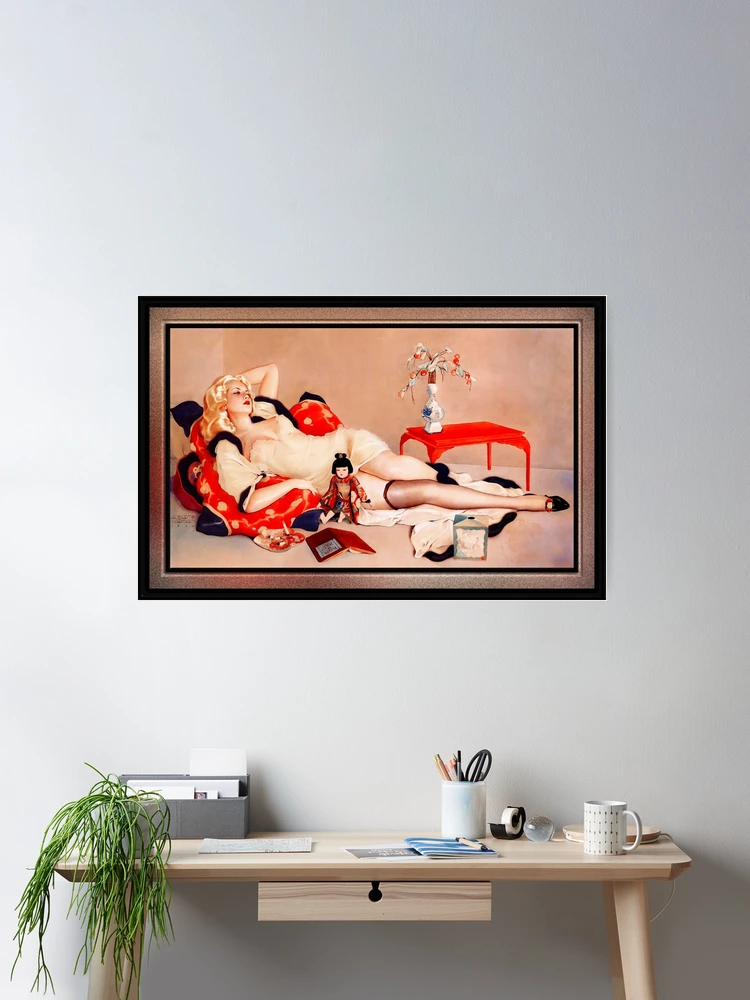
At the center of the painting lies a sultry and sensuous female figure, whose allure is both graceful and powerful. She reclines on a plush, red and white patterned cushion, exuding a relaxed yet provocative aura. Her golden blonde hair cascades around her shoulders, styled in soft waves that frame her face. Svipur hennar er rólegur, almost detached, with eyes gazing downward, which enhances the intimate atmosphere of the scene. The figure is draped in an off-white fabric that subtly hints at the contours of her body, reinforcing the sensuality of the piece without overtly revealing too much.
Myndin hennar, slender yet soft, epitomizes the idealized beauty often depicted in Vargas’s pin-up art. The careful rendering of her exposed legs and stockings, combined with the meticulous shading and highlights, draws attention to the delicate balance between eroticism and refinement. The stockings, held up by garter straps, create a bold contrast against the otherwise soft tones of the painting. This contrast adds a sense of intrigue, inviting the viewer to explore both the vulnerability and confidence embodied by the subject.
Objects and Surroundings
In the backdrop of the painting, subtle yet meaningful details emerge, enhancing the narrative and mood. Lítið, red table stands near the reclining figure, contributing a touch of vibrant color to the otherwise muted palette. On the table, a delicate porcelain vase filled with what appears to be flowers adds a naturalistic element to the composition. The flowers themselves seem to embody the theme of sensuality and impermanence, reinforcing the reference to Baudelaire’s “Fleurs du Mal” (Flowers of Evil), which explores themes of beauty, decadence, and corruption.
A doll sits beside the woman, a figure with a traditional, almost Eastern, appearance. The juxtaposition of this doll with the reclining woman, coupled with her seductive posture, hints at the duality of innocence and desire. The doll’s presence, seemingly innocent and detached from the sensuality of the main subject, acts as a contrast, making the viewer consider the boundaries between innocence and sensuality.
Auk þess, another object—a small box—sits just off to the side, adding another layer of narrative and symbolism to the scene. The exact nature of the box is unclear, but its presence within the composition may suggest the theme of mystery, with its closed, unexamined form inviting curiosity.
Landslag og efni
The terrain on which the woman rests is a simple, smooth surface that helps focus the viewer’s attention entirely on the subject and surrounding objects. Litunum í bakgrunninum er haldið hlutlausum, sem leggur alla áherslu á fígúruna og fylgihlutina sem henni fylgja. Þetta val í landslagi endurspeglar kunnátta notkun Vargas á plássi - skapar jafnvægi í samsetningu þar sem myndin er áfram miðpunktur athygli án truflunar.
Nákvæm notkun Vargas á olíumálningu vekur dýpt á sjónarsviðið, með náttúrulegum gljáa á húð konunnar og mýkt sem nánast býður áhorfandanum að snerta striga. Viðkvæma skyggingin á húð konunnar, öfugt við það feitletraða, skarpur hápunktur á rauða púðanum og borðinu, eykur þrívídd verksins. Vargas notar ljós til að móta myndina, highlighting the smoothness of her skin and the folds of her fabric in a way that creates a vivid realism, making the scene feel tangible and alive.
Stíll, Þema, og skap
The painting exudes the essence of Vargas’s pin-up art, which was characterized by idealized depictions of women, sameinar fegurð, allure, and glamour. Þetta málverk, þó, goes beyond simple eroticism, incorporating a subtle melancholy into its sensuality. The reference to Baudelaire’s “Fleurs du Mal” is not just an aesthetic choice; it is a reflection of the complex emotions encapsulated in the scene. The serene expression of the woman, coupled with her seductive pose, invokes a sense of longing and emotional depth, suggesting that beauty and desire are not merely fleeting, but tinged with sadness and imperfection.
The mood of the artwork balances between warmth and detachment. Það er skýrt boð um að láta undan sjónrænni ánægju af fegurð myndefnisins, samt er líka róleg viðurkenning á því að þessi eftirlátssemi er tímabundin. Samsetning saklausra hluta, eins og dúkkuna og vasann, með kúlulegu liggjandi konunni undirstrikar tvíeðli málverksins: hún er bæði hátíð kvenlegrar fegurðar og hugleiðing um hverfult eðli næmni og æsku.
Niðurstaða
“Fleurs du Mal c1920” eftir Alberto Vargas er töfrandi verk sem fangar kjarna bæði næmni og sjálfsskoðunar. Hæfni listamannsins til að sameina þessa þætti með lúmskum tilvísunum í bókmenntir og listasögu lyftir verkinu upp úr því að vera einfaldur pin-up list yfir í dýpri könnun á fegurð og hverfulleika. Konan í miðju málverksins, surrounded by carefully chosen objects, embodies a world where sensuality is not just an aesthetic pursuit but also a reflection of inner complexity.
Fleurs du Mal c1920 by Peruvian Artist Alberto Vargas (1896 – 1982); fyrir aðlaðandi og stórkostlega pin-up stelpulist sína og talin vera frægasta pin-up listamannategundin.
Depiction of a reclining woman in lingerie (wearing one stocking) surrounded by oriental objects, an ashtray with cigarettes, vase with flowers, Asian doll, Asian table, decorative box, and opened book “Fleurs du Mal”.
Þetta er lagfærð stafræn list af gömlum meistara eftirgerð af mynd í almenningseign.
Listamaður Bio
Upplýsingar að neðan Frá Wikipedia.org
Fæddur í Arequipa, Perú, hann var sonur þekkts perúíska ljósmyndarans Max T. Vei. Alberto Vargas flutti til Bandaríkjanna í 1916 eftir listnám í Evrópu, Zürich, og Genf fyrir fyrri heimsstyrjöldina.
Þegar hann var í Evrópu rakst hann á franska tímaritið La Vie Parisienne, með forsíðu eftir Raphael Kirchner, sem hann sagði hafa haft mikil áhrif á störf sín.
Snemma feril hans í New York innihélt vinnu sem listamaður fyrir Ziegfeld Follies og fyrir mörg Hollywood vinnustofur. Ziegfeld hengdi málverk sitt af Olive Thomas í leikhúsinu, og hún var talin ein af elstu Vargas stelpunum.
Vei’ frægasta kvikmyndaverkið var fyrir veggspjaldið 1933 kvikmynd The Synd Nora Moran, sem sýnir næstum nakta Zitu Johann í örvæntingarstellingu. Plakatið er oft nefnt eitt besta kvikmyndaplakat sem gert hefur verið.
Hann varð víða þekktur á fjórða áratugnum sem skapari helgimynda heimsstyrjaldarinnar pin-ups fyrir Esquire tímaritið þekkt sem “Vargas stelpur.” Milli 1940 og 1946 Vargas framleitt 180 málverk fyrir tímaritið.
Neflist margra flugvéla Bandaríkjanna og bandamanna í seinni heimsstyrjöldinni var innblásin og aðlöguð frá þessum Esquire pin-ups, sem og George Petty, og fleiri listamenn.