

Fleurs du Mal c1920
“Fleurs du Mal c1920” is a captivating work created by the Peruvian artist Immagine segnaposto Alberto Vargas, nato in 1896 e passando 1982. This iconic painting was completed during a period when Vargas was renowned for his pin-up art, which exuded sensuality and elegance. Il pezzo, titled after Charles Baudelaire’s famed collection of poems, evokes a mix of sensual allure and melancholy, creating an intimate, yet sophisticated narrative. The work reflects Vargas’s characteristic style, marked by the mastery of feminine form, dettagli intricati, and an impeccable use of color and composition.
Sommario
Soggetto principale e composizione
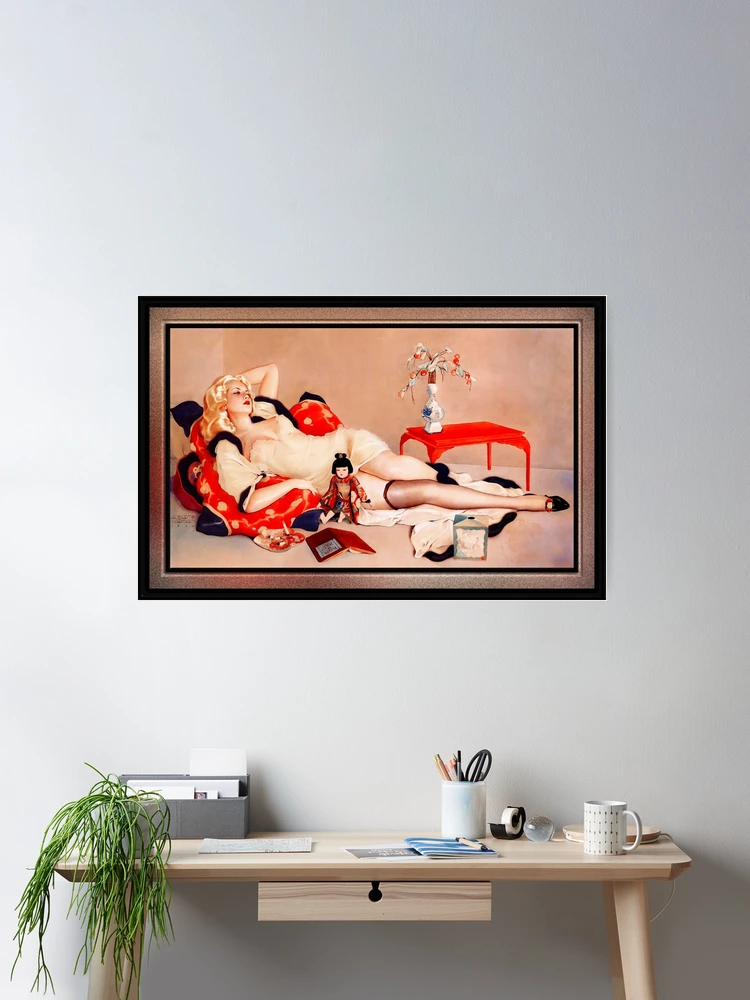
At the center of the painting lies a sultry and sensuous female figure, whose allure is both graceful and powerful. She reclines on a plush, red and white patterned cushion, exuding a relaxed yet provocative aura. Her golden blonde hair cascades around her shoulders, styled in soft waves that frame her face. La sua espressione è serena, quasi distaccato, with eyes gazing downward, which enhances the intimate atmosphere of the scene. The figure is draped in an off-white fabric that subtly hints at the contours of her body, reinforcing the sensuality of the piece without overtly revealing too much.
La sua figura, slender yet soft, epitomizes the idealized beauty often depicted in Vargas’s pin-up art. The careful rendering of her exposed legs and stockings, combined with the meticulous shading and highlights, draws attention to the delicate balance between eroticism and refinement. The stockings, held up by garter straps, create a bold contrast against the otherwise soft tones of the painting. This contrast adds a sense of intrigue, inviting the viewer to explore both the vulnerability and confidence embodied by the subject.
Oggetti e dintorni
In the backdrop of the painting, subtle yet meaningful details emerge, enhancing the narrative and mood. Un piccolo, red table stands near the reclining figure, contributing a touch of vibrant color to the otherwise muted palette. On the table, a delicate porcelain vase filled with what appears to be flowers adds a naturalistic element to the composition. The flowers themselves seem to embody the theme of sensuality and impermanence, reinforcing the reference to Baudelaire’s “I fiori del male” (Flowers of Evil), which explores themes of beauty, decadence, and corruption.
A doll sits beside the woman, a figure with a traditional, almost Eastern, appearance. The juxtaposition of this doll with the reclining woman, coupled with her seductive posture, hints at the duality of innocence and desire. The doll’s presence, seemingly innocent and detached from the sensuality of the main subject, acts as a contrast, making the viewer consider the boundaries between innocence and sensuality.
Inoltre, another object—a small box—sits just off to the side, adding another layer of narrative and symbolism to the scene. The exact nature of the box is unclear, but its presence within the composition may suggest the theme of mystery, with its closed, unexamined form inviting curiosity.
Terreno e materiale
The terrain on which the woman rests is a simple, smooth surface that helps focus the viewer’s attention entirely on the subject and surrounding objects. The colors in the background are kept neutral, which places all emphasis on the figure and the accessories that accompany her. This choice in terrain reflects Vargas’s skillful use of space—creating a balanced composition where the figure remains the central point of attention without distraction.
Vargas’s meticulous use of oil paints brings depth to the scene, with a natural sheen on the skin of the woman and a softness that almost invites the viewer to touch the canvas. The delicate shading on the woman’s skin, contrasted with the bold, sharp highlights on the red cushion and table, enhances the three-dimensionality of the piece. Vargas uses light to sculpt the figure, highlighting the smoothness of her skin and the folds of her fabric in a way that creates a vivid realism, making the scene feel tangible and alive.
Stile, Tema, e umore
The painting exudes the essence of Vargas’s pin-up art, which was characterized by idealized depictions of women, combinando la bellezza, fascino, e fascino. Questo dipinto, tuttavia, goes beyond simple eroticism, incorporating a subtle melancholy into its sensuality. The reference to Baudelaire’s “I fiori del male” is not just an aesthetic choice; it is a reflection of the complex emotions encapsulated in the scene. The serene expression of the woman, coupled with her seductive pose, invokes a sense of longing and emotional depth, suggesting that beauty and desire are not merely fleeting, but tinged with sadness and imperfection.
The mood of the artwork balances between warmth and detachment. There is a clear invitation to indulge in the visual pleasure of the subject’s beauty, yet there is also a quiet recognition that this indulgence is transient. The juxtaposition of innocent objects, such as the doll and the vase, with the sultry reclining woman underscores the dual nature of the painting: it is both a celebration of feminine beauty and a meditation on the ephemeral nature of sensuality and youth.
Conclusione
“Fleurs du Mal c1920” by Alberto Vargas is a stunning piece that captures the essence of both sensuality and introspection. The artist’s ability to combine these elements with subtle references to literature and art history elevates the piece from mere pin-up art to a deeper exploration of beauty and impermanence. The woman at the center of the painting, surrounded by carefully chosen objects, embodies a world where sensuality is not just an aesthetic pursuit but also a reflection of inner complexity.
Fiori del male c1920 dall'artista peruviano Immagine segnaposto Alberto Vargas (1896 – 1982); per la sua arte seducente e squisita di pin-up e considerata la più famosa del genere di pin-up artist.
Raffigurazione di una donna sdraiata in lingerie (indossare una calza) circondato da oggetti orientali, un posacenere con le sigarette, vaso con fiori, Bambola asiatica, tavola asiatica, scatola decorativa, e libro aperto “I fiori del male”.
Questa è una riproduzione ritoccata di arte digitale dei vecchi maestri di un'immagine di pubblico dominio.
Biografia dell'artista
Informazioni sotto da Wikipedia.org
Nato ad Arequipa, Perù, era il figlio del noto fotografo peruviano Max T. Vargas. Alberto Vargas si è trasferito negli Stati Uniti nel 1916 dopo aver studiato arte in Europa, Zurigo, e Ginevra prima della prima guerra mondiale.
Mentre era in Europa si imbatté nella rivista francese La Vie Parisienne, con una copertina di Raphael Kirchner, che ha detto è stata una grande influenza sul suo lavoro.
La sua prima carriera a New York includeva il lavoro come artista per le Ziegfeld Follies e per molti studi di Hollywood. Ziegfeld ha appeso il suo quadro di Olive Thomas a teatro, ed era considerata una delle prime Vargas Girls.
Vargas’ pezzo più famoso del lavoro cinematografico è stato per il poster del 1933 film Il peccato di Nora Moran, che mostra una Zita Johann quasi nuda in posa disperata. Il poster è spesso nominato uno dei più grandi poster cinematografici mai realizzati.
Divenne ampiamente noto negli anni '40 come il creatore delle iconiche pin-up dell'era della seconda guerra mondiale per la rivista Esquire nota come “Ragazze Vargas.” Tra 1940 e 1946 Vargas prodotto 180 quadri per la rivista.
L'arte del naso di molti aerei americani e alleati della seconda guerra mondiale è stata ispirata e adattata da queste pin-up di Esquire, così come quelli di George Petty, e altri artisti.