

Flowers Of Gardens
Introduktion till konstverket
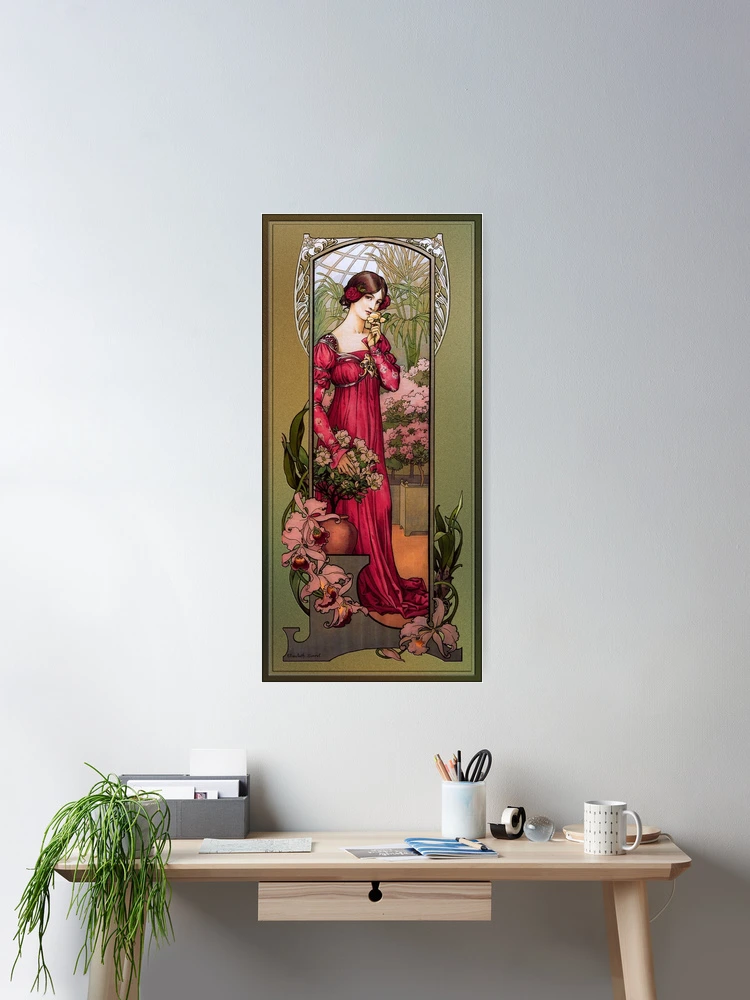
Målningen med titeln Flowers Of Gardens, skapat runt 1900 by French artist Elisabeth Sonrel, exemplifies the Art Nouveau style with its refined blend of nature and feminine grace. Elisabeth Sonrel (1874–1953) was an accomplished painter who, much like other artists of her time, sought to integrate decorative arts and natural elements into her work, creating serene and idealized depictions of women in harmony with their surroundings. Flowers Of Gardens stands as a testament to Sonrel’s mastery of capturing beauty, both in the human form and the natural world, within the confines of a highly stylized framework.
I detta stycke, the artist presents a young woman amidst a lush garden filled with blossoming flowers, creating a sense of peace, mjukhet, och tidlös elegans. The work belongs to the transition period of the late 19th and early 20th century, when artists began to experiment with more decorative elements in their work, setting the stage for the Art Nouveau movement to flourish.
Innehållsförteckning
Den centrala figuren: The Woman in the Garden
The focal point of the painting is the elegant woman, who stands poised amidst a garden of flourishing plants. She gazes slightly off to the side, gently holding a flower to her lips. Her expression is one of quiet contemplation, almost as if she is lost in thought, making the viewer ponder what she may be contemplating. The artist uses soft, fluid lines to create the delicate figure, accentuating her grace and beauty. Her posture is stately, yet relaxed, as though she is one with the flowers around her.
The woman is dressed in a flowing gown of deep pink, which enhances her romantic, almost ethereal appearance. Klänningen, with its intricate folds and soft fabric, kompletterar hennes känsliga drag. The long sleeves of her dress, which gather slightly at the wrists, suggest a gentle yet refined femininity, while the delicate rose-colored flowers in her hair add an extra layer of romanticism and connection to the floral surroundings. There is a sense of timelessness about her, as though she could exist in any era, embodying the ideal of beauty and serenity that Sonrel sought to portray.
The Floral and Botanical Setting
The garden setting in Flowers Of Gardens is lush and detailed, and it plays a crucial role in enhancing the overall theme of the painting. Surrounding the central figure is a profusion of flowers in various stages of bloom. The woman’s proximity to these plants, coupled with her tender interaction with them, suggests a deep connection between the human and natural worlds. Blommorna, though not named specifically, are painted with exquisite detail, and they seem to spring to life with every brushstroke. Their delicate petals, some of which are white or pale pink, contribute to the overall softness of the scene, reinforcing the tranquility of the moment.
The garden setting itself is depicted as a tranquil, slightly enclosed space, with the glass structure in the background resembling a greenhouse or garden conservatory. The latticework of the glass and the intertwining plants visible through it provide a sense of depth and structure within the composition. The background setting, with its muted greens and beiges, contrasts with the vibrant colors of the flowers and the woman’s gown, drawing attention to the central figure without overpowering the scene.
At the lower corners of the painting, large blooms—perhaps orchids—add another layer of complexity and interest to the piece. The intricate depiction of these flowers, with their sinuous curves and graceful form, echoes the flowing lines of the woman’s gown and hair, further blending human and natural elements.
Material och teknik
Sonrel’s technique in Flowers Of Gardens reflects her skill in creating harmony between color, linje, och form. The painting is rendered with soft, flowing lines typical of the Art Nouveau style, which often favors organic shapes and an emphasis on decoration. The use of pastel tones—soft pinks, gröna, and pale yellows—creates a serene, nästan drömlik atmosfär. The lightness of the color palette adds to the feeling of delicacy and elegance, as if the entire composition exists in a peaceful reverie.
The artist’s handling of light and shadow is subtle but effective. The soft shading around the figure and the background flowers suggests a gentle, diffused light source, as though the woman is bathed in the glow of a late afternoon sun. The absence of harsh shadows gives the painting a soft, inviting quality, reinforcing the tranquil mood.
Stämningen och temat
Stämningen av Flowers Of Gardens is one of harmony, nåd, and reflection. The artist’s emphasis on a young woman in a peaceful garden, surrounded by blooming flowers, speaks to the broader themes of natural beauty and the idealization of femininity. Sonrel creates an environment that is not only visually pleasing but emotionally evocative. The viewer is invited to pause and reflect on the natural beauty of the world, and the way in which human beings can interact with and appreciate the natural world in a delicate, almost spiritual way.
The theme of femininity is prevalent throughout the artwork, with the woman portrayed as the central figure of beauty and grace. She is not merely a passive object of admiration but is instead actively engaged with her surroundings, holding a flower as if it were an extension of herself. This interaction suggests a deeper connection with nature, a theme often found in the works of Art Nouveau artists.
Sonrel’s painting also carries a timeless quality, as if the scene could belong to any era in which beauty and nature were revered. Trädgården, with its rich symbolism, alludes to themes of growth, förnyelse, and the cycles of life, while the woman’s elegant pose conveys a sense of enduring beauty that transcends time.
Slutsats
Élisabeth Sonrel’s Flowers Of Gardens is a masterful representation of Art Nouveau’s emphasis on beauty, natur, and the female form. The artist’s ability to capture the soft harmony between the woman and her floral surroundings speaks to her deep understanding of both the natural world and human grace. The painting evokes a mood of serenity and timeless elegance, offering the viewer a moment of reflection and appreciation for the simple yet profound beauty of nature. Through her skillful use of color, linje, och form, Sonrel invites us to experience a world where beauty is both delicate and enduring, where humans and nature exist in a perfect, harmonious balance.
Flowers Of Gardens is a retouched digital art old masters reproduction of a public domain image.
Om konstnären
Info nedan med tillstånd Wikipedia.org
Elisabeth Sonrel (1874 Rundturer - 1953 Sälar) var en fransk målare och illustratör i jugendstil. Hennes verk inkluderade allegoriska ämnen, mysticism och symbolism, porträtt och landskap.
Hon var dotter till Nicolas Stéphane Sonrel, en målare från Tours, och fick hennes tidiga utbildning av honom. För vidare studier fortsatte hon till Paris som student vid Jules Lefebvre vid Ecole des Beaux-Arts.
I 1892 hon målade sitt diplomarbete, "Pax et Labor", ett verk att se på Musée des Beaux-Arts de Tours. Från och med då ställde hon ut på Salon des Artistes Français mellan 1893 och 1941, hennes signaturstycken är stora akvareller på ett pre-Raphaelite-sätt, som hon antog efter en resa till Florens och Rom, upptäcka renässansmålarna – några av hennes verk har tydliga övertoner av Botticelli. Hennes målningar inspirerades ofta av Arthurian romans, Dante Alighieris gudomliga komedi’ och "Det nya livet", bibliska teman, och medeltida legender. Hennes mystiska verk inkluderar "Ames errantes’ (Salong av 1894) och "Avgrundens andar’ (Salong av 1899) och "Ung kvinna med gobelängen".
Vid Exposition Universelle of 1900, vars huvudsakliga tema var jugendstil, henne 1895 målning "Jungfruns sömn’ (Jungfruens sömn), fick en bronsmedalj, och Henri Lehmann -priset av 3000 franc av The Academy of Fine Arts.[3] Från 1900 framåt begränsade hon sin målning till porträtt, natursköna Bretagne landskap, och en och annan blomsterstudie.
Hon gjorde regelbundna måleresor till Bretagne, inspirerad av skogen Brocéliande, och från 1910 till olika platser på kusten som Concarneau, Plougastel, Pont-l'Abbé och Loctudy, vistas ofta på värdshus och åtföljs av en eller två studenter. Hon målade flera verk i Le Faouët innan hon byggde en villa i La Baule på 1930 -talet. Arbetar främst i akvarell och gouache, hon upptäckte ett klart utbud av modeller bland unga tjejer i området, och tyckte att bretoner i allmänhet var vänliga, ärlig och självsäker.
Hennes sista utställning på salongen var i 1941 vid en ålder av 67. Det finns också ett register över att hon hade ställt ut i Liverpool. Under sina första år producerade Sonrel affischer, vykort och illustrationer, i jugendstil.