

Fleurs des montagnes
Fleurs des montagnes Élisabeth Sonrel (1874 – 1953); et illustrateur du style Art Nouveau; dont les œuvres comprenaient des sujets allégoriques, mysticisme et symbolisme, portraits et paysages.
Cette œuvre d'art exquise, Sonrel s'appuie sur l'attrait de la mythologie et de la nature, réunissant les deux éléments avec un équilibre délicat de beauté, grâce, et solitude introspective.
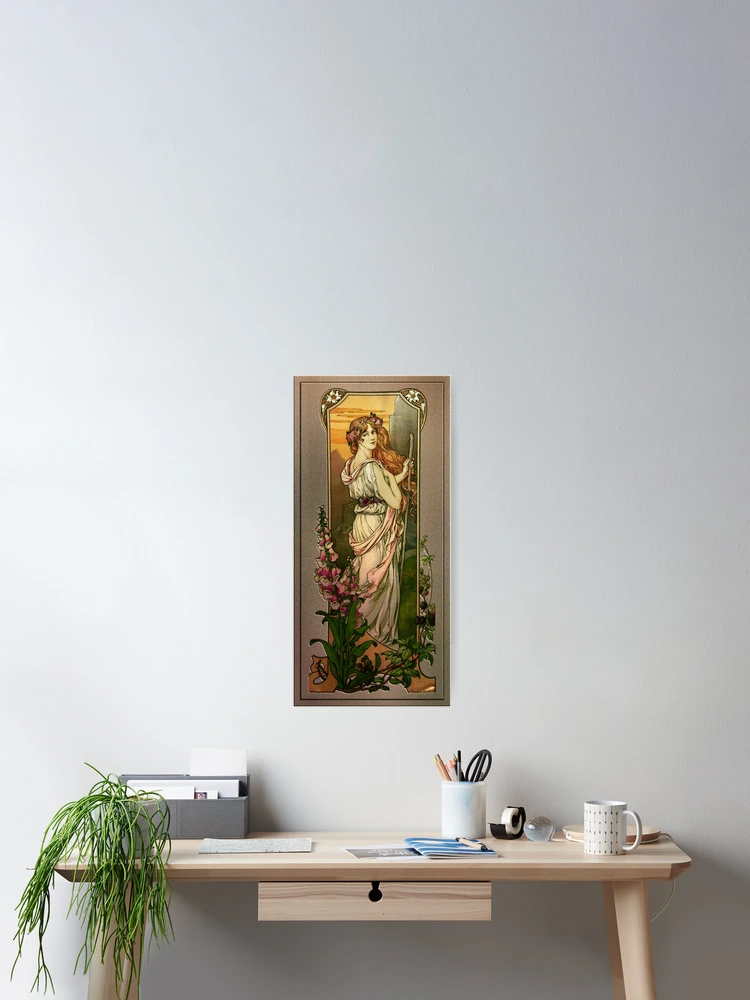
Table des matières
Sujet principal
Le personnage central de ce tableau est une figure féminine d'une beauté éthérée, qui se tient grand et posé sur fond de montagnes imposantes et d'un doux, ciel chaud. Le personnage est une jeune femme, drapé dans une robe blanche fluide qui flotte doucement dans la brise, le tissu rendu avec des plis doux qui ajoutent de la texture et de la profondeur. La robe, cintrée à la taille avec une ceinture simple mais élégante, améliore la fluidité de sa forme, soulignant l'harmonie entre la silhouette et la nature.
Ses cheveux, une cascade de riches mèches auburn, tombe librement sur ses épaules, évoquant davantage la qualité intemporelle de sa beauté. Une couronne de fleurs repose sur sa tête, créer une couronne délicate qui apporte un air sauvage à sa féminité. Les fleurs de la couronne sont petites et vibrantes, suggérant un lien avec le monde naturel, comme si la femme était une incarnation de la flore qui l'entoure. Cette couronne de fleurs rehausse son côté éthéré, présence presque divine.
Dans sa main droite, elle tient longtemps, personnel élancé, qui pourrait être interprété comme un symbole de sagesse ou de guidance. Le personnel est simple mais digne, agissant comme un rappel subtil de l’autorité de la femme et de son lien avec le terrain environnant. La prise douce et la posture détendue suggèrent que la silhouette est à l'aise dans son environnement., dégageant une confiance calme dans son rôle.
Objets et détails
De chaque côté de la femme se trouvent deux éléments floraux proéminents., une des fleurs de digitale (Digitale) à gauche et un riche éventail de vignes et de feuilles de mûres à droite. Ces plantes servent à encadrer la figure centrale, attirant le regard du spectateur vers elle tout en améliorant le récit de l’étreinte de la nature. Les digitales, avec leurs hautes flèches de fleurs en forme de cloche, sont vibrants et s'étendent vers le ciel, créant un contraste visuel avec la terre de la femme, posture terrestre. Les vignes de mûres, plein de feuilles vertes luxuriantes et sombres, baies mûrissantes, offrir un sentiment de sauvagerie et de fertilité, renforçant le thème du lien naturel de la femme avec la terre.
Les montagnes en arrière-plan, mais pas dominant dans leur représentation, donner une impression d'échelle et de profondeur. Ils s'élèvent majestueusement au loin, leurs sommets partiellement obscurcis par la brume, leur donnant une qualité mystérieuse et intemporelle. Le ciel au-dessus est inondé de chaleur, tons dorés, avec des notes de rose tendre et d'orange, suggérant soit l'aube, soit le crépuscule, des temps de transition et d’introspection. Ce choix de palette de couleurs confère à l'œuvre un sentiment de tranquillité et de contemplation tranquille..
Terrain et matériaux
Le terrain est accidenté et inflexible, pourtant cela complète la douceur de la silhouette de la femme. C'est un endroit où la vie s'épanouit malgré sa dureté, comme on le voit dans la flore environnante. Les couleurs utilisées pour le terrain et les fleurs sont terreuses et naturelles, suggérant que Sonrel s'est inspiré des paysages accidentés de la campagne française ou peut-être des paysages mythiques de la Grèce antique. L'attention particulière que l'artiste porte aux détails des plantes et des montagnes montre sa profonde compréhension de la nature et de la forme humaine., les mélangeant parfaitement dans cette pièce.
Style et thème
Le style de cette œuvre est profondément enraciné dans le mouvement Art Nouveau, qui a prospéré à la fin du 19e et au début du 20e siècle. Caractérisé par l'accent mis sur les formes organiques, lignes fluides, et intégration harmonieuse de la nature et des figures humaines, le style Art Nouveau est illustré ici à travers la courbure gracieuse de la pose de la femme et les détails floraux complexes qui l'entourent.. L'utilisation du soft par Sonrel, les couleurs mélangées et les lignes fluides confèrent à la pièce une qualité onirique, invitant le spectateur dans un monde où la nature et l'humanité coexistent en parfait équilibre.
Thématiquement, Fleurs des montagnes explore le lien entre la figure humaine et le monde naturel. La femme dans le tableau n'est pas seulement une figure de beauté mais aussi un symbole de la nature elle-même.. Sa présence parmi les fleurs, sa couronne, et le lien avec les montagnes suggèrent tous un lien plus profond entre l'humanité et la terre, peut-être en s'inspirant de mythologies anciennes où les femmes représentaient souvent la terre, fécondité, ou la vitalité de la nature. L'utilisation des fleurs, en particulier ceux associés à la guérison et à la croissance comme la digitale, suggère que le personnage n'est pas seulement passif dans son environnement mais participe activement à la force vitale de la nature..
Humeur et atmosphère
L'ambiance du tableau est celle d'une contemplation sereine. Il n’y a aucune précipitation dans la posture du personnage, aucune urgence dans son regard, qui est dirigé sur le côté, comme si elle était perdue dans ses pensées ou en communion tranquille avec le monde naturel qui l'entoure. La palette de couleurs, avec ses roses tendres, violets, et les verts, contribue en outre à l'atmosphère tranquille. Les montagnes, en étant présent, sont distants et discrets, ajoutant encore au sentiment de solitude et de paix. La pièce entière invite le spectateur à faire une pause et à réfléchir, offrir un moment de calme au milieu d'un monde occupé.
Conclusion
Dans Fleurs des montagnes, Elisabeth Sonrel a créé non seulement un portrait de femme, mais une célébration de la beauté de la nature et de son lien éternel avec l'esprit humain.. La fusion de la figure avec les fleurs, le doux, lignes fluides de sa forme, et le paysage serein transmettent tous un message d'harmonie, tranquillité, et le respect du monde naturel. Par son utilisation délicate de la couleur, lumière, et composition, Sonrel a produit une œuvre qui se présente comme un reflet intemporel de la beauté de la nature et du lien qui existe entre l’âme humaine et celle-ci..
Fleurs des montagnes.
Info ci-dessous avec l'aimable autorisation Wikipedia.org
Elisabeth Sonrel (1874 Visites – 1953 Sceaux) était un peintre et illustrateur français de style Art Nouveau. Ses œuvres comprenaient des sujets allégoriques, mysticisme et symbolisme, portraits et paysages.
Elle était la fille de Nicolas Stéphane Sonrel, un peintre tourangeau, et a reçu sa première formation de lui. Pour poursuivre ses études, elle part pour Paris en tant qu'élève de Jules Lefebvre à l'Ecole des Beaux-Arts..
Dans 1892 elle a peint son travail de diplôme, « Pax et travail », a work to be seen at the Musée des Beaux-Arts de Tours. Dès lors elle expose au Salon des Artistes Français entre 1893 et 1941, ses pièces de signature étant de grandes aquarelles à la manière préraphaélite, qu'elle a adopté après un voyage à Florence et à Rome, à la découverte des peintres de la Renaissance – certains de ses travaux ayant des connotations claires de Botticelli. Ses peintures étaient souvent inspirées par la romance arthurienne, La Divine Comédie de Dante Alighieri’ et "La nouvelle vie", thèmes bibliques, et légendes médiévales. Ses œuvres mystiques incluent ‘Ames errantes’ (Salon de 1894) and ‘Les Esprits de l’abime’ (Salon de 1899) and ‘Jeune femme a la tapisserie’.
A l'Exposition Universelle de 1900, dont le thème principal était l'Art Nouveau, sa 1895 painting ‘Le Sommeil de la Vierge’ (Sommeil de la Vierge), a reçu une médaille de bronze, et le prix Henri Lehmann de 3000 francs by L’académie des Beaux-Arts.[3] De 1900 elle a limité sa peinture aux portraits, paysages pittoresques de la Bretagne, et l'étude occasionnelle des fleurs.
Elle fait régulièrement des voyages de peinture en Bretagne, inspiré de la forêt de Brocéliande, et de 1910 à divers endroits sur la côte comme Concarneau, Plougastel, Pont-l’Abbé and Loctudy, séjournant souvent dans des auberges et accompagnés d'un ou deux étudiants. Elle peint plusieurs oeuvres au Faouët avant de construire une villa à La Baule dans les années 30. Travail principalement à l'aquarelle et à la gouache, elle a découvert une offre immédiate de modèles chez les jeunes filles de la région, et a trouvé les Bretons généralement amicaux, honnête et sûr de lui.
Sa dernière exposition au Salon était en 1941 à l'âge de 67. Il y a aussi une trace d'elle ayant exposé à Liverpool. Dans ses premières années, Sonrel produisait des affiches, cartes postales et illustrations, in Art Nouveau style.