

Galatea
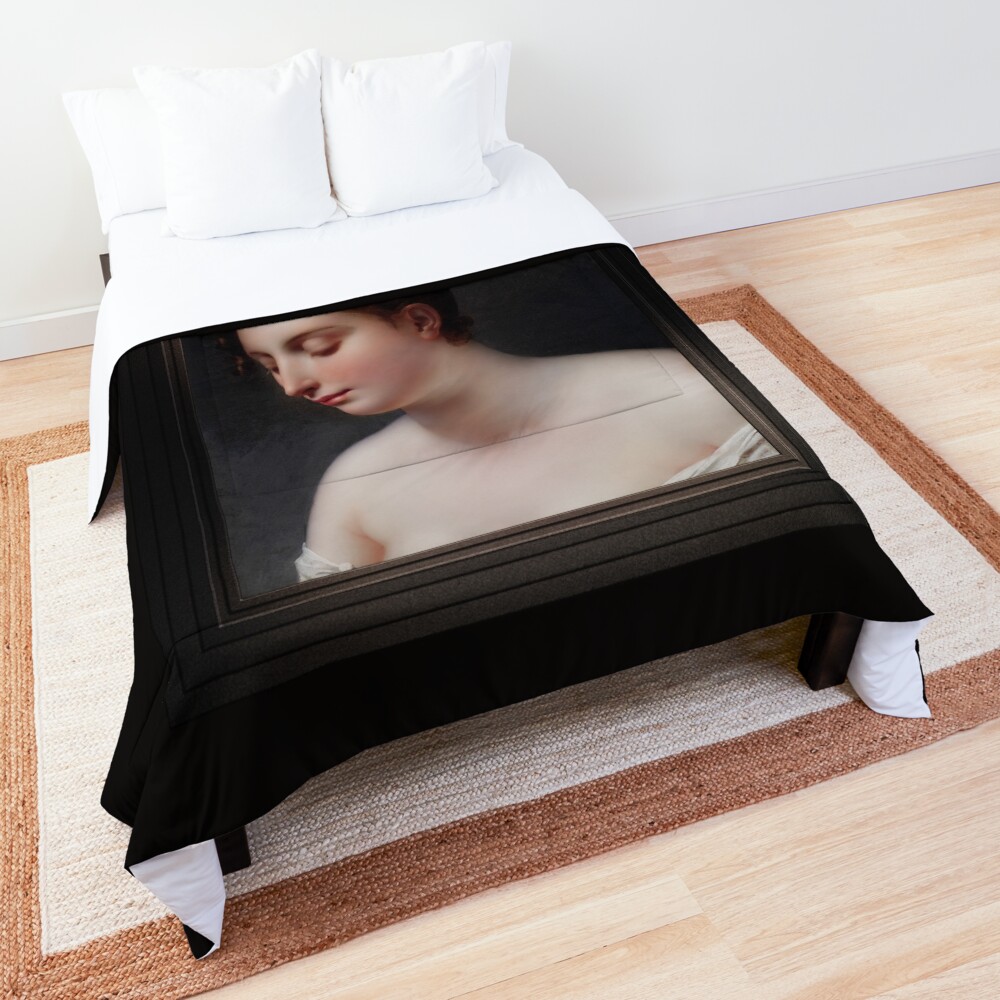
Galatea, creat pel pintor francès Anne Louis Girodet-Trioson (1767 – 1824), que va ser alumne de Jacques-Louis David; is an exemplary painting from the Neoclassical period, showcasing the artist’s mastery in capturing both the grace and intensity of mythological subjects. La peça, painted in the late 18th century, offers a powerful and nuanced representation of the Greek mythological figure Galatea, known for her beauty. This work is an exploration of divine femininity and the tension between myth and emotion. The mood conveyed is one of serene grace, tinged with a subtle melancholy that reflects the complex nature of Galatea’s mythological existence.
He show her in the same form and position as he did in the full dramatic piece Pygmalion et Galatee that he did in 1819, with her head slanted toward the ground and her eyes just beginning to open; with her wearing an off shoulder white dress.
Taula de continguts
El subjecte: Galatea
At the heart of the composition is the figure of Galatea, depicted as an ethereal beauty draped in soft, flowing fabrics that cascade around her form. She is shown in a moment of contemplation, her head slightly tilted and eyes cast downward, as though lost in thought or rapture. This pose is characteristic of the romantic and classical sensibilities of the time, allowing the artist to express both Galatea’s divine beauty and her inner turmoil. La seva cara, delicate and serene, is softly illuminated, capturing her timeless youth and otherworldly allure.
La seva pell, rendered with exquisite delicacy, glows with a soft porcelain-like quality, un segell distintiu de l'atenció al detall de Girodet. La corba elegant del seu coll i la suavitat de la seva forma transmeten una sensació de vulnerabilitat i puresa, emfatitzant el contrast entre la seva naturalesa celestial i la profunditat emocional que suggereix la seva mirada. La cortina fluïda al seu voltant, pàl·lid i gairebé translúcid, afegeix la sensació etèria de la peça, suggereix que Galatea està atrapada entre els regnes de la terra i els cels.
La configuració i el fons
L'escenari del quadre és un paisatge clàssic, evocant el món natural romàntic típic del període neoclàssic. Darrere de Galatea, veiem indicis d'una escena costanera amb onades suaus que simbolitzen la seva connexió amb el mar. Els blaus i verds apagats del fons contrasten amb els tons càlids de la seva pell, creating a visual harmony between the figure and the environment. Això suau, distant backdrop enhances the sense of isolation and calm, making Galatea appear as if she is floating in a dreamlike realm, detached from the concerns of the earthly world.
The painter’s use of light, particularly in the way it illuminates her face and shoulders, adds a divine quality to her figure, implying that she exists within a world of her own, untouched by earthly woes.
Estil i tècnica
Girodet-Trioson’s painting style blends the classical with the romantic, employing techniques that emphasize idealized beauty, soft textures, and harmonious color palettes. The softness of the brushwork in the portrayal of Galatea’s skin and hair contrasts with the more defined strokes in the background, creant una sensació de profunditat i dimensionalitat. The contrast between light and shadow is skillfully executed, especially on Galatea’s delicate form, which appears to glow against the darker, more subdued tones of the background. This contrast enhances the divine, almost supernatural quality of her character.
The painter’s technique of rendering skin tones is especially notable for its smoothness and luminosity. The use of subtle glazes gives her skin an almost translucent appearance, drawing attention to her vulnerability and femininity. This technique is indicative of Girodet’s meticulous attention to detail and his ability to render the human form in a way that feels both realistic and idealized.
The drapery around her, with its fine folds and soft texture, highlights the artist’s ability to depict materiality. The fabric flows elegantly, almost as if it were a natural extension of Galatea’s form, further emphasizing her connection to the world of the gods.
L'estat d'ànim i els temes
The mood of the painting is one of tranquility tinged with melancholy. There is an ethereal stillness to Galatea, as if she is suspended in time, reflecting on her own beauty or perhaps on the complex emotional landscape of her mythological tale. The softness of her expression, combined with her detached pose, suggests that she is both physically present and yet emotionally distant, caught between her divine nature and the emotional pull of her myth.
The theme of beauty and transformation is central to the work, as it explores the idea of divine femininity as both a gift and a burden. La bellesa de Galatea no només és la seva característica més definitòria, sinó també la font de les seves lluites emocionals i mítiques.. La seva expressió contemplativa deixa entreveure un món interior que sovint no s'associa amb figures mitològiques, que solen ser retratats com poderosos i triomfants. La interpretació de Girodet-Trioson de Galatea suggereix aquesta bellesa, mentre divina, també pot ser aïllant i ple de pena.
Conclusió
Galatea per Anne Louis Girodet-Trioson (1767 – 1824) és un exemple impressionant de l'art neoclàssic, combinant la narració mitològica amb una profunda ressonància emocional. La tècnica excepcional de l'artista, la delicada representació de la figura, i la interacció subtil entre la llum i l'ombra creen una pintura que és alhora captivadora visualment i rica temàticament. A través de la seva representació de Galatea, Girodet-Trioson convida l'espectador a considerar no només la bellesa del tema sinó també la complexitat emocional que hi ha sota aquesta bellesa., fent d'aquesta obra una exploració atemporal de la condició mitològica i humana.
Es tracta d'una reproducció d'antics mestres d'art digital remasteritzada d'una imatge de domini públic que està disponible com a Impressió de tela en línia.