

Gentlemen Prefer Blondes c1948
“Herrat mieluummin blondit,” luotu vuonna 1948 by the renowned American illustrator Earle Kulp Bergey (1901 – 1952), captures the allure of mid-century American pop culture and the golden age of Hollywood glamour. Bergey, known for his sultry and evocative depictions of women, channels the spirit of the era through this iconic piece, which epitomizes the classic pin-up style of the post-World War II era. The artwork features a glamorous, bold figure at its core, flanked by an array of charismatic men, embodying the spirit of both the title and the theme. The composition reflects an era of sensuality, viisaus, and lighthearted romance, characteristic of the mid-20th century.
Sisällysluettelo
Pääaihe
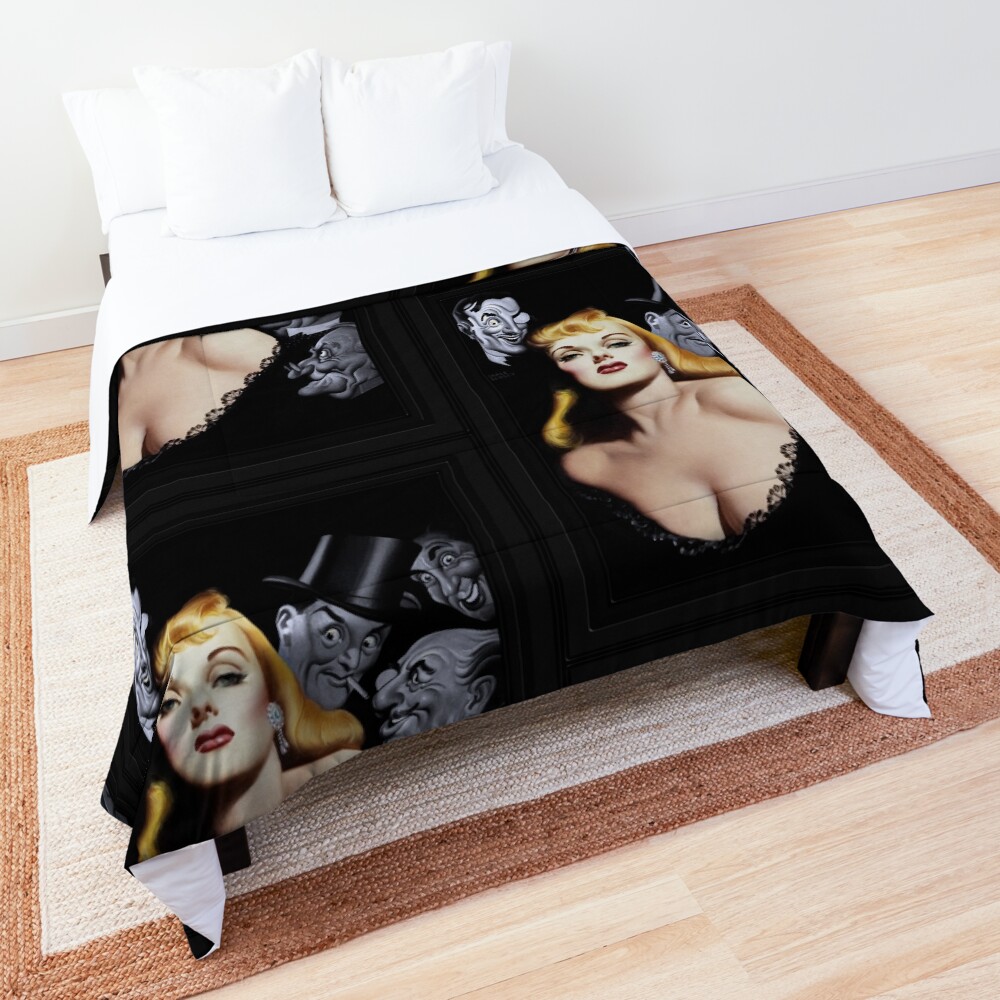
Keskeinen hahmo “Gentlemen Prefer Blondes” is a strikingly beautiful woman, her posture suggestive of confidence and allure. She gazes directly at the viewer, her full, plump lips slightly parted, giving her an air of both mystery and command. Her platinum blonde hair cascades in soft waves, its texture smooth and flowing, contributing to the feminine, hänen ulkonäönsä lähes eteerinen laatu. A pair of dangling earrings shimmer beneath her delicate ear, catching the viewer’s eye, reinforcing the notion of opulence and beauty.
Hänen pukeutumisensa, a deep black dress trimmed with lace, accentuates her curves and frames her décolletage in a way that is both elegant and provocative. The dress’s high neckline contrasts with the plunging scoop at the front, revealing her fair, porcelain-like skin. This balance between modesty and sensuality creates an enticing juxtaposition that was a hallmark of pin-up art during this period.
In stark contrast to the polished, statuesque beauty of the woman, a collection of mischievous, almost caricature-like men encircle her. Nämä luvut, with exaggerated facial expressions, evoke the playful, sometimes mischievous nature of male attention toward the female subject. Each man is drawn with exaggerated features—wide, almost cartoonish eyes, upturned lips in sly grins, and arched brows, giving them a whimsical, slightly sinister look. The men’s appearance is intentionally stylized, designed to enhance the seductive aura of the central woman while injecting an element of humor and farce.
Esineet ja symboliikka
Bergey’s use of minimal yet impactful objects within the composition serves both to elevate the central figure and to add a sense of narrative depth. The woman is adorned with sparkling diamond earrings, signifying wealth, viehätys, and status. These accessories, though small, function as symbols of desirability, further emphasizing the woman’s exalted position in society. Hänen mekkonsa, with its fine lace details, hints at the sophistication of the time, a time when women’s fashion was both a form of self-expression and a tool for empowerment.
The men surrounding the woman, though depicted with exaggerated features, seem to be captivated by her presence. They lean in toward her, each trying to attract her attention in their own exaggerated manner. Their various expressions—from the coy, almost shy smile of one to the playful, knowing grin of another—evoke the humor and complexity of romantic dynamics. This interaction between the woman and her male admirers is emblematic of the playful flirtation that often defined the post-war era’s art, reflecting a world where women were both objects of admiration and, ajoittain, the arbiters of their own fate.
Tyyli ja tekniikka
Earle Kulp Bergey’s artistic style in this piece reflects his mastery of the pin-up genre, a style known for its vibrant use of color, dramaattinen valaistus, and exaggerated forms. Bergey employs a combination of realism and stylization, creating figures that are at once recognizable yet idealized. The smooth contours of the woman’s face and body are rendered with soft, almost ethereal shading, contributing to the sensuality of her form. The men, kuitenkin, are depicted with more caricatured, angular features, a stark contrast that emphasizes their roles as playful bystanders to the woman’s commanding presence.
The artist’s use of deep, contrasting shadows heightens the drama of the piece. The background is dark, a subtle gradient of blacks and greys, providing the ideal backdrop to highlight the illuminated woman in the foreground. This contrast between light and dark adds depth to the painting, creating a sense of both intimacy and drama. The lighting itself is warm and soft, giving the entire composition a slightly dreamlike quality, as if the viewer is witnessing a moment suspended in time, frozen in a world of fantasy.
Teema ja mieliala
Teemana “Herrat mieluummin blondit” is unmistakably tied to the notion of beauty, charm, and the dynamics of attraction. The title itself alludes to the cultural perception of blonde women as desirable, an idea that was perpetuated by media and cinema during the time. The artwork plays with this perception, offering a playful yet biting commentary on how women, particularly those fitting the ideal of the time, were revered and sought after. The exaggerated expressions of the men around the woman reveal both their admiration and the absurdity of their pursuit, making the piece a light-hearted yet pointed commentary on the dynamics of flirtation and romantic attention.
The mood of the artwork is a blend of sensuality, humor, ja mysteeri. The central woman exudes confidence and allure, yet her expression remains somewhat distant, leaving the viewer wondering whether she is truly engaged with the men around her or merely indulging in their attention. The men, puolestaan, are caught in a state of animated anticipation, suggesting a whimsical pursuit that is unlikely to reach any serious conclusion. This playful exchange between the sexes gives the piece a feeling of both joy and whimsy, reflecting the carefree nature of the era and the idea of unattainable yet desirable beauty.
Tämä on retusoitu digitaalisen taiteen vanhojen mestareiden kopio julkisesta kuvasta.
Tämä digitaalisen taiteen luomus, Kuten kaikki taideteokset, jotka löytyvät Xzendor7-verkkosivustolta, ovat ostettavissa verkosta useissa eri materiaalimuodoissa, mukaan lukien kanvasvedokset, akryyliprintit, metalliprintit, puu tulosteita, kehystetyt printit, julisteita, ja kun valssatut kangastulosteet ovat erikokoisia 12 tuumaa 72 tuumaa riippuen todellisen taideteoksen koosta ja tilauspainatusliikkeestä, josta haluat ostaa taiteen.
Taideteoksia on saatavana myös laajassa valikoimassa miesten ja naisten vaatteita, mukeja, totes, huivit, muistikirjat ja päiväkirjat sekä monet kodin sisustustuotteet.
Tietoja Taiteilijasta
Tiedot alla Wikipedia.org
Earle K.. Bergey (elokuu 26, 1901 - Syyskuuta 30, 1952) oli amerikkalainen taiteilija ja kuvittaja, joka maalasi kansikuvia tuhansille selluloosalehdille ja pehmeäkantisille kirjoille. Yksi 1900 -luvun hedelmällisimmistä massakirjailijoista, Bergey tunnetaan siitä, että hän on luonut Gentlemen Prefer Blondes for Popular Library -lehden ikonisen kannen uransa huipulla. 1948.
Tämä merkitsee alkua Bergeyn erittäin vaikutusvaltaiselle uralle yhdysvaltalaisessa pehmeäkantisessa kuvittajana, tämä pommimaali teki Anita Loosin menestyslehden massakantisen kansikannen, Herrat mieluummin blondit (julkaistu suosittu kirjasto #221).
Earle K.. Bergeyn kansimaalaus herrasmielisille blondeille, noin 1948.
Bergey syntyi Philadelphiassa, Pennsylvaniasta A: han. Frank ja Ella Kulp Bergey. Hän opiskeli Pennsylvanian taideakatemiassa vuodesta 1921 että 1926, päättyy muodolliset akatemiaopinnot keväällä 1926. Hän meni aluksi työskentelemään Philadelphian sanomalehtien taideosastoille, mukaan lukien Public Ledger, ja hän piirsi sarjakuvan Deb Days in 1927. Uransa alkuvaiheessa, Bergey julkaisi monia kansia kustantaja Fiction Housen sellulehdille.
1930-luvun puoliväliin mennessä, Bergey teki kodin ja studion Bucksin piirikunnassa, Pennsylvania, ja hän meni naimisiin 1935.
Koko 1930 -luvun ajan, Bergey työskenteli freelancerina useissa kustantamoissa.
Hänen silmiinpistävät maalauksensa olivat pääosin kansiina monille sellulehdille, mukaan lukien romantiikka (Jännittävä rakkaus, Suosittu rakkaus, Rakasta romanseja) sekä etsivä, seikkailu, ilmailu, ja länsimaalaisia. Bergey kuvitti valtavirran julkaisuja, kuten The Saturday Evening Post, tänä aikana.
1940 -luvun aikana, Bergey jatkoi romantiikan kansien maalaamista, Urheilu, ja etsivä sellulehdet, ja hän alkoi työskennellä useiden science fiction -lehtien parissa, mukaan lukien vakiojulkaisut’ Outoja tarinoita, Hätkähdyttävät tarinat, ja kapteeni Future, ja myöhemmin Fantastic Story Magazine -lehdelle.
Bergeyn hieno taidekoulutus ja merkittävä lahja anatomian kuvaamiseen tekivät hänestä taiteilijan eri genreissä, jotka vaativat dramaattisia liikkeitä, valokuvarealistisista urheilukuvista kuuluisista urheilijoista, mukaan lukien Mickey Cochrane, Lou Gehrig, ja Jim Thorpe hänen allekirjoitukselleen Bergey Girls, joka ilmestyi risque -massoille koko masennuksen ajan ja toisen maailmansodan scifi -skenaarioissa.
Taiteilijan kuvat avaruudessa elossa olevista niukasti pukeutuneista naisista toimivat inspiraationa prinsessa Leian orjatyttöjen asussa Jedin paluu -elokuvassa., jopa sen väri ja leikkaus, ja Madonnan kartiomainen messinkirintaliivi. Bergeyn tieteiskirjallisuus kattaa, joskus kuvattu nimellä “Bim, HYVIN, Pylly,” Yleensä naista uhkasi Bug-Eyed Monster, ulkomaalainen, tai robotti, sankarillinen mies astronautti tuli hänen avukseen.
Bergey-tyttöjen käyttämät bikinit muistuttivat usein kuparista metallia, synnyttää lauseen “tyttö messinkirintaliivissä,” käytetään tämän tyyppiseen taiteeseen viitaten. Bergeyn työ on vaikuttanut television ja elokuvan visionääriin; Gene Roddenberry, esimerkiksi, tarjosi Star Trekin tuotesuunnittelijalle esimerkkejä Bergeyn futuristisista sellukansista.
Sisään 1948, Bergey siirtyi nopeasti kasvavaan paperikirjateollisuuteen yhdessä taitavien sellutaiteilijoiden kanssa, kuten Rudolph Belarski, jonka työ sekoitetaan usein Bergeyn omaan. Samalla kun hän jatkoi massan maalaamista kuolemaansa asti.