

Gentlemen Prefer Blondes c1948
“Heren geven de voorkeur aan blondines,” gemaakt in 1948 by the renowned American illustrator Earle Kulp Bergey (1901 – 1952), captures the allure of mid-century American pop culture and the golden age of Hollywood glamour. Bergey, known for his sultry and evocative depictions of women, channels the spirit of the era through this iconic piece, which epitomizes the classic pin-up style of the post-World War II era. The artwork features a glamorous, bold figure at its core, flanked by an array of charismatic men, embodying the spirit of both the title and the theme. The composition reflects an era of sensuality, verstand, and lighthearted romance, characteristic of the mid-20th century.
Inhoudsopgave
Het belangrijkste onderwerp
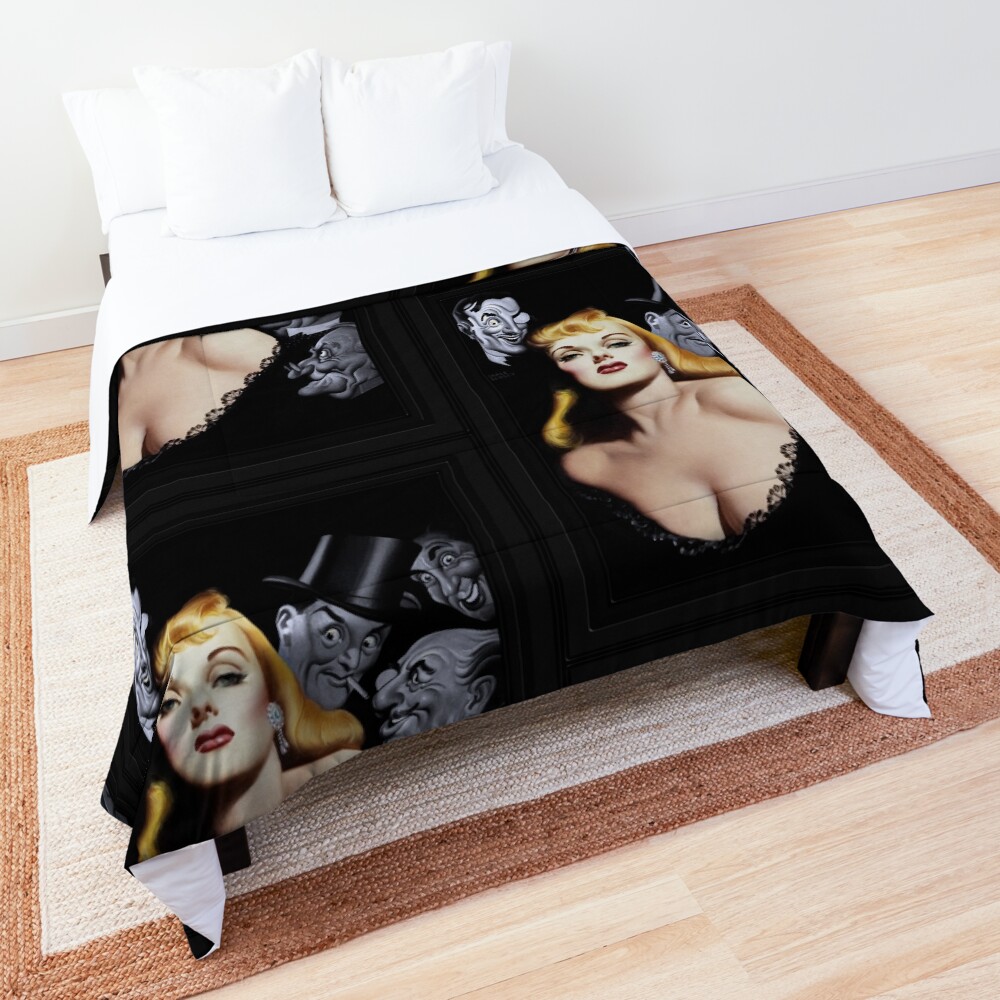
De centrale figuur binnen “Gentlemen Prefer Blondes” is a strikingly beautiful woman, her posture suggestive of confidence and allure. Ze kijkt de kijker rechtstreeks aan, her full, plump lips slightly parted, giving her an air of both mystery and command. Her platinum blonde hair cascades in soft waves, its texture smooth and flowing, contributing to the feminine, almost ethereal quality of her appearance. A pair of dangling earrings shimmer beneath her delicate ear, catching the viewer’s eye, reinforcing the notion of opulence and beauty.
Haar kleding, a deep black dress trimmed with lace, accentuates her curves and frames her décolletage in a way that is both elegant and provocative. The dress’s high neckline contrasts with the plunging scoop at the front, revealing her fair, porcelain-like skin. This balance between modesty and sensuality creates an enticing juxtaposition that was a hallmark of pin-up art during this period.
In stark contrast to the polished, statuesque beauty of the woman, a collection of mischievous, almost caricature-like men encircle her. Deze figuren, with exaggerated facial expressions, evoke the playful, sometimes mischievous nature of male attention toward the female subject. Each man is drawn with exaggerated features—wide, almost cartoonish eyes, upturned lips in sly grins, and arched brows, giving them a whimsical, slightly sinister look. The men’s appearance is intentionally stylized, designed to enhance the seductive aura of the central woman while injecting an element of humor and farce.
Objecten en symboliek
Bergey’s use of minimal yet impactful objects within the composition serves both to elevate the central figure and to add a sense of narrative depth. The woman is adorned with sparkling diamond earrings, signifying wealth, verleiden, and status. These accessories, though small, function as symbols of desirability, further emphasizing the woman’s exalted position in society. Haar jurk, with its fine lace details, hints at the sophistication of the time, a time when women’s fashion was both a form of self-expression and a tool for empowerment.
The men surrounding the woman, though depicted with exaggerated features, seem to be captivated by her presence. They lean in toward her, each trying to attract her attention in their own exaggerated manner. Their various expressions—from the coy, almost shy smile of one to the playful, knowing grin of another—evoke the humor and complexity of romantic dynamics. This interaction between the woman and her male admirers is emblematic of the playful flirtation that often defined the post-war era’s art, reflecting a world where women were both objects of admiration and, soms, the arbiters of their own fate.
Stijl en techniek
Earle Kulp Bergey’s artistic style in this piece reflects his mastery of the pin-up genre, a style known for its vibrant use of color, dramatische verlichting, and exaggerated forms. Bergey employs a combination of realism and stylization, creating figures that are at once recognizable yet idealized. The smooth contours of the woman’s face and body are rendered with soft, almost ethereal shading, contributing to the sensuality of her form. The men, echter, are depicted with more caricatured, angular features, a stark contrast that emphasizes their roles as playful bystanders to the woman’s commanding presence.
The artist’s use of deep, contrasting shadows heightens the drama of the piece. The background is dark, a subtle gradient of blacks and greys, providing the ideal backdrop to highlight the illuminated woman in the foreground. This contrast between light and dark adds depth to the painting, creating a sense of both intimacy and drama. The lighting itself is warm and soft, giving the entire composition a slightly dreamlike quality, as if the viewer is witnessing a moment suspended in time, frozen in a world of fantasy.
Thema en stemming
Het thema van “Heren geven de voorkeur aan blondines” is unmistakably tied to the notion of beauty, charme, and the dynamics of attraction. The title itself alludes to the cultural perception of blonde women as desirable, an idea that was perpetuated by media and cinema during the time. The artwork plays with this perception, offering a playful yet biting commentary on how women, particularly those fitting the ideal of the time, were revered and sought after. The exaggerated expressions of the men around the woman reveal both their admiration and the absurdity of their pursuit, making the piece a light-hearted yet pointed commentary on the dynamics of flirtation and romantic attention.
The mood of the artwork is a blend of sensuality, humor, and mystery. The central woman exudes confidence and allure, yet her expression remains somewhat distant, leaving the viewer wondering whether she is truly engaged with the men around her or merely indulging in their attention. The men, in turn, are caught in a state of animated anticipation, suggesting a whimsical pursuit that is unlikely to reach any serious conclusion. This playful exchange between the sexes gives the piece a feeling of both joy and whimsy, reflecting the carefree nature of the era and the idea of unattainable yet desirable beauty.
Dit is een retoucheerde digitale reproductie van kunst oude meesters van een openbaar domeinafbeelding.
Deze digitale kunstcreatie, zoals bij alle kunstwerken die op de Xzendor7-website te vinden zijn, is deze online te koop in verschillende materiaalformaten, waaronder canvasafdrukken, acryl afdrukken, metalen prints, hout prints, ingelijste afdrukken, affiches, en zoals opgerolde canvasafdrukken in verschillende maten uit 12 inch tot 72 inch, afhankelijk van de grootte van het daadwerkelijke kunstwerk en de print on demand-winkel waar je de kunst wilt kopen.
Het artwork is ook beschikbaar op een breed scala aan heren- en dameskleding, mokken, bakken, sjaals, notitieboekjes en tijdschriften en veel woondecoratieproducten.
Over de kunstenaar
Info hieronder van Wikipedia.org
Earle K. Bergey (augustus 26, 1901 - September 30, 1952) was een Amerikaanse kunstenaar en illustrator die omslagen schilderde voor duizenden pulp fiction tijdschriften en paperbacks. Een van de meest productieve pulpfictionkunstenaars van de 20e eeuw, Bergey staat bekend om het creëren van de iconische cover van Gentlemen Prefer Blondes for Popular Library op het hoogtepunt van zijn carrière in 1948.
Het begin van Bergey's zeer invloedrijke serie als Amerikaanse paperback-illustrator, dit bombshell-schilderij maakte de massale paperback-omslag van de kaskraker van Anita Loos, Heren geven de voorkeur aan blondines (gepubliceerd als populaire bibliotheek #221).
Earle K. Bergey's omslagschildering voor Gentlemen Prefer Blondes, ongeveer 1948.
Bergey werd geboren in Philadelphia, Pennsylvania naar A. Frank en Ella Kulp Bergey. Hij ging naar de Pennsylvania Academy of the Fine Arts van 1921 naar 1926, het afronden van formele Academiestudies in het voorjaar van 1926. Hij ging aanvankelijk werken op de kunstafdelingen van kranten in Philadelphia, waaronder Public Ledger, en hij tekende de strip Deb Days in 1927. Vroeg in zijn carrière, Bergey heeft veel covers bijgedragen aan de pulpmagazines van uitgeverij Fiction House.
Tegen het midden van de jaren dertig, Bergey maakte een huis en studio in Bucks County, Pennsylvania, en hij trouwde in 1935.
Gedurende de jaren '30, Bergey werkte freelance voor een aantal uitgeverijen.
Zijn in het oog springende schilderijen waren voornamelijk te zien als omslagen op een breed scala aan pulptijdschriften, inclusief romantiek (Opwindende liefde, populaire liefde, Liefdesromans) evenals detective, avontuur, luchtvaart, en westerns. Bergey illustreerde reguliere publicaties, zoals The Saturday Evening Post, gedurende deze periode.
Tijdens de jaren 1940, Bergey bleef covers schilderen voor romantiek, sport-, en detectivepulptijdschriften, en hij begon te werken aan een aantal sciencefictiontijdschriften, inclusief standaard publicaties’ Vreemde verhalen, Verrassende verhalen, en Kapitein Future, en later voor Fantastic Story Magazine.
Bergey's kunstopleiding en opvallende gave voor het weergeven van anatomie maakten hem tot een go-to-artiest in een verscheidenheid aan genres waarvoor scènes met dramatische beweging nodig waren, van fotorealistische sportportretten van beroemde atleten, waaronder Mickey Cochrane, Lou Gehrig, en Jim Thorpe tot zijn kenmerkende Bergey Girls die tijdens de Depressie en in sciencefictionscenario's uit de Tweede Wereldoorlog op riskante pulp verscheen.
De illustraties van de kunstenaar van schaars geklede vrouwen die in de ruimte overleven, dienden als inspiratie voor prinses Leia's slavenmeisje-outfit in Return of the Jedi, zelfs de kleur en snit, en Madonna's conische koperen bustehouder. De sciencefictioncovers van Bergey, soms beschreven als: “Bim, GOED, Zitvlak,” meestal een vrouw die werd bedreigd door een Bug-Eyed Monster, buitenaards wezen, of robot, met een heldhaftige mannelijke astronaut die haar te hulp komt.
Bikinitopjes gedragen door Bergey-meisjes leken vaak op koperachtig metaal, aanleiding geven tot de uitdrukking “het meisje in de koperen bh,” gebruikt met betrekking tot dit soort kunst. Visionairs in tv en film zijn beïnvloed door het werk van Bergey; Gene Roddenberry, bijvoorbeeld, voorzag zijn productieontwerper voor Star Trek van voorbeelden van Bergey's futuristische pulphoezen.
In 1948, Bergey maakte de overstap naar de snelgroeiende paperback-boekenindustrie samen met bekwame pulpartiesten zoals Rudolph Belarski, wiens werk vaak wordt verward met dat van Bergey. Terwijl hij doorging met het schilderen van pulpomslagen tot aan zijn dood.