

Gentlemen Prefer Blondes c1948
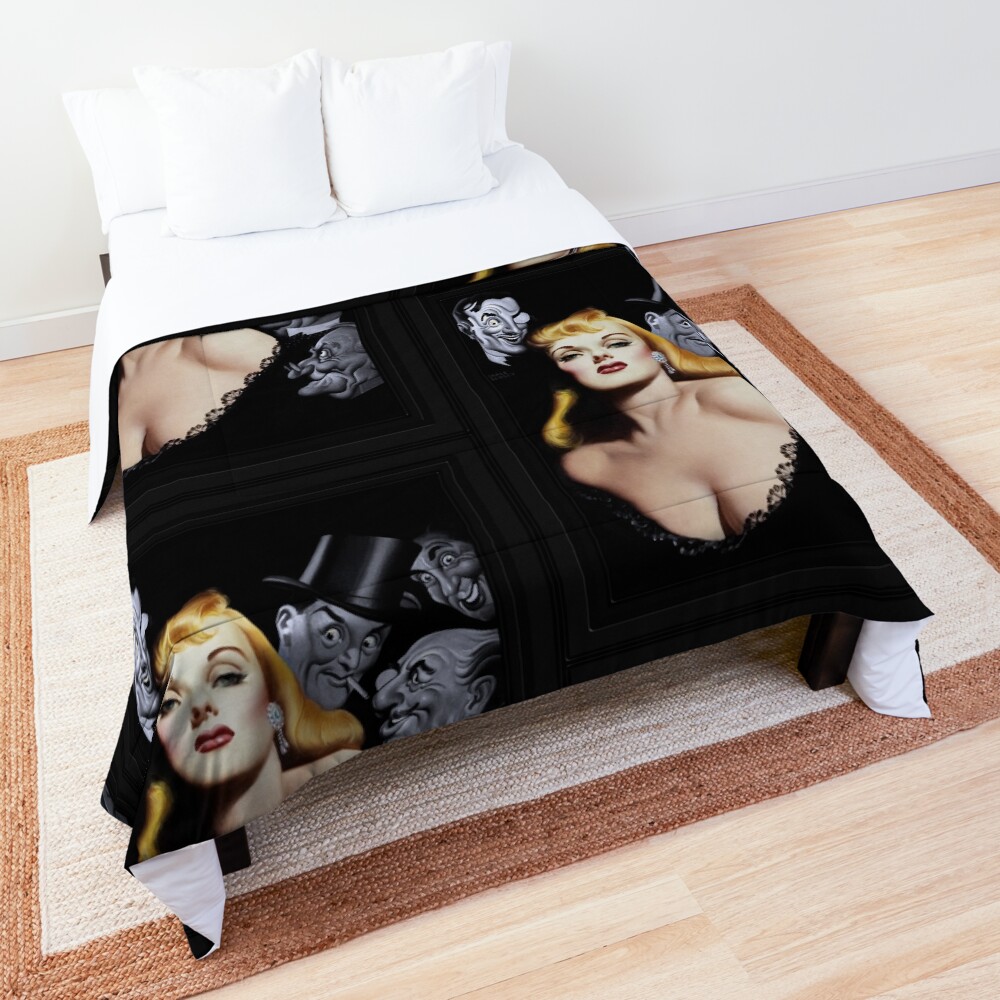
“Gentlemen Prefer Blondes,” criado em 1948 by the renowned American illustrator Earle Kulp Bergey (1901 – 1952), captures the allure of mid-century American pop culture and the golden age of Hollywood glamour. Bergey, known for his sultry and evocative depictions of women, channels the spirit of the era through this iconic piece, which epitomizes the classic pin-up style of the post-World War II era. The artwork features a glamorous, bold figure at its core, flanked by an array of charismatic men, embodying the spirit of both the title and the theme. The composition reflects an era of sensuality, sagacidade, and lighthearted romance, characteristic of the mid-20th century.
Índice
O assunto principal
A figura central em “Senhores preferem Blondes” is a strikingly beautiful woman, her posture suggestive of confidence and allure. She gazes directly at the viewer, her full, plump lips slightly parted, giving her an air of both mystery and command. Her platinum blonde hair cascades in soft waves, its texture smooth and flowing, contributing to the feminine, almost ethereal quality of her appearance. A pair of dangling earrings shimmer beneath her delicate ear, chamando a atenção do espectador, reinforcing the notion of opulence and beauty.
Seu traje, a deep black dress trimmed with lace, accentuates her curves and frames her décolletage in a way that is both elegant and provocative. The dress’s high neckline contrasts with the plunging scoop at the front, revealing her fair, porcelain-like skin. This balance between modesty and sensuality creates an enticing juxtaposition that was a hallmark of pin-up art during this period.
In stark contrast to the polished, statuesque beauty of the woman, a collection of mischievous, almost caricature-like men encircle her. These figures, with exaggerated facial expressions, evoke the playful, sometimes mischievous nature of male attention toward the female subject. Each man is drawn with exaggerated features—wide, almost cartoonish eyes, upturned lips in sly grins, and arched brows, giving them a whimsical, slightly sinister look. The men’s appearance is intentionally stylized, designed to enhance the seductive aura of the central woman while injecting an element of humor and farce.
Objetos e Simbolismo
Bergey’s use of minimal yet impactful objects within the composition serves both to elevate the central figure and to add a sense of narrative depth. The woman is adorned with sparkling diamond earrings, signifying wealth, fascinar, and status. These accessories, though small, function as symbols of desirability, further emphasizing the woman’s exalted position in society. O vestido dela, with its fine lace details, hints at the sophistication of the time, a time when women’s fashion was both a form of self-expression and a tool for empowerment.
The men surrounding the woman, though depicted with exaggerated features, seem to be captivated by her presence. They lean in toward her, each trying to attract her attention in their own exaggerated manner. Their various expressions—from the coy, almost shy smile of one to the playful, knowing grin of another—evoke the humor and complexity of romantic dynamics. This interaction between the woman and her male admirers is emblematic of the playful flirtation that often defined the post-war era’s art, reflecting a world where women were both objects of admiration and, at times, the arbiters of their own fate.
Estilo e Técnica
Earle Kulp Bergey’s artistic style in this piece reflects his mastery of the pin-up genre, a style known for its vibrant use of color, iluminação dramática, and exaggerated forms. Bergey employs a combination of realism and stylization, creating figures that are at once recognizable yet idealized. The smooth contours of the woman’s face and body are rendered with soft, almost ethereal shading, contributing to the sensuality of her form. The men, no entanto, are depicted with more caricatured, angular features, a stark contrast that emphasizes their roles as playful bystanders to the woman’s commanding presence.
The artist’s use of deep, contrasting shadows heightens the drama of the piece. The background is dark, a subtle gradient of blacks and greys, providing the ideal backdrop to highlight the illuminated woman in the foreground. This contrast between light and dark adds depth to the painting, creating a sense of both intimacy and drama. The lighting itself is warm and soft, giving the entire composition a slightly dreamlike quality, as if the viewer is witnessing a moment suspended in time, frozen in a world of fantasy.
Tema e humor
The theme of “Gentlemen Prefer Blondes” is unmistakably tied to the notion of beauty, charme, and the dynamics of attraction. The title itself alludes to the cultural perception of blonde women as desirable, an idea that was perpetuated by media and cinema during the time. The artwork plays with this perception, offering a playful yet biting commentary on how women, particularly those fitting the ideal of the time, were revered and sought after. The exaggerated expressions of the men around the woman reveal both their admiration and the absurdity of their pursuit, making the piece a light-hearted yet pointed commentary on the dynamics of flirtation and romantic attention.
The mood of the artwork is a blend of sensuality, humor, e mistério. The central woman exudes confidence and allure, yet her expression remains somewhat distant, leaving the viewer wondering whether she is truly engaged with the men around her or merely indulging in their attention. The men, por sua vez, are caught in a state of animated anticipation, suggesting a whimsical pursuit that is unlikely to reach any serious conclusion. This playful exchange between the sexes gives the piece a feeling of both joy and whimsy, reflecting the carefree nature of the era and the idea of unattainable yet desirable beauty.
Esta é uma reprodução retocada de arte digital de antigos mestres de uma imagem de domínio público.
Esta criação de arte digital, assim como todas as obras de arte que podem ser encontradas no site do Xzendor7 estão disponíveis para compra on-line em uma variedade de formatos de materiais, incluindo impressões em tela, impressões acrílicas, impressões metálicas, gravuras em madeira, impressões emolduradas, cartazes, e como impressões em tela enrolada em vários tamanhos, desde 12 polegadas para 72 polegadas, dependendo do tamanho da obra de arte real e da loja de impressão sob demanda em que você escolher comprar a arte.
A arte também está disponível em uma ampla variedade de roupas masculinas e femininas, canecas, bolsas, lenços, cadernos e diários e muitos produtos de decoração para casa.
Sobre o Artista
Informações abaixo de Wikipédia.org
Earle K. Bergey (August 26, 1901 – September 30, 1952) was an American artist and illustrator who painted cover art for thousands of pulp fiction magazines and paperback books. One of the most prolific pulp fiction artists of the 20th century, Bergey is recognized for creating the iconic cover of Gentlemen Prefer Blondes for Popular Library at the height of his career in 1948.
Marking the start of Bergey’s highly influential run as an American paperback illustrator, this bombshell painting made the mass paperback cover of Anita Loos’s blockbuster, Gentlemen Prefer Blondes (published as Popular Library #221).
Earle K. Bergey’s cover painting for Gentlemen Prefer Blondes, circa 1948.
Bergey was born in Philadelphia, Pennsylvania to A. Frank and Ella Kulp Bergey. He attended Pennsylvania Academy of the Fine Arts from 1921 para 1926, finishing formal Academy studies in the spring of 1926. He initially went to work in the art departments of Philadelphia newspapers including Public Ledger, and he drew the comic strip Deb Days in 1927. Early in his career, Bergey contributed many covers to the pulp magazines of publisher Fiction House.
By the mid-1930s, Bergey made a home and studio in Bucks County, Pennsylvania, and he married in 1935.
Throughout the 1930s, Bergey worked freelance for a number of publishing houses.
His eye-catching paintings were predominantly featured as covers on a wide array of pulp magazines, including romance (Thrilling Love, Popular Love, Love Romances) as well as detective, adventure, aviation, and Westerns. Bergey illustrated mainstream publications, such as The Saturday Evening Post, during this time.
During the 1940s, Bergey continued to paint covers for romance, esportes, and detective pulp magazines, and he began working on a number of science fiction magazines, including Standard Publications’ Strange Stories, Startling Stories, and Captain Future, and later for Fantastic Story Magazine.
Bergey’s fine art training and salient gift for depicting anatomy made him a go-to artist across a diversity of genres that required scenes with dramatic movement, from photo-realistic sports portraits of famous athletes including Mickey Cochrane, Lou Gehrig, and Jim Thorpe to his signature Bergey Girls that appeared on risque pulps throughout the Depression and in science fiction scenarios from World War II.
The artist’s illustrations of scantily-clad women surviving in outer space served as an inspiration for Princess Leia’s slave-girl outfit in Return of the Jedi, even its color and cut, and Madonna’s conical brass brassiere. Bergey’s science fiction covers, sometimes described as “Bim, BEM, Bum,” usually featured a woman being menaced by a Bug-Eyed Monster, alien, or robot, with an heroic male astronaut coming to her assistance.
Bikini-tops worn by Bergey girls often resembled coppery metal, giving rise to the phrase “the girl in the brass bra,” used in reference to this sort of art. Visionaries in TV and film have been influenced by Bergey’s work; Gene Roddenberry, por exemplo, provided his production designer for Star Trek with examples of Bergey’s futuristic pulp covers.
Em 1948, Bergey made the transition to the rapidly expanding paperback book industry along with skilled pulp artists like Rudolph Belarski, whose work is often confused with Bergey’s. While continuing to paint pulp covers until his death.