

Gentlemen Prefer Blondes c1948
“Джентльмены предпочитают блондинок,” создано в 1948 by the renowned American illustrator Earle Kulp Bergey (1901 – 1952), captures the allure of mid-century American pop culture and the golden age of Hollywood glamour. Bergey, known for his sultry and evocative depictions of women, channels the spirit of the era through this iconic piece, which epitomizes the classic pin-up style of the post-World War II era. Работа отличается гламурным, bold figure at its core, flanked by an array of charismatic men, embodying the spirit of both the title and the theme. The composition reflects an era of sensuality, остроумие, and lighthearted romance, characteristic of the mid-20th century.
Оглавление
Основная тема
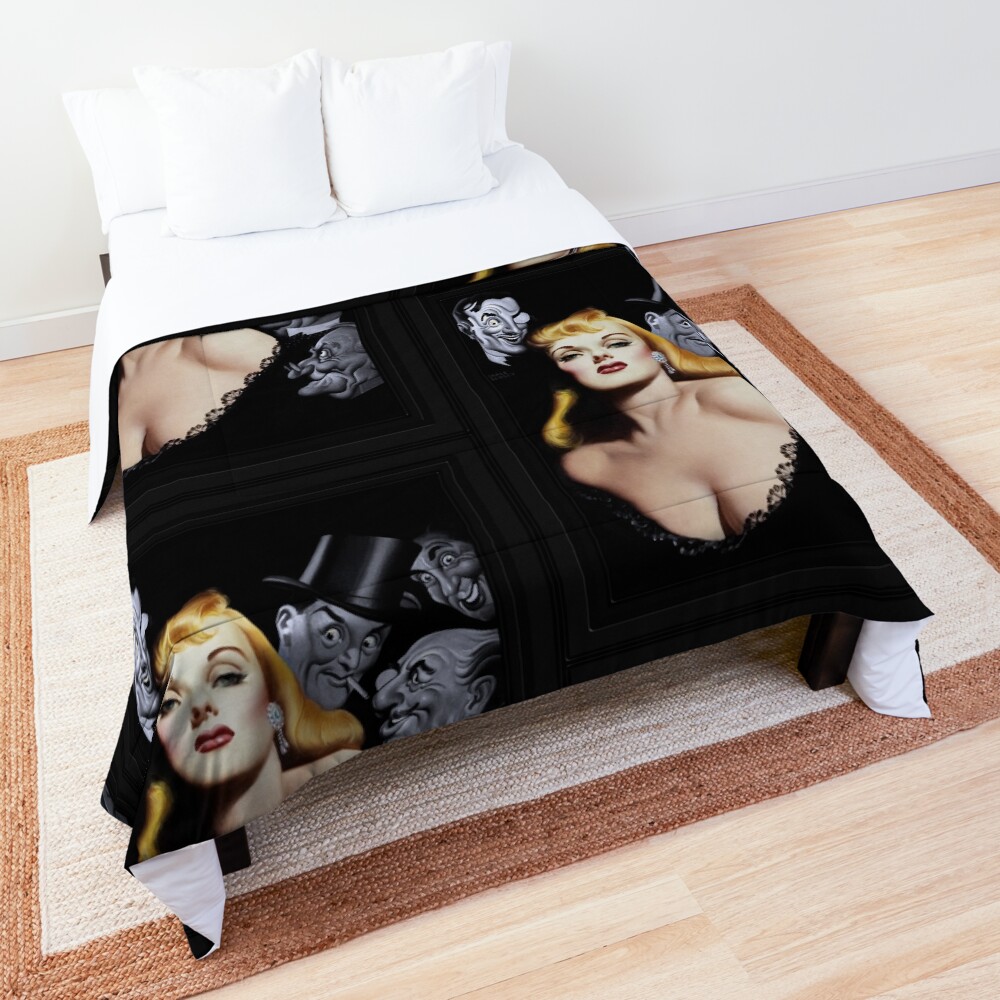
Центральная фигура в “Выбор между красивой брюнеткой или блондинкой Blondes” is a strikingly beautiful woman, her posture suggestive of confidence and allure. She gazes directly at the viewer, her full, plump lips slightly parted, giving her an air of both mystery and command. Her platinum blonde hair cascades in soft waves, its texture smooth and flowing, contributing to the feminine, almost ethereal quality of her appearance. A pair of dangling earrings shimmer beneath her delicate ear, catching the viewer’s eye, reinforcing the notion of opulence and beauty.
Ее наряд, a deep black dress trimmed with lace, accentuates her curves and frames her décolletage in a way that is both elegant and provocative. The dress’s high neckline contrasts with the plunging scoop at the front, revealing her fair, porcelain-like skin. This balance between modesty and sensuality creates an enticing juxtaposition that was a hallmark of pin-up art during this period.
In stark contrast to the polished, statuesque beauty of the woman, a collection of mischievous, almost caricature-like men encircle her. Эти цифры, with exaggerated facial expressions, evoke the playful, sometimes mischievous nature of male attention toward the female subject. Each man is drawn with exaggerated features—wide, almost cartoonish eyes, upturned lips in sly grins, and arched brows, giving them a whimsical, slightly sinister look. The men’s appearance is intentionally stylized, designed to enhance the seductive aura of the central woman while injecting an element of humor and farce.
Объекты и символизм
Bergey’s use of minimal yet impactful objects within the composition serves both to elevate the central figure and to add a sense of narrative depth. The woman is adorned with sparkling diamond earrings, signifying wealth, очарование, and status. These accessories, хоть и маленький, function as symbols of desirability, further emphasizing the woman’s exalted position in society. Ее платье, with its fine lace details, hints at the sophistication of the time, a time when women’s fashion was both a form of self-expression and a tool for empowerment.
The men surrounding the woman, though depicted with exaggerated features, seem to be captivated by her presence. They lean in toward her, each trying to attract her attention in their own exaggerated manner. Their various expressions—from the coy, almost shy smile of one to the playful, knowing grin of another—evoke the humor and complexity of romantic dynamics. This interaction between the woman and her male admirers is emblematic of the playful flirtation that often defined the post-war era’s art, reflecting a world where women were both objects of admiration and, at times, the arbiters of their own fate.
Стиль и техника
Earle Kulp Bergey’s artistic style in this piece reflects his mastery of the pin-up genre, a style known for its vibrant use of color, драматическое освещение, and exaggerated forms. Bergey employs a combination of realism and stylization, creating figures that are at once recognizable yet idealized. The smooth contours of the woman’s face and body are rendered with soft, almost ethereal shading, contributing to the sensuality of her form. The men, тем не мение, are depicted with more caricatured, angular features, a stark contrast that emphasizes their roles as playful bystanders to the woman’s commanding presence.
The artist’s use of deep, contrasting shadows heightens the drama of the piece. The background is dark, a subtle gradient of blacks and greys, providing the ideal backdrop to highlight the illuminated woman in the foreground. This contrast between light and dark adds depth to the painting, creating a sense of both intimacy and drama. The lighting itself is warm and soft, giving the entire composition a slightly dreamlike quality, as if the viewer is witnessing a moment suspended in time, frozen in a world of fantasy.
Тема и настроение
Тема “Джентльмены предпочитают блондинок” is unmistakably tied to the notion of beauty, очарование, and the dynamics of attraction. The title itself alludes to the cultural perception of blonde women as desirable, an idea that was perpetuated by media and cinema during the time. The artwork plays with this perception, offering a playful yet biting commentary on how women, particularly those fitting the ideal of the time, were revered and sought after. The exaggerated expressions of the men around the woman reveal both their admiration and the absurdity of their pursuit, making the piece a light-hearted yet pointed commentary on the dynamics of flirtation and romantic attention.
The mood of the artwork is a blend of sensuality, humor, and mystery. The central woman exudes confidence and allure, yet her expression remains somewhat distant, leaving the viewer wondering whether she is truly engaged with the men around her or merely indulging in their attention. The men, по очереди, are caught in a state of animated anticipation, suggesting a whimsical pursuit that is unlikely to reach any serious conclusion. This playful exchange between the sexes gives the piece a feeling of both joy and whimsy, reflecting the carefree nature of the era and the idea of unattainable yet desirable beauty.
Это ретушированная цифровая художественная репродукция старых мастеров изображения из общественного достояния..
Это творение цифрового искусства, как и все произведения искусства, которые можно найти на веб-сайте Xzendor7, они доступны для покупки в Интернете в различных форматах материалов, включая отпечатки на холсте., акриловые принты, металлические отпечатки, гравюры на дереве, отпечатки в рамке, плакаты, и в виде рулонных отпечатков на холсте различных размеров от 12 дюймов до 72 дюймов в зависимости от размера фактического произведения искусства и магазина печати по запросу, в котором вы решили купить произведение искусства..
Эти изображения также доступны на широком ассортименте мужской и женской одежды., кружки, сумки, шарфы, блокноты и журналы, а также многие товары для домашнего декора..
О художнике
Информация ниже от Wikipedia.org
Эрл К.. Bergey (август 26, 1901 - Сентябрь 30, 1952) был американским художником и иллюстратором, который рисовал обложки для тысяч журналов криминальной фантастики и книг в мягкой обложке.. Один из самых плодовитых художников криминального чтива ХХ века., Берджи получил признание за создание культовой обложки книги «Джентльмены предпочитают блондинок для популярной библиотеки» на пике своей карьеры в кино. 1948.
Начало очень влиятельной карьеры Берджи в качестве американского иллюстратора в мягкой обложке., эта картина-бомба стала массовой обложкой в мягкой обложке блокбастера Аниты Лоос., Джентльмены предпочитают блондинок (опубликовано как Popular Library #221).
Эрл К.. Картина Берджи на обложке книги "Джентльмены предпочитают блондинок", около 1948.
Берджи родился в Филадельфии., Пенсильвания в А. Фрэнк и Элла Кулп Берджи. Он учился в Пенсильванской академии изящных искусств с 1921 к 1926, заканчивая формальное обучение в Академии весной 1926. Сначала он работал в отделах искусства газет Филадельфии, включая Public Ledger., и он нарисовал комикс Deb Days in 1927. В начале своей карьеры, Берджи написал множество обложек для журналов издательства Fiction House..
К середине 1930-х гг., Берджи сделал дом и студию в округе Бакс., Пенсильвания, и он женился в 1935.
На протяжении 1930-х гг., Берджи работал внештатным сотрудником в ряде издательств..
Его привлекательные картины в основном появлялись на обложках целого ряда журналов., включая романтику (Захватывающая любовь, Популярная любовь, Любовные романсы) а также детектив, приключение, авиация, и вестерны. Бергей иллюстрировал основные публикации, например, The Saturday Evening Post, в течение этого времени.
В 1940-е годы, Берджи продолжил рисовать обложки для романтики, виды спорта, и детективные журналы, и он начал работать над рядом научно-фантастических журналов, включая стандартные публикации’ Странные истории, Поразительные истории, и капитан будущее, и позже для журнала Fantastic Story Magazine.
Изобразительное искусство Берджи и выдающийся дар изображать анатомию сделали его популярным художником в самых разных жанрах, где требовались сцены с драматическим движением., из фотореалистичных спортивных портретов известных спортсменов, в том числе Микки Кокрейна, Лу Гериг, и Джим Торп с его подписью Bergey Girls, которые появлялись на небрежной публике во время Великой депрессии и в сценариях научной фантастики времен Второй мировой войны..
Рисунки художника с изображением полураздетых женщин, выживших в открытом космосе, послужили вдохновением для наряда принцессы Леи и девушки-рабыни в "Возвращении джедая"., даже его цвет и разрез, и конический латунный бюстгальтер Мадонны. Обложки научно-фантастических произведений Берджи, иногда описывается как “Бим, ХОРОШО, Бездельничать,” обычно изображала женщину, которой угрожает Глазоглазый монстр., инопланетянин, или робот, с героическим мужчиной-космонавтом, идущим ей на помощь.
Топы от купальников, которые носили девушки из Берджи, часто напоминали медный металл., породив фразу “девушка в латунном бюстгальтере,” используется в отношении этого вида искусства. Провидцы на телевидении и в кино находились под влиянием работ Берджи.; Джин Родденберри, Например, предоставил своему художнику-постановщику «Звездного пути» примеры футуристических обложек целлюлозы Берджи..
В 1948, Берджи совершил переход к быстрорастущей книжной индустрии в мягкой обложке вместе с опытными художниками целлюлозы, такими как Рудольф Беларски., чью работу часто путают с работами Берджи. Продолжая красить целлюлозные покрытия до самой смерти.