

Girl in Yellow Drapery
John William Godward’s “Girl in Yellow Drapery,” créé dans 1901, presents a striking depiction of classical beauty, rendered with masterful detail. Vers Dieu, an artist known for his contributions to the Néoclassique style, captured the timeless grace of the ancient world in a manner that emphasizes harmony, beauté, et sérénité. Vers Dieuc'est (1861 – 1922) works often reflect his deep admiration for the art of ancient Rome and Greece, blending idealized female forms with the architectural and natural elements of the classical world. His penchant for delicate color palettes, along with his skill in creating lifelike textures, is evident in this painting.

Table des matières
Le sujet principal: A Sleeping Figure of Serenity
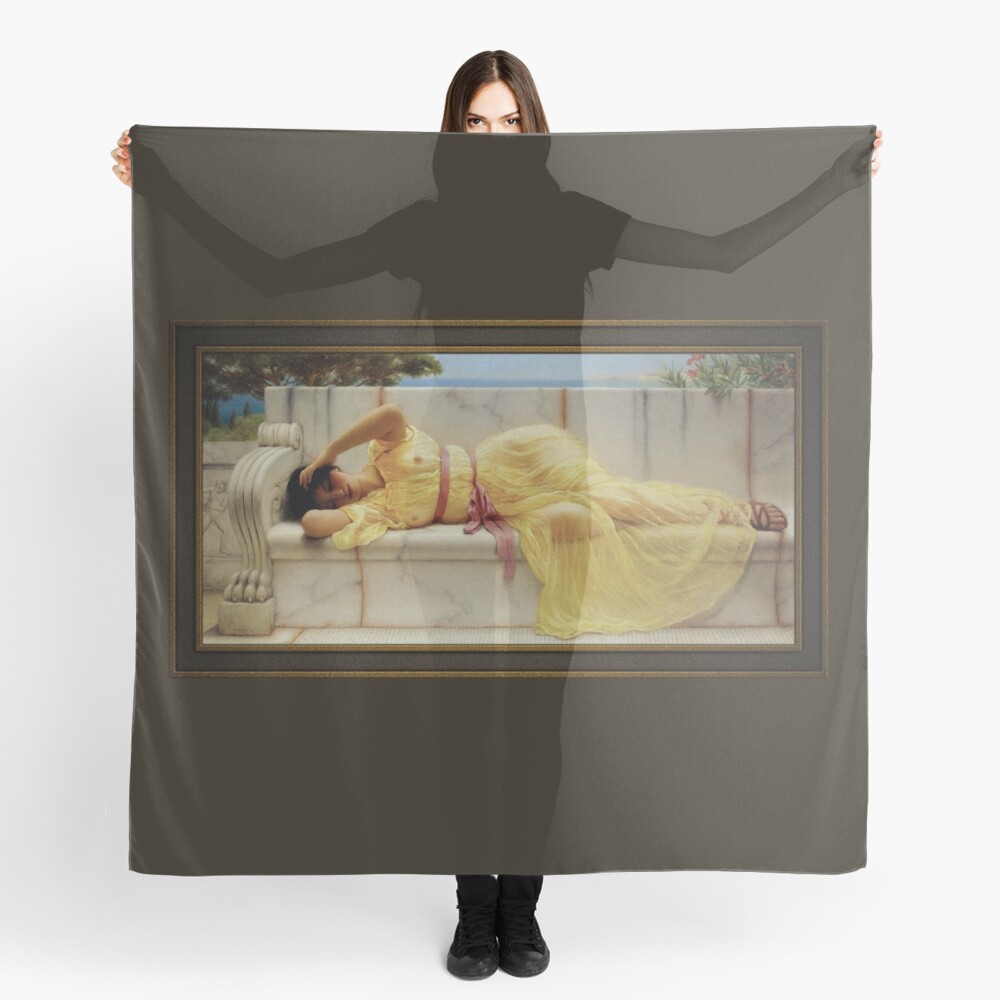
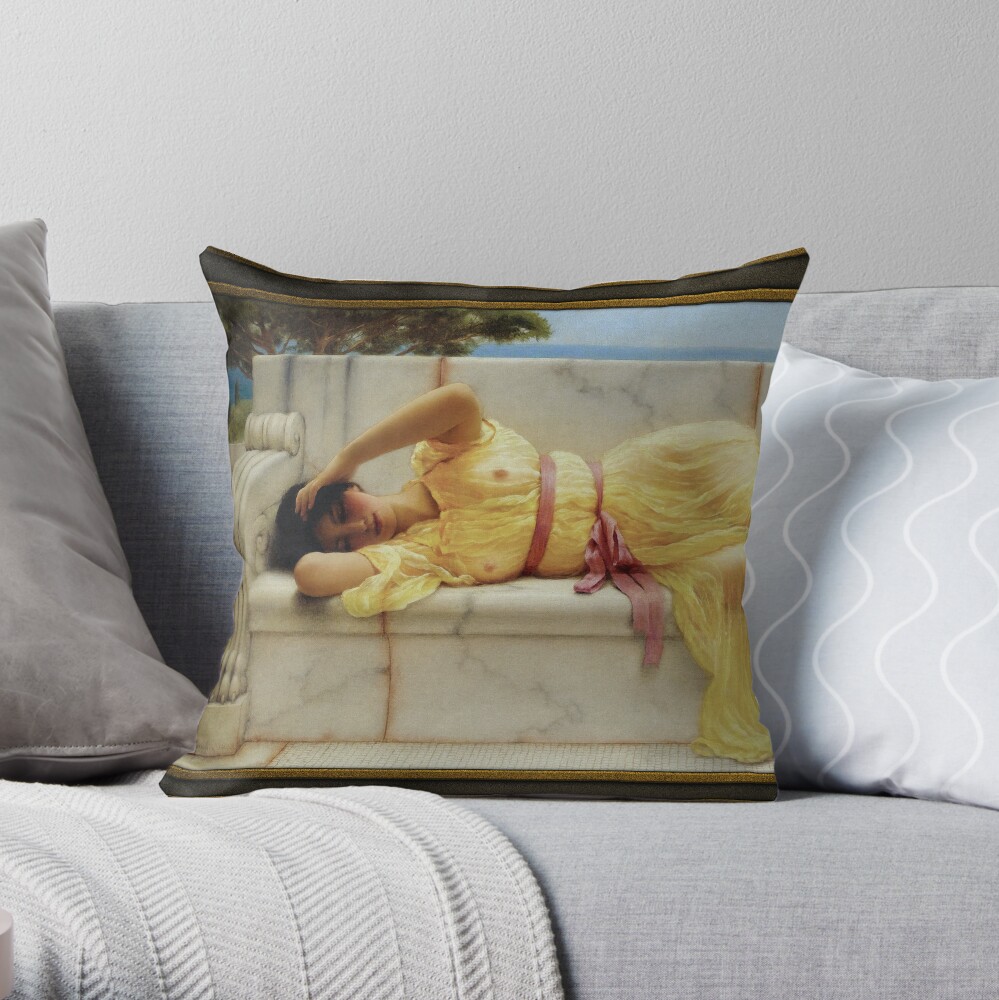
At the heart of the painting is a reclining young woman draped in a soft, écoulement yellow gown that contrasts gracefully against the serene landscape. Le girl’s pose suggests a moment of quiet rest, her head gently resting on her arm while her other hand lies across her forehead, seemingly shielding her eyes from the soft light.
Her physical form is captured with remarkable finesse, sa visage is serene and perfectly sculpted, reflecting the beauté idéalisée that was a hallmark of Godward’s work. The pale yellow gown she wears is airy, almost translucent, fluttering gently around her form as if caressed by a soft breeze. La draperie, though delicate and light in color, carries with it a sense of weight and depth, a testament to the artist’s careful study of fabric and anatomy.
L'atmosphère: Tranquil and Timeless
The mood of the painting is one of tranquility, intemporalité, et grâce. The figure appears to be in a state of deep repose, perhaps in the midst of a nap or daydream, untouched by the concerns of the outside world. Le douceur of her drapery and the gentle pose of her body evoke an air of peaceful slumber, while the absence of any overt emotion or action leaves the viewer to experience the scene as an invitation to pause and reflect. Vers Dieu, in capturing this moment, creates a serene stillness, where time seems suspended.
The Architecture: Classical Influence
Derrière la silhouette, the scene is framed by a classical stone bench that connects the subject to the world of ancient civilization. Le marbre bench, with its slightly weathered, elegant columns and scrollwork, serves as a reminder of the classical heritage that influenced much of Godward’s work. The artist’s attention to architectural detail is remarkable, with the texture of the stone clearly articulated in the subtle shadows and light reflections. Le colonnes, designed in the Corinthian style, suggest an elevated cultural and intellectual world, adding to the painting’s timeless quality.
The Natural Landscape: Calm and Expansive
En arrière-plan, the viewer can see a peaceful vista that stretches out beyond the stone bench. The landscape is bathed in soft light, hinting at a horizon where the sea meets the sky. Although the colors of the sky are muted, les expansive nature of the scene provides a sense of espace, suggesting an open, tranquil world that contrasts beautifully with the intimacy of the figure’s repose. Arbres with a variety of lush greenery add to the sense of calm, their foliage subtly suggesting the warmth of an ancient Mediterranean climate.
The Medium and Technique: Fine Detail and Texture
Godward’s technical prowess is evident in the exquisite detailing of both the figure et les éléments environnants. The softness of the woman’s yellow gown contrasts with the rigid, almost tactile quality of the marble columns and bench. The use of light and shadow on the fabric emphasizes its delicate, flowing nature while the skin of the figure appears almost lifelike in its natural tone. Godward’s technique in blending light and shadow contributes to the sense of realism and depth, imbuing the work with an almost three-dimensional quality. His meticulous rendering of the textures—whether it is the smoothness of the stone, the transparency of the fabric, or the natural sheen of the skin—demonstrates his mastery of light and texture.
Godward’s Style and Themes: Classical Beauty Revisited
Le style de “Girl in Yellow Drapery” embodies the core ideals of Néoclassicisme, a movement that sought to revive the aesthetics and ideals of ancient Greece and Rome. This style is characterized by its focus on idealized beauty, smooth forms, and an emphasis on proportion and harmony. Godward’s work is deeply infused with these principles, especially in his portrayal of the female figure, which is often idealized and posed in tranquil, relaxed settings. His subjects are frequently depicted in lush landscapes or classical architectural settings, as seen in this piece. Cette peinture, en particulier, encapsulates Godward’s fascination with female beauty and classical antiquity.
The theme of a reclining figure, often a symbol of both sensuality and repose, further emphasizes the artist’s commitment to creating a harmonious, serene world in his works. The image of the young woman in Godward’s painting is not merely of a sleeping figure; it is a vision of calm and perfection, disconnected from the worries of the world and set within a timeless environment. It’s an invitation for the viewer to step into a space where beauty and stillness reign.
Conclusion: The Enduring Legacy of Godward’s Work
John William Godward’s “Girl in Yellow Drapery” is a fine example of the artist’s dedication to the Neoclassical style, illustrating his skill in portraying idealized beauty and his deep admiration for classical art forms. Through the careful depiction of the figure, les éléments architecturaux, et le monde naturel, Godward creates a scene of serene elegance that has continued to captivate audiences long after its creation. His ability to evoke a mood of timeless peace, combined with his technical precision, ensures that this painting remains a significant work in the history of British art.
Girl in Yellow Drapery is a remastered digital art old masters reproduction of a public domain image that is available as a impression sur toile en ligne.
Cette création d'art numérique, comme toutes les œuvres d'art disponibles sur le site Web Xzendor7, elles sont disponibles à l'achat en ligne dans une variété de formats de matériaux, y compris des impressions sur toile., impressions acryliques, impressions métalliques, gravures sur bois, impressions encadrées, affiches, et sous forme d'impressions sur toile roulées dans une variété de tailles de 12 pouces à 72 pouces en fonction de la taille de l'œuvre d'art réelle et de la boutique d'impression à la demande auprès de laquelle vous choisissez d'acheter l'art.
L’œuvre d’art est également disponible sur une large gamme de vêtements pour hommes et femmes., tasses, fourre-tout, écharpes, cahiers et journaux et de nombreux produits de décoration intérieure.
Biographie de l'artiste
Info ci-dessous de Wikipedia.org
John William Godward était l'aîné de cinq enfants, et a été nommé d'après son père John et son grand-père William.
Il expose à la Royal Academy de 1887. Lorsqu'il a déménagé en Italie avec l'un de ses modèles en 1912, sa famille a rompu tout contact avec lui et a même coupé son image des photos de famille. Godward retourna en Angleterre en 1921, mort en 1922, et est enterré au cimetière de Brompton, Londres Ouest.
L'un de ses tableaux les plus connus est Dolce far Niente (1904), qui a été acheté pour la collection d'Andrew Lloyd Webber en 1995. Comme dans le cas de plusieurs autres peintures, Godward a peint plus d'une version; dans ce cas, un plus tôt (et moins connu) 1897 version avec un autre 1906 version.
Il s'est suicidé à l'âge de 61 et aurait écrit dans sa note de suicide que “le monde n'est pas assez grand pour [tous les deux] moi et un Picasso”.
Sa famille éloignée, qui avait désapprouvé qu'il devienne artiste, eu honte de son suicide et brûlé ses papiers. Une seule photographie de Godward est connue pour survivre.
Godward était un néo-classique victorien, et donc, en théorie, un disciple de Frederic Leighton. pourtant, il est plus étroitement lié stylistiquement à Sir Lawrence Alma-Tadema, avec qui il partageait un penchant pour le rendu de l'architecture classique - en particulier, éléments paysagers statiques construits en marbre.
La grande majorité des images existantes de Godward présentent des femmes en tenue classique posées contre des éléments du paysage; bien qu'il y ait des figures semi-nues et entièrement nues incluses dans son œuvre, un exemple notable étant “Dans le Tepidarium c1913”.
Un titre partagé avec une peinture controversée d'Alma-Tadema du même sujet qui réside dans le “Galerie d'art Lady Lever”. Les titres reflètent la source d'inspiration de Godward; qui était la civilisation classique, notamment celui de la Rome antique; un sujet liant Godward étroitement à Alma-Tadema artistiquement.
Étant donné que l'érudition classique était plus répandue parmi le public potentiel pour ses peintures de son vivant qu'aujourd'hui, une recherche méticuleuse des détails était importante pour atteindre une position d'artiste dans ce genre.
Alma-Tadema était archéologue et peintre, qui a visité des sites historiques et collecté des objets qu'il a ensuite utilisés dans ses peintures: Vers Dieu, trop, étudié des détails tels que l'architecture et la tenue vestimentaire, afin de garantir que ses œuvres portent le sceau de l'authenticité.
en plus, Godward a rendu minutieusement et méticuleusement d'autres éléments importants de ses peintures., peaux d'animaux dont les peintures “Repos de midi c1910” et “Une retraite fraîche c1910” contient des exemples d'une telle interprétation ainsi que des fleurs sauvages “Nerissa c1906” et “Fleurs d'été c1903”.
L’apparition de belles femmes dans des poses étudiées dans de nombreuses toiles de Godward amène de nombreux nouveaux venus dans ses œuvres à le classer à tort comme étant préraphaélite., d'autant plus que sa palette est souvent très colorée. Le choix du sujet (civilisation ancienne contre, par example, Légende arthurienne) est plus proprement celui du néo-classique victorien.
En commun avec de nombreux peintres contemporains de lui, Godward était un « grand rêveur victorien », produire des images d'un monde idéalisé et romancé qui, dans le cas de Godward et d'Alma-Tadema, est venu à être critiqué comme une vision du monde des Victoriens en toge.
Vers Dieu “rapidement établi une réputation pour ses peintures de jeunes femmes dans un cadre classique et sa capacité à transmettre avec sensibilité et maîtrise technique la sensation de textures contrastées de chair, marbre, fourrure et tissus.
Le penchant de Godward pour la création d’œuvres d’art se déroulant dans la période classique venait probablement de la période à laquelle il est né.; car ce fut la dernière renaissance classique à grande échelle dans les peintures occidentales, qui a prospéré en Angleterre des années 1860 aux années 1890.