

Gå din vei c1833
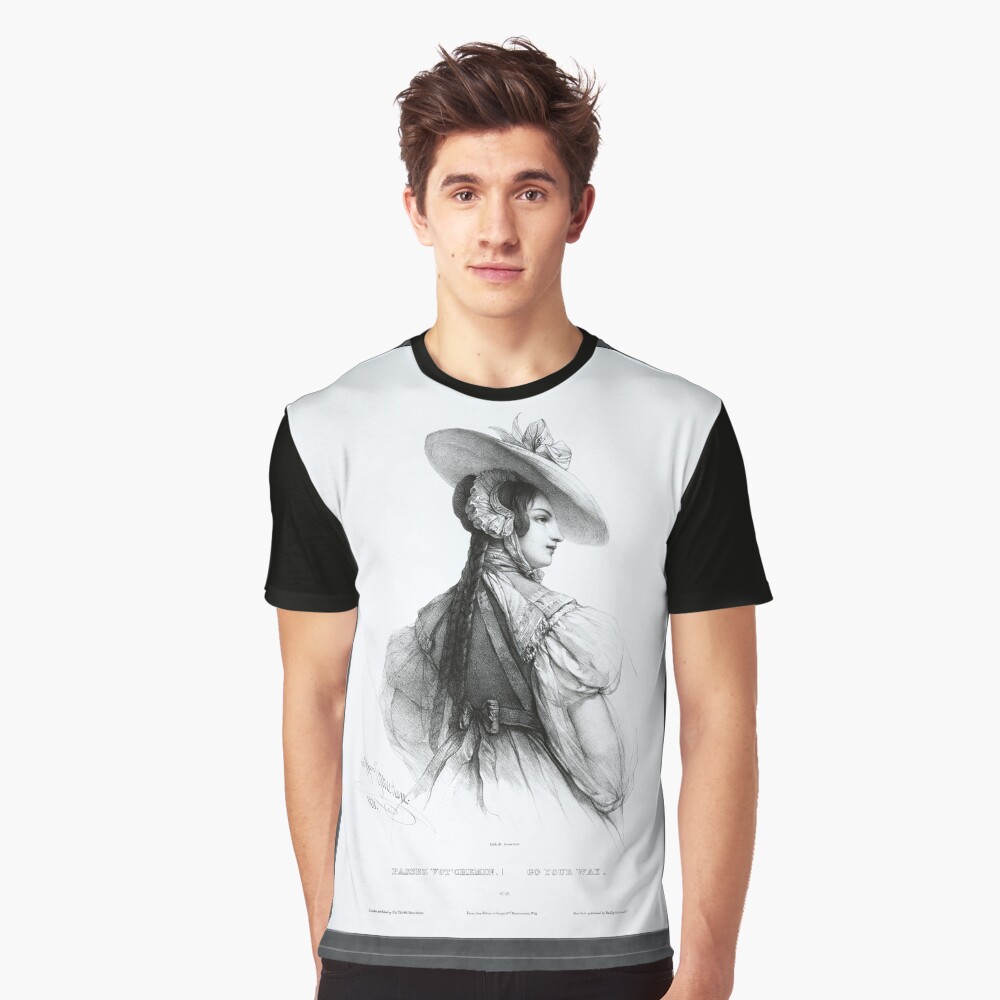
“Gå din vei (Gå forbi)” er en utsøkt portrett tegning laget av den franske maleren Henri Grevedon i 1833. Født i 1776 og går bort i 1860, Grevedon var en fremtredende kunstner på begynnelsen av 1800-tallet, kjent for sine detaljerte og emosjonelle verk som ofte skildret elegansen og raffinementet til tiden. Dette stykket er et mesterlig eksempel på Grevedons evne til å fange ynden og finessen til fransk mote og den gripende elegansen til kvinner i den romantiske perioden.
Tegningen skildrer en kvinne kledd i et forseggjort ensemble, figuren hennes fanget i profil mens hun stirrer over skulderen, hennes uttrykk gåtefull. Kunstneren har gitt henne en følelse av uavhengighet og selvtillit, the underlying theme of the piece suggesting a sense of liberation or a personal journey. Tittelen “Gå din vei” suggests a narrative of individual empowerment, an assertion of autonomy in the face of society’s expectations. The phrase “Gå forbi,” which translates to “Go your way,” reinforces this interpretation, possibly alluding to the idea of a woman making her own path in the world.
Innholdsfortegnelse
The Subject and Composition
The central subject of the artwork is the elegantly dressed woman, who is portrayed with delicate features and a graceful posture. The artist has carefully captured her profile, focusing on the smoothness of her complexion and the flowing nature of her attire. She wears an oversized, bredbremmet lue prydet med bånd og en floral aksent, som er et kjennetegn på fransk mote fra 1800-tallet. Antrekket hennes er en overdådig kjole med intrikate folder og blondedetaljer, en indikasjon på de luksuriøse tekstilene som var populære i den perioden. Det flytende håret, pent flettet og fossende nedover ryggen hennes, antyder både ungdom og raffinement, fremhever hennes raffinerte skjønnhet.
Kvinnens holdning er spesielt slående - hodet snudd til siden, antyder en følelse av bevegelse eller kontemplasjon. Det er en subtil, men umiskjennelig fortelling antydet av måten hun ser ut til å vende seg bort fra betrakteren, som om det var på nippet til å gå bort eller på vei ut i det fjerne. Dette skaper en illusjon av dynamikk i kunstverket, som om motivet er i ferd med å ta hennes neste skritt inn i det ukjente.
Grevedons omhyggelige oppmerksomhet på detaljer er tydelig i foldene på kvinnens kjole, hver fold og skygge er nøye tegnet for å indikere både tekstur og bevegelse. Den myke, feiende linjer i kjolen hennes står i kontrast til det skarpe, delikate detaljer om tilbehøret hennes og de feiende blomsterdekorasjonene i hatten hennes. Denne bruken av detaljer forsterker den generelle realismen og dybden i tegningen, sikre at hvert element tjener til å fremheve emnets ynde.
Style and Materials
Stilen til dette verket er karakteristisk for den romantiske perioden, en bevegelse som la vekt på følelser, individualisme, og skjønnheten i den naturlige verden. Fokuset på den feminine figuren og det sanselige draperiet til kjolen er typisk for romantisk kunst, which often celebrated the human form and the beauty of personal expression. Grevedon’s choice of using pencil and ink gives the work a soft, eterisk kvalitet, lending an almost tactile sense to the textures in the gown and the fluid lines of the woman’s hair. The choice of monochrome enhances the focus on the intricate details without the distraction of color, allowing the viewer to fully appreciate the delicate shading and contour of the subject.
The overall mood of the piece is one of quiet introspection, combined with a sense of movement and a personal journey. The delicate shading and soft linework convey a quiet, almost meditative stillness, while the woman’s poised stance and the slight twist of her body suggest anticipation and the promise of action. The stark, simple background serves to further isolate the subject, placing all focus on the woman herself and her emotional narrative.
Tema og stemning
The theme of this artwork revolves around the idea of personal autonomy and the quiet strength of women during an era that often limited their freedom. Tittelen “Gå din vei” can be interpreted as a statement of independence, urging the viewer to consider the subject’s path as one chosen for herself, rather than one dictated by society. The phrase “Gå forbi” imbues the artwork with a sense of defiance and self-determination. Dette, coupled with the composition and posture of the figure, suggests a woman who is contemplating her own future, perhaps on the cusp of making a life-altering decision.
The mood of the piece is subdued and contemplative. The soft lines and delicate rendering convey a sense of elegance, while the woman’s expression and posture evoke a quiet resilience. There is an almost mysterious quality to her demeanor, as if she is engaged in deep thought, yet prepared to step forward into her destiny. The lack of any overt narrative or context allows the viewer to project their own interpretation, making the artwork timeless in its exploration of personal journey and empowerment.
Konklusjon
“Gå din vei (Gå forbi)” is a remarkable example of 19th-century French art that combines technical mastery with deep emotional resonance. Henri Grevedon’s skill in rendering the details of fashion, tekstur, and emotion in a restrained and graceful manner captures the essence of the Romantic period while also exploring themes of individualism, empowerment, and the journey of life. The elegance of the subject, den nøye oppmerksomheten på detaljer, and the evocative mood make this artwork a timeless reflection on the beauty of personal autonomy.
Dette er en remastret digital kunst-gamle mesterreproduksjon av et offentlig domenebilde som er tilgjengelig som en lerretstrykk online.
Kunstnerbiografi
Pierre Louis Henri Grevedon was a French painter, printmaker, lithographer and draughtsman who at the age of 13 studied at the workshop of French Painter Jean Baptiste Regnault (1754 – 1829) at the Ecole des Beaux-Arts de Paris and exhibiting at the Paris Salon from 1824 til 1859.
I en alder av 30 i 1806 he traveled to Russia, where he became an associate at the Academy of Saint Petersburg; where he stayed until 1812, at which time he traveled to Stockholm, Sverige; then on to London England and finally returning to Paris, Frankrike i 1816.
Shortly afterwards he devoted his talents to the art of lithography which better suited him than painting; making a name for himself in this endeavor; working mainly for the studio of French Lithographer and Printmaker Charles Motte (1785 – 1836) during the 1820s.
As his reputation grew he a gathered a list of personalities from the entertainment field, which included actresses and dancers such as La Malibran, Lucile Grahn, Fanny Elssler, Rachel ,Taglioni, Léontine Fay and many more.
Da han var 56 years old on January 1832, he was awarded with the title of Chevalier of the Legion of Honor; which is the highest French order of merit for both military personnel and civilians, which was established by Napoleon Bonaparte (1769 – 1821) i 1802.