

Golden Beauty c1957
Het kunstwerk getiteld Golden Beauty c1957 was created by the renowned American artist Gil Elvgren, who was born in 1914 and passed away in 1980. Elvgren is celebrated for his iconic pin-up art, which emerged during the mid-20th century. His work captured the playful, idealized, and sensual depictions of women that were prevalent in advertising and popular culture at the time. This piece, “Gouden schoonheid,” van 1957, exemplifies his signature style, with a soft focus on the female form, idealized beauty, and vibrant colors that invoke a sense of warmth and allure.

Inhoudsopgave
Onderwerp en compositie
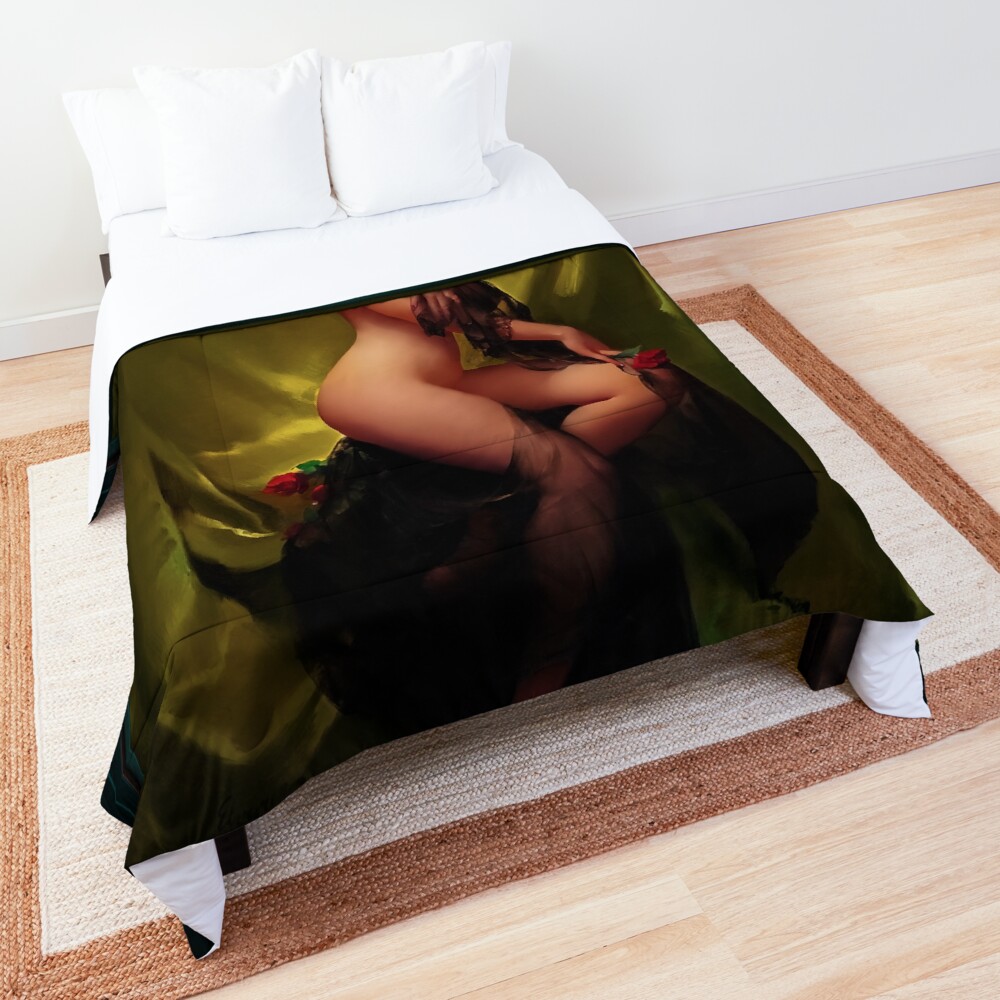
In het hart van Golden Beauty c1957 is the central figure of a young woman, depicted in a soft, glamorous pose that radiates elegance and sensuality. She is seated gracefully on a chaise lounge, surrounded by the soft folds of luxurious drapery in hues of golden yellow and deep green. Her facial expression, a subtle smile, exudes confidence and charm, giving the impression of a woman at ease with herself and her surroundings. Her blonde hair cascades in waves, framed by the vibrant backdrop that emphasizes her delicate features. The figure’s posture is one of languid elegance, with one arm bent at the elbow, supporting herself while the other delicately holds a rose, symbolizing beauty and femininity.
The model is presented in a moment of vulnerability, her modesty barely maintained by a sheer piece of fabric that drapes across her body. Echter, the pose never seems overly provocative; liever, it conveys an innocence combined with an air of self-assuredness. The artist’s use of light and shadow around the model’s form accentuates her curves and enhances the overall mood of sensuality without crossing into excess. The juxtaposition of her delicate pose with the ethereal background imbues the piece with a sense of dreamlike allure, as if she were a figure who exists somewhere between reality and fantasy.
Materialen en techniek
Gil Elvgren employed the classic technique of oil painting for Gouden schoonheid, allowing him to achieve a rich depth of color and a smooth finish that is characteristic of his work. The brushstrokes, though subtle, are used effectively to create the illusion of softness and fluidity in the woman’s skin, haar, and fabric. The luxurious velvet-like texture of the fabric draped around her body contrasts with the softness of her skin and the delicate features of her face, showcasing Elvgren’s expert control over his medium. The artist’s skillful application of highlights and shadows gives the entire composition a sense of three-dimensionality, enhancing the viewer’s perception of the figure as a tangible, lifelike presence.
In terms of the background, Elvgren uses rich, almost glowing shades of green and yellow to set a luxurious, almost surreal stage for his subject. These colors enhance the golden tones in the woman’s hair, creating a harmonious relationship between the model and her surroundings. The fabric folds in the background echo the folds of her clothing, guiding the viewer’s eye across the canvas and creating a sense of movement within the otherwise still image.
Thema en stemming
Het thema van Gouden schoonheid is rooted in the idealized portrayal of feminine beauty that was a hallmark of mid-20th-century advertising and magazine illustrations. Echter, Elvgren transcends mere commercial art by infusing his subject with a depth of personality and elegance. The model is not a passive object; she is a fully realized figure who exudes both strength and grace. The title Gouden schoonheid underscores her radiant and almost ethereal quality, which is further heightened by the luminous quality of the painting’s palette. The soft glow surrounding her reinforces this sense of divine beauty, presenting her as both an ideal and an inspiration.
The mood of the painting is one of playful elegance. There is an undeniable sense of flirtation in the woman’s pose, but it is tempered by her poised and dignified demeanor. This duality of innocence and allure creates a mood of warmth, charme, en tijdloze elegantie. The soft color palette evokes feelings of nostalgia, transporting the viewer to an era of glamorous Hollywood stars and the golden age of pin-up art.
The backdrop plays a crucial role in reinforcing this mood. De zachte, golden glow suggests a moment of repose in a dreamlike world, where the viewer can escape into the fantasy of beauty and elegance. The green tones introduce an element of nature and tranquility, further complementing the serenity of the moment and the quiet confidence of the woman. The balance between light and dark, soft and bold, creates a visual harmony that guides the viewer’s emotional response to the painting, making it both inviting and captivating.
Significance of the Artist
Gil Elvgren was a key figure in the development of the pin-up art style during the 1940s and 1950s. His work was part of a broader cultural phenomenon that celebrated femininity, schoonheid, and sexual allure in a way that was playful and innocent yet undeniably seductive. Elvgren’s mastery of light and shadow, his attention to detail, and his ability to capture the charm and elegance of his models made him one of the leading artists of the genre. Gouden schoonheid illustreert deze kwaliteiten, showcasing his ability to balance sensuality with sophistication.
The artist’s influence on American popular culture, especially in terms of advertising, illustratie, and fashion, cannot be overstated. His work resonated with audiences at a time when there was a strong cultural focus on the idealized image of women. Elvgren’s portrayal of women, while often sexualized, is never crude or aggressive; in plaats van, it reflects a nuanced view of feminine allure that blends playfulness, schoonheid, en genade.
Conclusie
Gouden schoonheid by Gil Elvgren is a quintessential example of mid-20th-century American pin-up art. Through his masterful use of oil paint, Elvgren has created an image that transcends the commercial intent of many of his contemporaries, offering a glimpse into a world of idealized beauty, elegantie, en charme. The artwork continues to captivate audiences today, serving as both a reflection of the cultural landscape of its time and an enduring symbol of feminine elegance.
Golden Beauty is a retouched digital art old masters reproduction of a public domain image that is available for purchase as a online opgerold afdrukken.
Bio -kunstenaar
Info hieronder afgeleid van Wikipedia.org
Gillette A. Elvgren werd geboren in St. Paul, Minnesota, en ging naar de University High School. Na het afstuderen, hij begon kunst te studeren aan het Minneapolis Institute of Arts.
Later verhuisde hij naar Chicago om te studeren aan de American Academy of Art, en studeerde af aan de Academie tijdens de grote depressie, op tweeëntwintigjarige leeftijd.
Na zijn afstuderen trad Elvgren toe tot de artiestenstal bij Stevens en Gross, Chicago's meest prestigieuze reclamebureau, en werd een beschermeling van de kunstenaar Haddon Sundblom.
In 1937, Gil begon kalenderpin-ups te schilderen voor Louis F. Dow, een van Amerika's toonaangevende uitgeverijen, gedurende welke tijd hij ongeveer 60 pin-up girl werkt op 22″ × 28″ canvas en onderscheidt ze door een gedrukte handtekening.
Veel van zijn pin-ups werden gereproduceerd als neuskunst op militaire vliegtuigen tijdens de Tweede Wereldoorlog; en het was rond deze tijd in 1944, dat Elvgren werd benaderd door de Brown and Bigelow Publishing Company; een bedrijf dat nog steeds het veld domineert in het produceren van kalenders, reclamespecialiteiten en promotionele merchandise.
Het volgende jaar vanaf 1945 tot 1972, Elvgren werd geassocieerd met de Brown & Bigelow uitgeverij, en begon te werken met 24 centimeter bij 30 inch doeken, een formaat dat hij zou gebruiken voor de volgende 30 jaren, en ondertekende zijn werk in cursief.
Elvgren was een commercieel succes. Hij woonde op verschillende locaties, en was actief van de jaren '30 tot de jaren '70. In 1951 hij begon te schilderen in een studio in zijn huis, dan in Winnetka, Illinois, een assistent gebruiken om verlichting in te stellen, bouw rekwisieten en scènes, foto sets, en zijn verven voorbereiden.
Tot zijn klanten behoorden bekende bedrijven als Brown en Bigelow, Cokes, General Electric en de Sealy Mattress Company, om er een paar te noemen. Daarnaast, in de jaren veertig en vijftig illustreerde hij verhalen voor tal van tijdschriften, zoals The Saturday Evening Post en Good Housekeeping.
Onder de modellen en Hollywood-legendes die Elvgren tijdens zijn carrière schilderde, was Myrna Hansen, Donna Reed, Barbara Hale, Arlene Dahl, Lola Albright en Kim Novak.