

Golden Eagle At A Cliffs Edge c1880
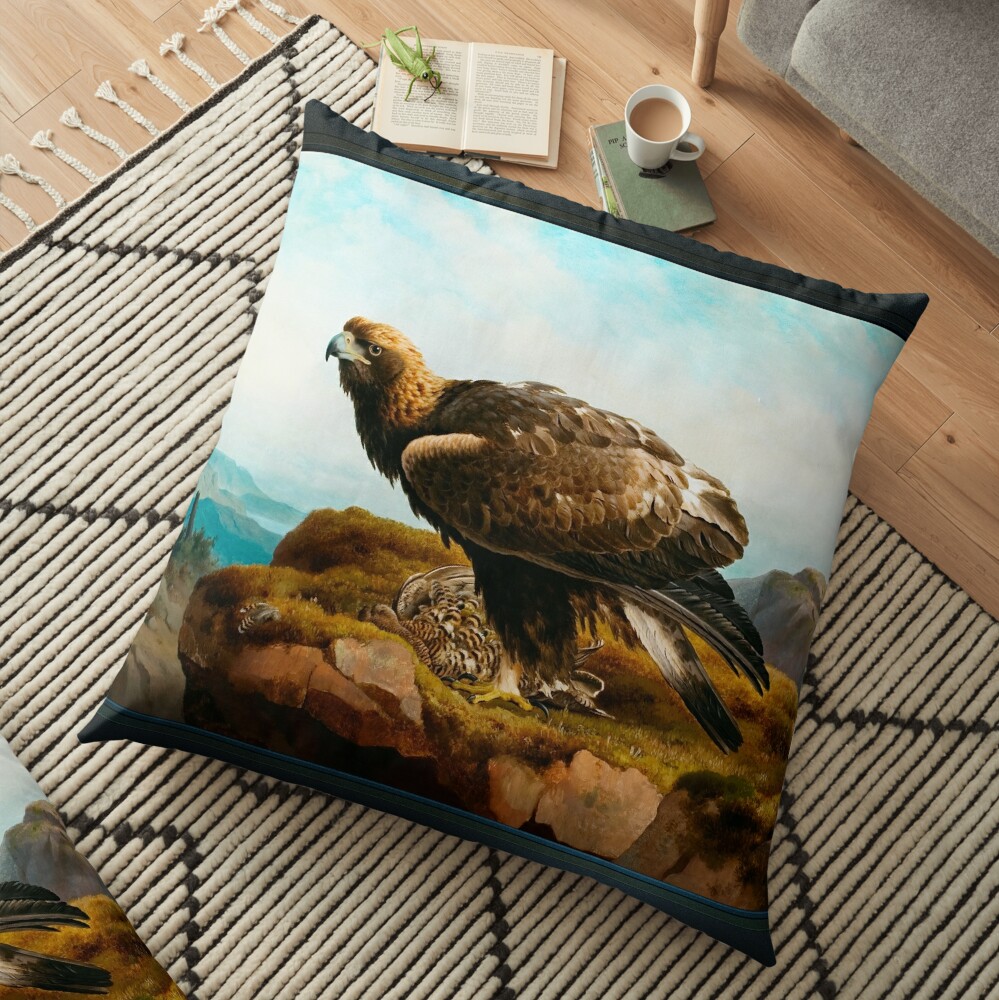
“Golden Eagle At A Cliffs Edge” is a masterful artwork created in 1880 by the Finnish painter Ferdinand von Wright (1822–1906). This stunning ealaín chlasaiceach piece is a representation of the natural world that blends realistic detail with the atmospheric beauty of the landscape.
Known for his expertise in capturing the essence of wildlife, von Wright’s style in this painting elevates the noble and untamed nature of the golden eagle to a level of reverence, placing it at the forefront of the composition against a dramatic backdrop of a rugged, windswept terrain. His ability to illustrate the fine details of feathers, uigeachtaí, and the play of light and shadow creates an immersive experience that transports the viewer into the wild and untamed world of the eagle.
Clár na nÁbhar
Main Subject and Mood
At the heart of the painting stands the golden eagle, an embodiment of strength, mhóracht, and dominance. The bird is perched near the edge of a cliff, its powerful form commanding attention. The eagle’s posture, with its wings partially spread, suggests a sense of alertness and readiness to take flight at a moment’s notice.
The artist’s meticulous attention to detail in the depiction of the eagle’s feathers, especially the dark and light interplay along the wings and body, conveys the grace and power of this magnificent creature. The eagle’s gaze is intense, its eyes sharp and penetrating as though surveying its domain, while its sharp talons are slightly visible, clenching the rocky surface beneath it.
The mood of the painting is one of solitude and quiet strength. There is no sense of rush, but instead an impression of calm vigilance. The eagle, in its natural element, evokes a timeless quality, representing both the fierce beauty and the fragility of the wilderness. The contrast of light and shadow in the bird’s form adds a sense of depth and three-dimensionality, reinforcing the idea that the eagle is a living, breathing creature in a moment of quiet observation.
Terrain and Natural Setting
The terrain surrounding the eagle is rugged, with steep cliffs and distant mountains stretching across the horizon. The rocky outcrops on which the eagle stands are bathed in warm golden light, contrasting with the cooler, more muted tones of the distant hills and sky. The sparse vegetation, tufts of grass and scattered shrubs, are finely painted, emphasizing the harshness of the landscape. The color palette used for the terrain is dominated by earth tones: ochre, donn, agus liath, interspersed with greens and blues in the distant landscape. These colors contribute to the sense of isolation and the unspoiled beauty of the natural world.
The sky above the eagle is expansive, le bog, billowing clouds that hint at a serene day, though the eagle’s stance implies a readiness for the unpredictable nature of its environment. The distant mountains, painted with delicate brushstrokes, create a sense of scale and perspective, giving the scene a vastness that suggests the eagle’s lofty position at the apex of its world. There is a subtle tension between the grandeur of the eagle and the vastness of its surroundings, symbolizing the strength of the bird in contrast to the immensity of the natural world.
Ábhair agus Teicníc
Ferdinand von Wright’s technique is rooted in the precision and clarity of realism. He masterfully captures textures, from the fine details of the eagle’s feathers to the rough, jagged edges of the cliffside. His use of light and shadow is particularly effective in adding depth to the painting, creating the illusion of three-dimensionality on a two-dimensional canvas. The eagle’s feathers are rendered with delicate, yet firm strokes that bring the bird to life, while the rugged landscape is similarly detailed but with broader strokes that convey a sense of wildness and natural beauty.
Von Wright’s choice of oil paints allows him to achieve rich textures and vibrant colors, imbuing the painting with a naturalistic glow. The varying tones of the earth, the eagle’s feathers, and the sky are seamlessly blended to create a harmonious composition. His understanding of light, particularly how it interacts with the forms in the painting, enhances the mood of the scene, infusing it with a quiet yet powerful energy.
Stíl agus Téama
The painting exemplifies the academic realism of the 19th century, with a focus on accurate and detailed representations of nature. Von Wright’s work, rooted in his training as an artist and his deep love for the Finnish landscape, often centered on wildlife and nature, agus ní haon eisceacht é an píosa seo. The eagle, a symbol of freedom and strength, is portrayed in its natural environment, a theme that von Wright frequently explored in his art.
The theme of the painting can be interpreted as a tribute to the untamed beauty of nature, where the eagle represents the majesty of the wild, untamed landscapes that are both harsh and beautiful. The eagle’s solitary presence at the cliff’s edge suggests a contemplation of the grandeur and vastness of the natural world. The scene is devoid of human presence, allowing the focus to remain entirely on the bird and its environment, which is characteristic of von Wright’s commitment to portraying nature in its purest form.
Conclúid
“Golden Eagle At A Cliffs Edge” is a striking and evocative painting that encapsulates Ferdinand von Wright’s dedication to portraying the beauty and majesty of wildlife. Through his masterful rendering of the golden eagle and its rugged natural surroundings, von Wright invites the viewer to appreciate the strength and grace of the eagle as well as the grandeur of its environment. The painting captures a moment frozen in time, where nature is both fierce and serene, and the eagle, perched at the edge of the world, stands as a symbol of nature’s untamed spirit.
Seo atáirgeadh seanmháistrí ealaíne digiteach athmháistrithe d’íomhá fearainn phoiblí atá ar fáil mar a priontáil chanbhás ar líne.
Ealaíontóir Bith Díorthaithe Ó Wikipedia.org
Ba é Ferdinand an duine deiridh de naonúr clainne a mhair don Maor Fionlannach Henrik Magnus von Wright a bhí ar scor.; a bheirt dheartháir níos sine Magnus von Wright (1805 – 1868) agus Wilhelm von Wright (1810 – 1887) péintéirí agus maisitheoirí a bhí ann agus lean sé a gcos, inniúlacht luath san ealaín a léiriú, a forbraíodh le linn an ama a chaith sé ag seilg agus ag fiosrú an dúlra, ag taifeadadh a raibh feicthe aige ina leabhair sceitseála.
I 1837 d’fhág sé an Fhionlainn agus thaistil sé go dtí an tSualainn lena dheartháir is sine Wilhelm; a bhí ag an am ag obair mar maisitheoir don Zó-eolaí Sualannach Bengt Fredrik Fries (1799 – 1839); ansin isteach 1838 he went back to Sweden to work for the Swedish amateur Ornithologist Count Nils Bonde (1685 – 1760).
Tar éis dó dul ar ais go dtí an Fhionlainn ar chríochnú a chuid oibre; d'fhill sé ansin ar an tSualainn i 1842 agus d’fhreastail sé go hachomair ar Acadamh Ealaíon Ríoga na Sualainne ag staidéar faoin dealbhóir Sualannach Johan Niclas Byström (1783 – 1848); ansin dhá bhliain ina dhiaidh sin ar ais abhaile go dtí an Fhionlainn.
Ansin isteach 1849 thaistil sé go Turku, An Fhionlainn áit ar ghlac sé ceachtanna péintéireachta breise ón bPéintéir Rómánsúil Sualannach Robert Wilhelm Ekman (1808 – 1873); tar éis a chuid staidéir, chuaigh sé féin agus a dheartháireacha go Heilsincí, príomhchathair na Fionlainne agus bhunaigh sé stiúideo; agus sé bliana ina dhiaidh sin thaistil sé go Dresden, An Ghearmáin chun staidéar a dhéanamh faoin péintéir ainmhithe Gearmánach aitheanta Johann Siegwald Dahl (1827 – 1902).
Le linn na 1870idí d’fhulaing sé roinnt strócanna a choinnigh a luí air; ach lean sé ag péinteáil, agus i 1881 rinne sé a thuras deireanach go Orust chun cuairt a thabhairt ar a dheartháir Wilhelm a bhí tinn freisin.
Ón bpointe seo ar aghaidh bhí a chuid oibre níos tráchtála, agus i 1886 rinne sé a phéinteáil is cáiliúla “Na Capercailles Troda” agus bhí sé ag cur ailt le foilseacháin éaneolaíochta éagsúla.
Thart ar an am seo fuair sé pinsean stáit ealaíontóirí; agus i rith na 1890idí tháinig go leor dá iar-scoláirí ar cuairt, agus go déanach sna 90í péintéir éan Matti Karppanen (1873 – 1953) d'fhan sé ina dhalta agus ina chúntóir aige.