

Golden Eagle At A Cliffs Edge c1880
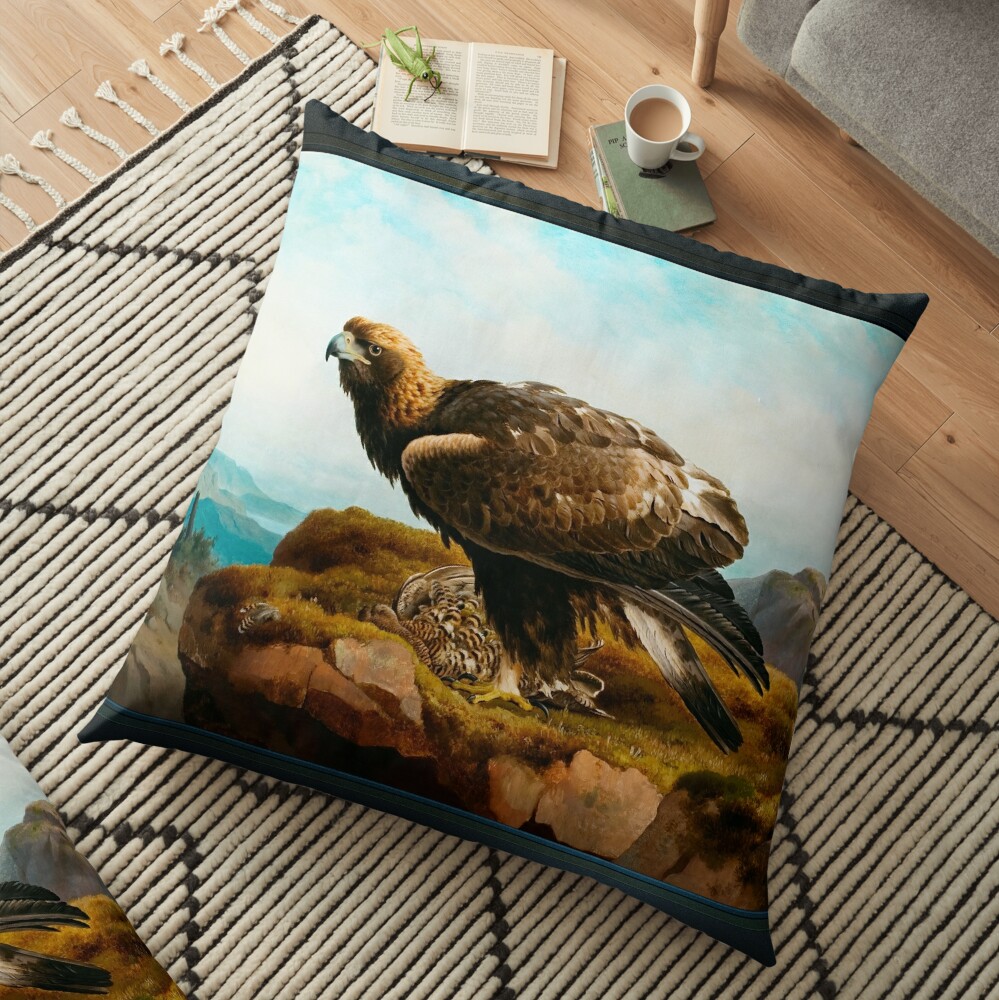
“Golden Eagle At A Cliffs Edge” is a masterful artwork created in 1880 by the Finnish painter Ferdinand von Wright (1822–1906). This stunning klassesch Konscht piece is a representation of the natural world that blends realistic detail with the atmospheric beauty of the landscape.
Known for his expertise in capturing the essence of wildlife, von Wright’s style in this painting elevates the noble and untamed nature of the golden eagle to a level of reverence, placing it at the forefront of the composition against a dramatic backdrop of a rugged, windswept terrain. His ability to illustrate the fine details of feathers, Texturen, and the play of light and shadow creates an immersive experience that transports the viewer into the wild and untamed world of the eagle.
Inhaltsverzeechnes
Main Subject and Mood
At the heart of the painting stands the golden eagle, an embodiment of strength, Majestéit, and dominance. The bird is perched near the edge of a cliff, its powerful form commanding attention. The eagle’s posture, with its wings partially spread, suggests a sense of alertness and readiness to take flight at a moment’s notice.
The artist’s meticulous attention to detail in the depiction of the eagle’s feathers, especially the dark and light interplay along the wings and body, conveys the grace and power of this magnificent creature. The eagle’s gaze is intense, its eyes sharp and penetrating as though surveying its domain, while its sharp talons are slightly visible, clenching the rocky surface beneath it.
The mood of the painting is one of solitude and quiet strength. There is no sense of rush, but instead an impression of calm vigilance. Den Adler, in its natural element, rifft eng zäitlos Qualitéit op, representing both the fierce beauty and the fragility of the wilderness. The contrast of light and shadow in the bird’s form adds a sense of depth and three-dimensionality, reinforcing the idea that the eagle is a living, breathing creature in a moment of quiet observation.
Terrain and Natural Setting
The terrain surrounding the eagle is rugged, with steep cliffs and distant mountains stretching across the horizon. The rocky outcrops on which the eagle stands are bathed in warm golden light, contrasting with the cooler, more muted tones of the distant hills and sky. The sparse vegetation, tufts of grass and scattered shrubs, are finely painted, emphasizing the harshness of the landscape. The color palette used for the terrain is dominated by earth tones: ochre, brong, and gray, interspersed with greens and blues in the distant landscape. These colors contribute to the sense of isolation and the unspoiled beauty of the natural world.
The sky above the eagle is expansive, mat mëll, billowing clouds that hint at a serene day, though the eagle’s stance implies a readiness for the unpredictable nature of its environment. The distant mountains, painted with delicate brushstrokes, create a sense of scale and perspective, giving the scene a vastness that suggests the eagle’s lofty position at the apex of its world. There is a subtle tension between the grandeur of the eagle and the vastness of its surroundings, symbolizing the strength of the bird in contrast to the immensity of the natural world.
Materialien an Technik
Ferdinand von Wright’s technique is rooted in the precision and clarity of realism. He masterfully captures textures, from the fine details of the eagle’s feathers to the rough, jagged edges of the cliffside. His use of light and shadow is particularly effective in adding depth to the painting, creating the illusion of three-dimensionality on a two-dimensional canvas. The eagle’s feathers are rendered with delicate, yet firm strokes that bring the bird to life, while the rugged landscape is similarly detailed but with broader strokes that convey a sense of wildness and natural beauty.
Von Wright’s choice of oil paints allows him to achieve rich textures and vibrant colors, imbuing the painting with a naturalistic glow. The varying tones of the earth, the eagle’s feathers, and the sky are seamlessly blended to create a harmonious composition. Säi Verständnis vu Liicht, particularly how it interacts with the forms in the painting, enhances the mood of the scene, infusing it with a quiet yet powerful energy.
Styl an Thema
The painting exemplifies the academic realism of the 19th century, with a focus on accurate and detailed representations of nature. Von Wright’s work, rooted in his training as an artist and his deep love for the Finnish landscape, often centered on wildlife and nature, an dëst Stéck ass keng Ausnahm. Den Adler, a symbol of freedom and strength, is portrayed in its natural environment, a theme that von Wright frequently explored in his art.
The theme of the painting can be interpreted as a tribute to the untamed beauty of nature, where the eagle represents the majesty of the wild, untamed landscapes that are both harsh and beautiful. The eagle’s solitary presence at the cliff’s edge suggests a contemplation of the grandeur and vastness of the natural world. The scene is devoid of human presence, allowing the focus to remain entirely on the bird and its environment, which is characteristic of von Wright’s commitment to portraying nature in its purest form.
Conclusioun
“Golden Eagle At A Cliffs Edge” is a striking and evocative painting that encapsulates Ferdinand von Wright’s dedication to portraying the beauty and majesty of wildlife. Through his masterful rendering of the golden eagle and its rugged natural surroundings, von Wright invites the viewer to appreciate the strength and grace of the eagle as well as the grandeur of its environment. The painting captures a moment frozen in time, where nature is both fierce and serene, and the eagle, perched at the edge of the world, stands as a symbol of nature’s untamed spirit.
Dëst ass eng remastered digital Konscht al Master Reproduktioun vun engem Public Domain Bild dat als verfügbar ass Leinwandprint online.
Kënschtler Bio ofgeleet vun Wikipedia.org
Ferdinand war déi lescht vun néng iwwerliewend Kanner op déi pensionéiert Finnesch Major Henrik Henner Von Wright; Seng zwee eeler Bridder Magnus Von Wright (1805 – 1868) an Wilhelm Von Wright (1810 – 1887) ware Moler a Illustrateuren an hien ass an hire Fouss gefollegt, eng fréi Aptitude fir Konscht ze weisen, déi entwéckelt gouf an der Zäit déi hie sech jotéiert an d'Natur verbruecht huet, Opname wat hien a senger Skizzebicher observéiert hat.
An 1837 hien huet Findland verlooss an gereest zu Schweessen mat sengem zweeten eelsten Brudder Wilelm; Wiem zu der Zäit war als Illustrator fir déi schwedesch Zoologist Benggt Freds (1799 – 1839); dann an 1838 he went back to Sweden to work for the Swedish amateur Ornithologist Count Nils Bonde (1685 – 1760).
Nodeems Dir zréck op Finnland op der Fäerdegstellung vun senger Aarbecht; Hien ass duerno zréck an d'Schweden 1842 a kuerz hunn d'kinneklech swedish Academy vun Arts an der Swedish Sculptor Johan Nichlas byström studéiert (1783 – 1848); Dunn zwee Joer méi spéit heem bis Finnland.
Den Émile Vernon war e Student an der Fine Arts School zu Tours, wou hien den éischte Präis fir Zeechnen gewonnen huet 1849 Hien ass op Turku gereest, Finnland wou hien zousätzlech Molerschaftscoursen aus schwedish romanteschen Moler Robetem Milhelm ekman gemaach huet (1808 – 1873); Folgend seng Studien, hien a seng Bridder sinn op Helsinki gaang, d'Haaptstad vun Finnland an huet en Atelier opgestallt; a sechs Joer méi spéit huet hien op drestden gereest, Däitschland fir ënner dem bemierten däitscheneschen Déieremaffer Johann SieGwald Dahl ze studéieren (1827 – 1902).
An den 1870er; Awer hien ass weider ze molen, an an 1881 huet seng lescht Rees gemaach fir säi Brudder ze besichen Wilhelm déi och krank war.
Vun dësem Punkt op senger Aarbecht gouf méi kommerziell ginn, an an 1886 hien huet säi beschte bekannte Molerei produzéiert “De Kämpf Capachecues” a war d'Artikele fir verschidden ornitologesch Publikatioun bäi bäizedroen.
Iwwer dës Kéier krut hien eng Staatstäerkt Pensioun; an wärend 1890er vill vu senge fréiere Schüler koumen sech bei, Wärend am spéiden 90er Vugel Moler Mutter Mati karppanen (1873 – 1953) bliwwen fir säi Schüler an Assistent ze sinn.