

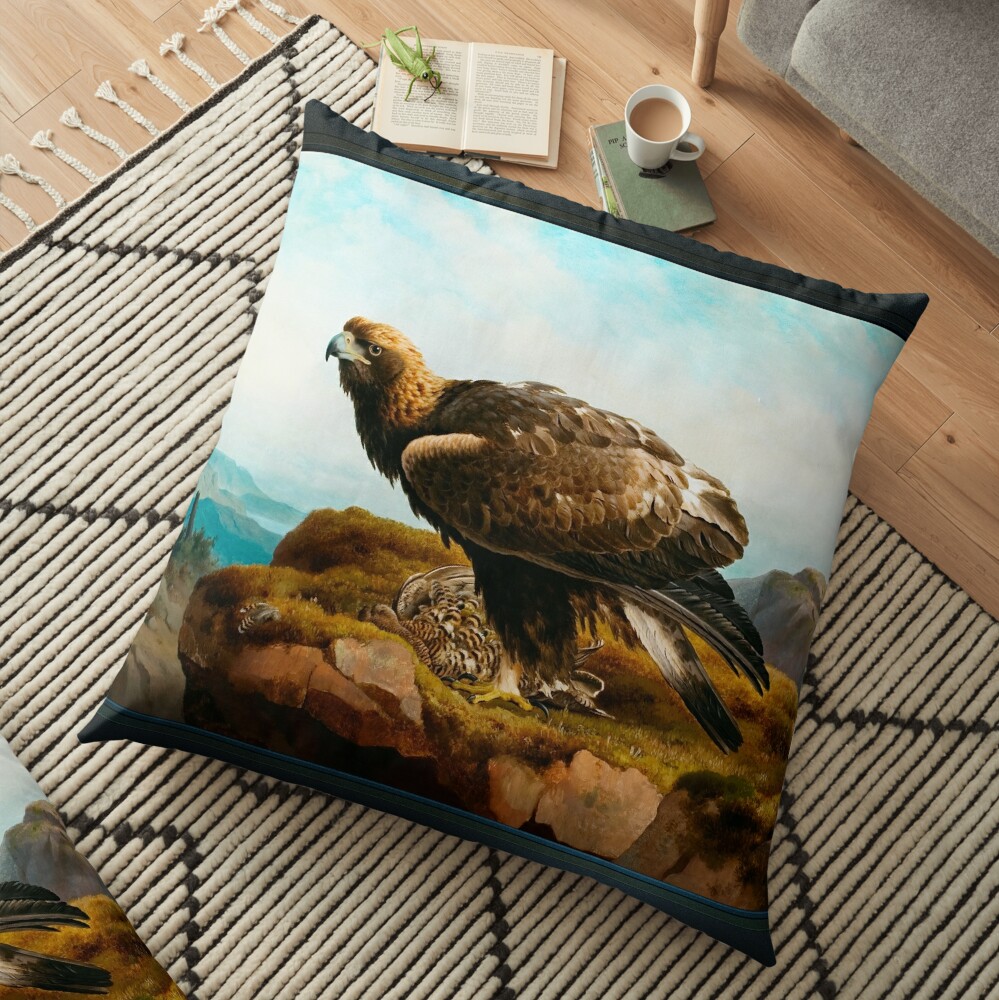
Golden Eagle At A Cliffs Edge c1880
“Золотой орел на краю скал” is a masterful artwork created in 1880 by the Finnish painter Ferdinand von Wright (1822–1906). This stunning классическое искусство piece is a representation of the natural world that blends realistic detail with the atmospheric beauty of the landscape.
Known for his expertise in capturing the essence of wildlife, von Wright’s style in this painting elevates the noble and untamed nature of the golden eagle to a level of reverence, placing it at the forefront of the composition against a dramatic backdrop of a rugged, windswept terrain. His ability to illustrate the fine details of feathers, текстуры, and the play of light and shadow creates an immersive experience that transports the viewer into the wild and untamed world of the eagle.
Оглавление
Основной предмет и настроение
At the heart of the painting stands the golden eagle, an embodiment of strength, majesty, and dominance. The bird is perched near the edge of a cliff, its powerful form commanding attention. The eagle’s posture, with its wings partially spread, suggests a sense of alertness and readiness to take flight at a moment’s notice.
The artist’s meticulous attention to detail in the depiction of the eagle’s feathers, especially the dark and light interplay along the wings and body, conveys the grace and power of this magnificent creature. The eagle’s gaze is intense, its eyes sharp and penetrating as though surveying its domain, while its sharp talons are slightly visible, clenching the rocky surface beneath it.
The mood of the painting is one of solitude and quiet strength. There is no sense of rush, but instead an impression of calm vigilance. Орел, in its natural element, вызывает вневременное качество, representing both the fierce beauty and the fragility of the wilderness. The contrast of light and shadow in the bird’s form adds a sense of depth and three-dimensionality, reinforcing the idea that the eagle is a living, breathing creature in a moment of quiet observation.
Terrain and Natural Setting
The terrain surrounding the eagle is rugged, with steep cliffs and distant mountains stretching across the horizon. The rocky outcrops on which the eagle stands are bathed in warm golden light, contrasting with the cooler, more muted tones of the distant hills and sky. The sparse vegetation, tufts of grass and scattered shrubs, are finely painted, emphasizing the harshness of the landscape. The color palette used for the terrain is dominated by earth tones: ochre, коричневый, and gray, interspersed with greens and blues in the distant landscape. These colors contribute to the sense of isolation and the unspoiled beauty of the natural world.
The sky above the eagle is expansive, с мягким, billowing clouds that hint at a serene day, though the eagle’s stance implies a readiness for the unpredictable nature of its environment. The distant mountains, painted with delicate brushstrokes, create a sense of scale and perspective, giving the scene a vastness that suggests the eagle’s lofty position at the apex of its world. There is a subtle tension between the grandeur of the eagle and the vastness of its surroundings, symbolizing the strength of the bird in contrast to the immensity of the natural world.
Материалы и техника
Ferdinand von Wright’s technique is rooted in the precision and clarity of realism. He masterfully captures textures, from the fine details of the eagle’s feathers to the rough, jagged edges of the cliffside. His use of light and shadow is particularly effective in adding depth to the painting, creating the illusion of three-dimensionality on a two-dimensional canvas. The eagle’s feathers are rendered with delicate, yet firm strokes that bring the bird to life, while the rugged landscape is similarly detailed but with broader strokes that convey a sense of wildness and natural beauty.
Von Wright’s choice of oil paints allows him to achieve rich textures and vibrant colors, imbuing the painting with a naturalistic glow. The varying tones of the earth, the eagle’s feathers, and the sky are seamlessly blended to create a harmonious composition. His understanding of light, particularly how it interacts with the forms in the painting, enhances the mood of the scene, infusing it with a quiet yet powerful energy.
Стиль и тема
The painting exemplifies the academic realism of the 19th century, with a focus on accurate and detailed representations of nature. Von Wright’s work, rooted in his training as an artist and his deep love for the Finnish landscape, often centered on wildlife and nature, И эта часть не является исключением. Орел, a symbol of freedom and strength, is portrayed in its natural environment, a theme that von Wright frequently explored in his art.
The theme of the painting can be interpreted as a tribute to the untamed beauty of nature, where the eagle represents the majesty of the wild, untamed landscapes that are both harsh and beautiful. The eagle’s solitary presence at the cliff’s edge suggests a contemplation of the grandeur and vastness of the natural world. The scene is devoid of human presence, allowing the focus to remain entirely on the bird and its environment, which is characteristic of von Wright’s commitment to portraying nature in its purest form.
Заключение
“Золотой орел на краю скал” is a striking and evocative painting that encapsulates Ferdinand von Wright’s dedication to portraying the beauty and majesty of wildlife. Through his masterful rendering of the golden eagle and its rugged natural surroundings, von Wright invites the viewer to appreciate the strength and grace of the eagle as well as the grandeur of its environment. The painting captures a moment frozen in time, where nature is both fierce and serene, and the eagle, perched at the edge of the world, stands as a symbol of nature’s untamed spirit.
Это обновленная цифровая репродукция старых мастеров изображения, являющегося общественным достоянием, которое доступно в качестве Все эти ремастерированные изображения старых мастеров цифрового искусства, являющиеся общественным достоянием, доступны как.
Биография художника получена из Wikipedia.org
Фердинанд был последним из девяти выживших детей отставного финского майора Хенрика Магнуса фон Райта.; два его старших брата Магнус фон Райт (1805 – 1868) и Вильгельм фон Райт (1810 – 1887) были художниками и иллюстраторами, и он пошел по их стопам, проявляя ранние способности к искусству, который был разработан в то время, когда он охотился и изучал природу, записывать то, что он наблюдал в своих альбомах для рисования.
В 1837 он покинул Финляндию и отправился в Швецию со своим вторым старшим братом Вильгельмом.; который в то время работал иллюстратором у шведского зоолога Бенгта Фредрика Фрайса. (1799 – 1839); затем в 1838 он вернулся в Швецию, чтобы работать на шведского орнитолога-любителя графа Нильса Бонде. (1685 – 1760).
После возвращения в Финляндию по завершении работы; Затем он вернулся в Швецию в 1842 и ненадолго посещал Шведскую королевскую академию художеств, обучаясь у шведского скульптора Йохана Николаса Быстрёма. (1783 – 1848); затем через два года вернулся домой в Финляндию.
Затем в 1849 он отправился в Турку, Финляндия, где он брал дополнительные уроки живописи у шведского художника-романтика Роберта Вильгельма Экмана. (1808 – 1873); после учебы, он и его братья отправились в Хельсинки, столицу Финляндии и открыл студию; а шесть лет спустя он отправился в Дрезден, Германия будет учиться у известного немецкого художника-анималиста Иоганна Зигвальда Даля. (1827 – 1902).
В 1870-х годах он перенес несколько инсультов, из-за которых был прикован к постели.; но продолжал рисовать, И в 1881 совершил свою последнюю поездку в Оруст, чтобы навестить своего брата Вильгельма, который также был болен.
С этого момента его работа стала более коммерческой., И в 1886 он создал свою самую известную картину “Боевые глухари” и публиковал статьи в различных орнитологических изданиях..
Примерно в это же время он получил государственную пенсию художников.; а в течение 1890-х годов многие из его бывших учеников приезжали в гости, а в конце 90-х художник-птица Матти Карппанен (1873 – 1953) остался его учеником и помощником.