

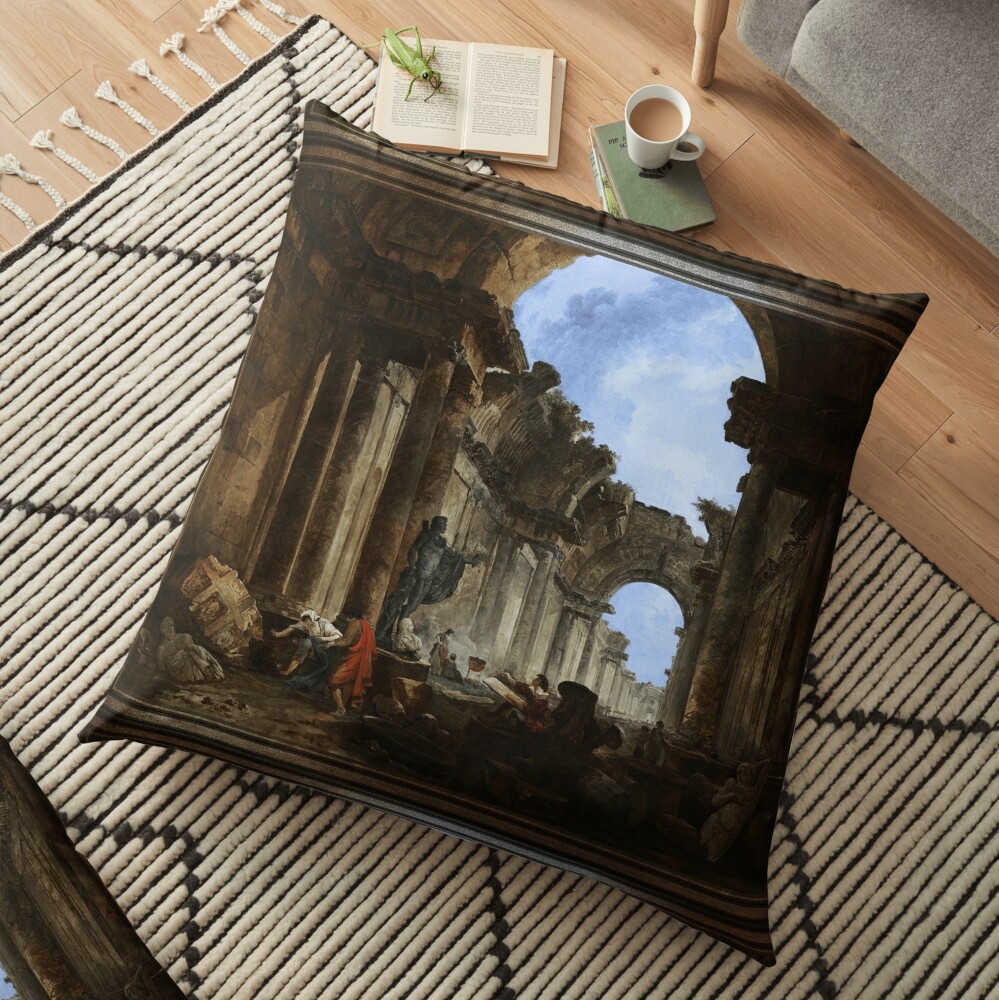
Grand Gallery of the Louvre in Ruins c1796
Hubert Robert‘s “Imaginary View of the Grand Gallery of the Louvre in Ruins,” painted circa 1796, is a stunning and dramatic depiction of the famed Louvre Gallery in Paris, envisioned as a ruin. An t-ealaíontóir, renowned for his imaginative landscapes and depictions of architectural grandeur, presents an evocative and somber vision of the Louvre in a state of decay, playing on the theme of time’s power to both create and destroy.
Rugadh i 1733 agus bás i 1808, Robert’s work often explored the juxtaposition of classical beauty and the inevitability of ruin, which is captured with masterful skill in this piece. Through the use of light, scáth, and a carefully structured composition, Robert imbues this imaginary scene with a sense of profound melancholy, while also offering a reflection on the passage of history.
Clár na nÁbhar
An Príomh-Ábhar agus Comhdhéanamh
In the center of Robert’s canvas stands the magnificent but crumbling architecture of the Grand Gallery of the Louvre, an iconic symbol of Parisian culture and art. The gallery, once a space of grandeur and cultural significance, is now portrayed in ruins. The columns that once supported the structure are cracked and crumbling, and the arches appear weakened, as though they may collapse at any moment.
The absence of a roof is particularly striking, letting in vast expanses of blue sky that contrast sharply with the somber, weathered ruins below. The ruin’s grandeur is evident, but it has been overtaken by time’s erosion, giving the viewer a sense of abandonment and decay.
A group of figures populates the scene, scattered throughout the space. They are small in scale, almost dwarfed by the monumental ruins, and their actions add a layer of intrigue to the piece. Sa tulra, one figure appears to be assisting another, while two others sit on the ground amidst fallen columns and broken statues.
These figures seem to be the remnants of a once-vibrant cultural hub, now reduced to mere observers in the face of destruction. Their presence invites the viewer to contemplate the human aspect of decay, how history is shaped not only by the grand structures but also by the people who live within and around them.
Cuspóirí agus Ábhair
The objects scattered throughout the ruins speak volumes about the once-immense cultural importance of the gallery. Tá deilbh mharmair briste ag cosa na bhfigiúirí, cuid acu le blúirí géaga agus torsos, daoine eile go hiomlán shattered. Na píosaí seo, a bheadh ina shaothair ealaíne luachmhara tráth, bréag anois i ndeisriocht, caillte de bharr scrios ama agus faillí. Ar an talamh, cuireann blúiríní potaireachta agus smionagar scaipthe béim bhreise ar staid fhothrach an ghailearaí.
Ábhair an phéinteáil, ola ar chanbhás, lig do Robert leibhéal iontach mionsonraí agus uigeachta a ghabháil. Na colúin marmair atá ag lobhadh, lena n-imill chipped agus dromchlaí síonchaite, cuma beagnach tadhlach, amhail is dá bhféadfadh duine síneadh amach agus garbh na cloiche a mhothú.
Na figiúirí, freisin, a léirítear le cúram cúramach, a gcuid éadaí draped ag sileadh go réidh sa ghaoth a scuabadh tríd an spás oscailte. A nathanna cainte, cé go somber, cosúil go léiríonn sé mothú éirí as oifig seachas éadóchas. Comhshuíomh na mbeo, cé gur buaileadh é, cuireann figiúirí i gcoinne na bhfothracha cloch gan toradh le béim a chur ar nádúr neamhbhuan na beatha agus na healaíne araon.
Terrain and Atmosphere
An tír-raon an radharc, cé gur cuid de ghailearaí mór é, sáraithe le cur isteach an dúlra. Fásra, lena n-áirítear eidhneán agus fíniúnacha creeping, gaotha trí na háirsí agus na colúin briste, dearbhú dosheachanta an dúlra struchtúir de dhéantús an duine a athghabháil.
Tá an t-urlár bruscair le brablach, bloic mhóra cloiche, agus shattered gnéithe ailtireachta a bhí tráth an ordúil, dearadh maorga an ghailearaí. In ainneoin an léirscrios, tá áilleacht sa tslí ina bhfuil nádúr agus meath sa radharc. The ivy creeping through the cracks in the stone is not a sign of destruction but a reminder of the resilience of life, even in the face of human folly.
The atmosphere in Robert’s painting is tinged with a melancholic sense of inevitability. The open sky, with its soft clouds and light, contrasts with the weight of the ruins, creating a feeling of duality. On the one hand, the light suggests hope, a promise of renewal and rebirth, while the ruin itself speaks to the fragility of human achievement. The overall mood is contemplative, urging the viewer to reflect not only on the history of the Louvre as a symbol of culture and art but also on the universal themes of decay, change, and time’s unrelenting progression.
Stíl, Téama, agus Mood
Tá stíl phéinteáil Robert fréamhaithe sa traidisiún clasaiceach, le scuab-obair bheacht agus d'aon ghnó a thugann braistint réalachais don radharc samhlaithe. ach, ní théann a chuid cumadóireachta ach le hionadaíocht, ag ionchorprú gnéithe den sublime. Mórgacht na bhfothrach, suite i gcoinne spéir ollmhór agus folamh, taispeánann sé mothúcháin uafás agus lionn dubh. Ní dhéantar aon iarracht an t-am atá thart a idéalachú; in áit, Gabhann Robert nóiméad scriosta agus meathlaithe, ag ligean don bhreathnóir dul i ngleic le dul i léig dosheachanta gach rud.
Baineann téama an phéinteáil le himeacht ama agus le neamhbhuan na hiarrachta daonna. Cuireann Robert an Louvre i láthair, ceann de na hinstitiúidí cultúrtha is cáiliúla ar domhan, mar shéadchomhartha ar an rud a bhí tráth agus atá ina fhothrach anois.
Tá smaoineamh an scriosta lárnach don phíosa, yet there is also an implicit message of renewal. The passage of time, while destructive, also allows for new beginnings, as nature slowly overtakes the ruins, and the cycle of life continues.
The mood of the painting is one of melancholy and introspection. The viewer is invited to meditate on the transitory nature of existence, the fragility of human creations, and the passage of time. It is a reminder that, despite the grandiosity of human accomplishments, all things are subject to decay. Fós féin, in this decay, there is also beauty—the beauty of nature’s resilience and the memory of what once was.
Grand Gallery of the Louvre in Ruins is a retouched digital art old masters reproduction of a public domain image that is available as a priontáil chanbhás ar líne.
Beathaisnéis Ealaíontóir
Below Info Derived From Wikipedia.org
Rugadh Hubert Robert i bPáras i 1733. A athair, Nicolas robert, bhí sé i seirbhís François-Joseph de Choiseul, marquis de Stainville, taidhleoir mór le rá as Lorraine. Chríochnaigh Young Robert a chuid staidéir leis na hÍosánaigh ag an Collège de Navarre i 1751 agus chuaigh sé isteach ar atelier an dealbhóra Michel-Ange Slodtz a mhúin dearadh agus peirspictíocht dó ach a spreag é chun dul ag péinteáil. I 1754 d’imigh sé chun na Róimhe ar thraein Étienne-François de Choiseul, mac le fostóir a athar, a ainmníodh mar ambasadóir na Fraince agus a thiocfadh chun bheith ina Rúnaí Stáit do Ghnóthaí Eachtracha do Louis XV in 1758.
Chaith sé aon bhliain déag go hiomlán sa Róimh, tréimhse shuntasach ama; tar éis d’áit chónaithe oifigiúil an ealaíontóra óig in Acadamh na Fraince sa Róimh rith amach, thacaigh sé leis trí shaothair a rinne sé chun cuairt a thabhairt ar connoisseurs cosúil leis an abbé de Saint-Non, a thug Robert go Napoli i mí Aibreáin 1760 chun cuairt a thabhairt ar fhothracha Pompeii. An marquis de Marigny, choinnigh stiúrthóir an Bâtiments du Roi ar an eolas maidir lena fhorbairt i gcomhfhreagras le Natoire, stiúrthóir ar Acadamh na Fraince, a áitigh ar na pinsinéirí sceitseáil a dhéanamh lasmuigh, ón nádúr: Ní raibh aon áiteamh ag teastáil ó Robert; déanann líníochtaí óna leabhair sceitse a chuid taistil a dhoiciméadú: Villa bliadhnaicheanEste, Caprarola.
Amharc ar Chalafort Rippeta sa Róimh, c. 1766, ag taispeáint an Pantheon Rómhánach Ársa in aice le calafort samhailteach