

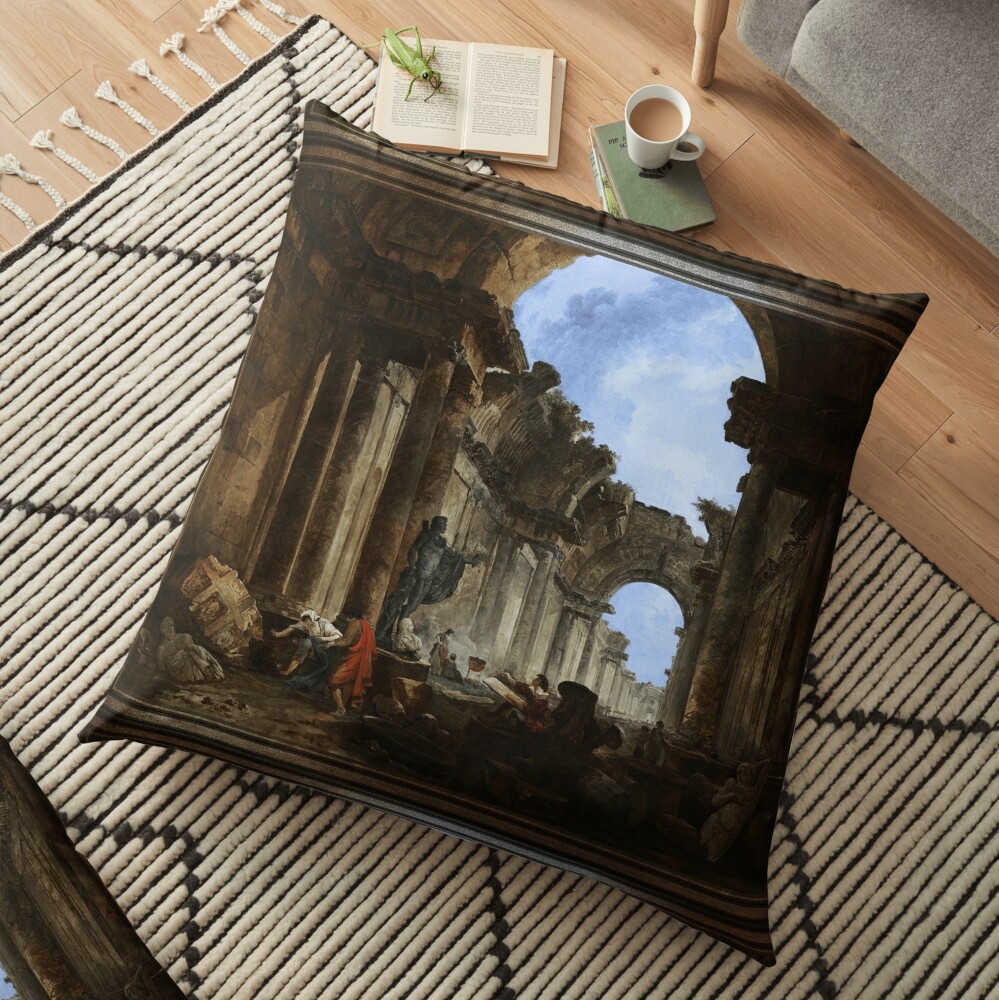
Grote Galerij van het Louvre in ruïnes c1796
Hubert Robert'S “Denkbeeldig zicht op de grote galerij van het Louvre in ruïnes,” geschilderd omstreeks 1796, is een verbluffende en dramatische afbeelding van de beroemde Louvre Gallery in Parijs, voorgesteld als een ruïne. De kunstenaar, bekend om zijn fantasierijke landschappen en afbeeldingen van architectonische grandeur, presenteert een suggestieve en sombere visie op het Louvre in staat van verval, spelend op het thema van de kracht van de tijd om zowel te creëren als te vernietigen.
Geboren in 1733 en binnen overlijden 1808, In Roberts werk werd vaak de combinatie van klassieke schoonheid en de onvermijdelijkheid van de ondergang onderzocht, die in dit stuk met meesterlijke vaardigheid wordt vastgelegd. Door het gebruik van licht, schaduw, en een zorgvuldig gestructureerde compositie, Robert doordrenkt deze denkbeeldige scène met een gevoel van diepe melancholie, terwijl het ook een reflectie biedt op het verloop van de geschiedenis.
Inhoudsopgave
Het hoofdonderwerp en de compositie
In het midden van Roberts canvas staat de prachtige maar afbrokkelende architectuur van de Grote Galerij van het Louvre, een iconisch symbool van de Parijse cultuur en kunst. De galerij, ooit een ruimte van grootsheid en culturele betekenis, wordt nu in puin afgebeeld. De kolommen die ooit de structuur ondersteunden, zijn gebarsten en brokkelen af, en de bogen lijken verzwakt, alsof ze elk moment kunnen instorten.
Opvallend is vooral de afwezigheid van een dak, en laat enorme uitgestrekte blauwe lucht binnen die scherp contrasteert met de somberheid, verweerde ruïnes beneden. De grandeur van de ruïne is duidelijk zichtbaar, maar het is ingehaald door de erosie van de tijd, giving the viewer a sense of abandonment and decay.
A group of figures populates the scene, scattered throughout the space. They are small in scale, almost dwarfed by the monumental ruins, and their actions add a layer of intrigue to the piece. Op de voorgrond, one figure appears to be assisting another, while two others sit on the ground amidst fallen columns and broken statues.
These figures seem to be the remnants of a once-vibrant cultural hub, now reduced to mere observers in the face of destruction. Their presence invites the viewer to contemplate the human aspect of decay, how history is shaped not only by the grand structures but also by the people who live within and around them.
Objecten en materialen
The objects scattered throughout the ruins speak volumes about the once-immense cultural importance of the gallery. Broken marble sculptures lie at the feet of the figures, some with fragments of limbs and torsos, others completely shattered. These pieces, which would have once been prized works of art, now lie in disrepair, lost to the ravages of time and neglect. Op de grond, shards of pottery and scattered debris further emphasize the ruinous state of the gallery.
The materials of the painting, olieverf op canvas, allow Robert to capture an astonishing level of detail and texture. The decaying marble columns, with their chipped edges and weathered surfaces, seem almost tactile, as if one could reach out and feel the roughness of the stone.
The figures, te, are depicted with meticulous care, their draped garments flowing gently in the breeze that sweeps through the open space. Their expressions, though somber, seem to reflect a sense of resignation rather than despair. The juxtaposition of the living, albeit defeated, figures against the unyielding stone ruins serves to underscore the transient nature of both life and art.
Terrein en sfeer
The terrain of the scene, though part of a grand gallery, is overrun with nature’s intrusion. Vegetation, including ivy and creeping vines, winds through the broken arches and columns, asserting nature’s inevitable reclaiming of manmade structures.
The floor is littered with rubble, large stone blocks, and shattered architectural elements that once formed the orderly, majestic design of the gallery. Despite the devastation, there is a beauty in the way nature and decay coexist in the scene. The ivy creeping through the cracks in the stone is not a sign of destruction but a reminder of the resilience of life, even in the face of human folly.
The atmosphere in Robert’s painting is tinged with a melancholic sense of inevitability. The open sky, with its soft clouds and light, contrasts with the weight of the ruins, creating a feeling of duality. On the one hand, the light suggests hope, a promise of renewal and rebirth, while the ruin itself speaks to the fragility of human achievement. The overall mood is contemplative, urging the viewer to reflect not only on the history of the Louvre as a symbol of culture and art but also on the universal themes of decay, change, and time’s unrelenting progression.
Stijl, Thema, en stemming
The style of Robert’s painting is rooted in the classical tradition, with precise and deliberate brushwork that lends a sense of realism to the imagined scene. Echter, his composition moves beyond mere representation, incorporating elements of the sublime. The grandeur of the ruins, set against a vast and empty sky, evokes feelings of awe and melancholy. There is no attempt to idealize the past; liever, Robert captures a moment of ruin and decay, allowing the viewer to confront the inevitable demise of all things.
The theme of the painting revolves around the passage of time and the impermanence of human endeavor. Robert presents the Louvre, one of the most famous cultural institutions in the world, as a monument to what was once grand and is now in ruins.
The idea of destruction is central to the piece, yet there is also an implicit message of renewal. The passage of time, while destructive, also allows for new beginnings, as nature slowly overtakes the ruins, and the cycle of life continues.
The mood of the painting is one of melancholy and introspection. The viewer is invited to meditate on the transitory nature of existence, the fragility of human creations, en het verstrijken van de tijd. It is a reminder that, despite the grandiosity of human accomplishments, all things are subject to decay. Nog, in this decay, there is also beauty—the beauty of nature’s resilience and the memory of what once was.
Grand Gallery of the Louvre in Ruins is a retouched digital art old masters reproduction of a public domain image that is available as a canvas print online.
Bio -kunstenaar
Onderstaande informatie afgeleid van: Wikipedia.org
Hubert Robert werd geboren in Parijs in 1733. Zijn vader, Nicolas Robert, was in dienst van François-Joseph de Choiseul, markies de Stainville een vooraanstaande diplomaat uit Lotharingen. De jonge Robert voltooide zijn studie bij de jezuïeten aan het Collège de Navarre in 1751 en ging het atelier van de beeldhouwer Michel-Ange Slodtz binnen, die hem ontwerp en perspectief leerde, maar hem aanmoedigde om te schilderen. In 1754 hij vertrok naar Rome in de trein van Étienne-François de Choiseul, zoon van de werkgever van zijn vader, die tot Franse ambassadeur was benoemd en staatssecretaris van Buitenlandse Zaken van Lodewijk XV zou worden in 1758.
Hij bracht de volledige elf jaar door in Rome, een opmerkelijke tijdsduur; nadat de officiële residentie van de jonge kunstenaar aan de Franse Academie in Rome opraakte, hij steunde zichzelf met werken die hij maakte voor bezoekende kenners zoals de abbé de Saint-Non, die Robert in april naar Napels bracht 1760 om de ruïnes van Pompeii te bezoeken. De markies de Marigny, directeur van de Bâtiments du Roi werd op de hoogte gehouden van zijn ontwikkeling in correspondentie met Natoire, directeur van de Franse Academie, die de pensionaires aanspoorde om buitenshuis te schetsen, uit de natuur: Robert had geen aansporing nodig; tekeningen uit zijn schetsboeken documenteren zijn reizen: Villa d'Este, Caprarola.
Uitzicht op de haven van Rippeta in Rome, C. 1766, met het oude Romeinse Pantheon naast een denkbeeldige poort