

день рождения бабушки
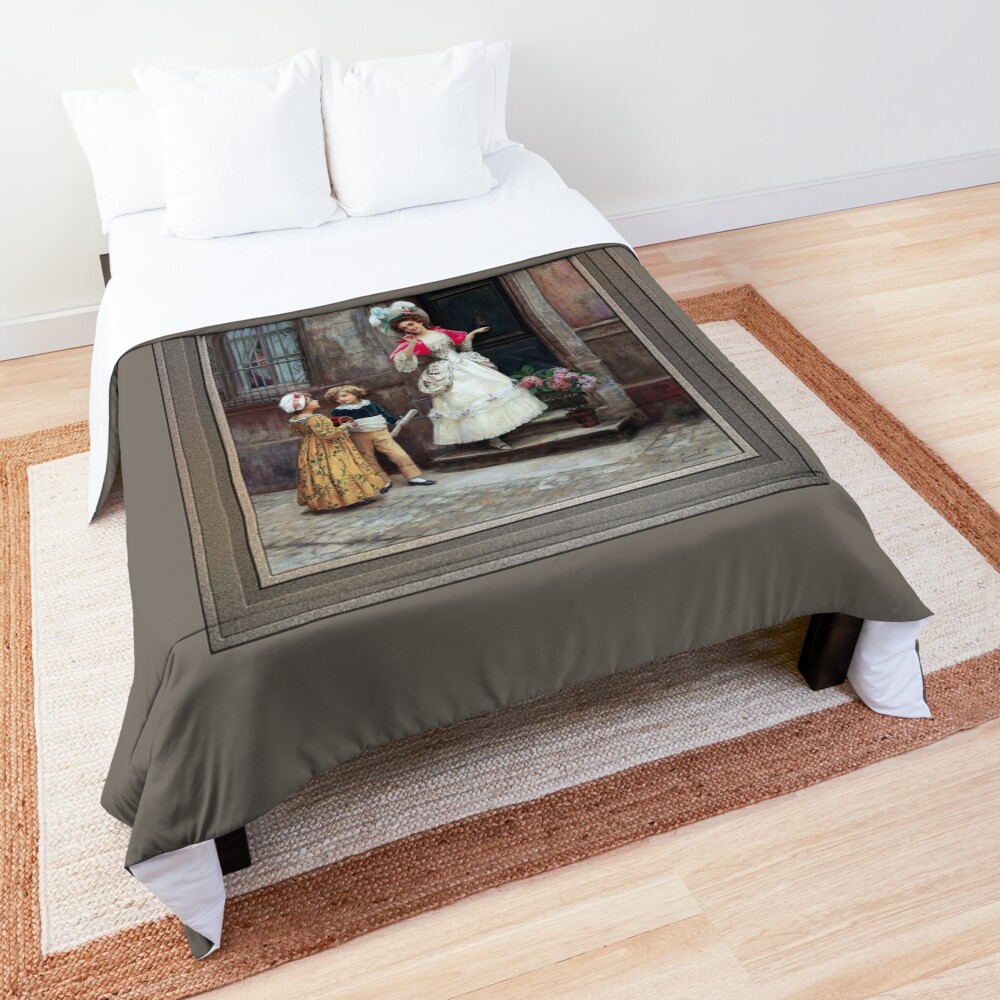
Jules Girardet’s painting “день рождения бабушки”, created sometime in the late 1900s, is a charming depiction of a joyful familial moment set against the backdrop of a quaint European street. Girardet, known for his ability to capture intricate details and narrative scenes, infuses this artwork with both lightheartedness and warmth, using the theme of family and celebration to draw the viewer into the scene. Родился в 1856 и скончался в 1938, Girardet’s work often explores the daily lives and sentiments of the people of his time, focusing on emotions conveyed through realistic depictions of figures and surroundings.
Оглавление
Основная тема: The Family
In the center of the genre composition stands the mother, elegantly dressed in a white gown with pink highlights, украшенный цветами. Her outfit exudes refinement and sophistication, suggesting she is of a certain social standing or class. The details of her attire, including the ribbons and lace, are delicately rendered by Girardet, with the artist capturing the gentle folds and texture of the fabric. Her presence conveys a sense of maternal warmth, as she stands on the stone steps leading to a door, smiling at her children. She holds a small gift in her hand, which hints at the purpose of their visit, a birthday celebration.
Дети, standing at her side, are dressed in period-appropriate clothing. The young girl to the left wears a yellow dress with delicate floral patterns, a charming reflection of her innocence and the tender nature of the moment. Her hair is covered by a white bonnet, further accentuating the period setting. В ее руке, she clutches a small rolled-up gift, adding to the sense of anticipation and delight that accompanies the occasion.
The boy on the right, dressed in a sailor-like shirt and trousers, is caught in the act of holding his own gift, the presence of which creates a sense of equality in the moment. His playful stance and the subtle turn of his head towards his sister underscore the familial bond between the two siblings, who are engaged in this joyful visit. The boy’s expression is one of curiosity, perhaps eager to see the reactions of their grandmother upon receiving the gifts.
Обстановка: A Quaint European Street
The scene takes place outside a weathered building, suggesting an older European architectural style, possibly in a residential district. The stone-paved ground beneath the family’s feet evokes a sense of historical continuity, with its slight unevenness suggesting age and use. The color palette employed by Girardet captures the muted tones of the environment—earthy hues of ochre, коричневый, and gray are juxtaposed with the lighter and brighter tones of the figures’ clothing, emphasizing the prominence of the family within the scene.
On the right side of the composition, a flowerpot with bright flowers rests on the stone step, a gentle touch of nature that contrasts with the solid, unyielding stone of the building. This floral element adds a sense of life and movement to the otherwise still and structured environment. Girardet’s ability to incorporate such details highlights the harmony between man-made architecture and the organic world.
Над фигурами, the building’s window is adorned with curtains, partially revealing the gaze of an elderly woman. The grandmother, seen through the window, gazes lovingly at her visitors from the first floor, watching the arrival of her children and grandchildren. Her figure is only partially visible, suggesting that she is more of an observer, perhaps overwhelmed with emotion at the sight of her loved ones. This moment of quiet observation contrasts with the active and vibrant presence of the family outside.
The Mood and Tone of the Painting
The overall mood of the painting is one of joy and anticipation. The familial interaction between the mother and her children, as well as the presence of the grandmother observing the scene from above, conveys a sense of love and connection. The composition captures the beauty of the moment through detailed expressions and body language. The mother’s gentle smile and the children’s excited gazes create an atmosphere of lighthearted joy, emphasizing the bond that family members share in times of celebration.
Girardet also balances the moment of familial connection with a sense of nostalgia, as seen in the soft, muted tones of the background. The weathered appearance of the building suggests a time long past, inviting the viewer to reflect on the passage of time and the enduring significance of family rituals, such as birthday celebrations. The presence of the flowers, the children’s clothes, and the intimacy of the scene all work together to elevate this moment into something timeless, reflecting both the artist’s skill and the emotional depth embedded within familial love and tradition.
The Materials and Artistic Style
Girardet employs oil paints to achieve the rich textures and finely detailed depictions in the scene. The brushwork is precise, particularly in the rendering of the figures’ clothing and the details of the background architecture. The delicacy of the mother’s gown and the texture of the children’s outfits suggest the artist’s focus on materiality, with each fabric rendered in a way that highlights its individual texture and weight. The figures themselves are painted with soft shading and gradual transitions of light, creating a lifelike quality to their appearances.
The overall style of the painting is a blend of realism and romanticism, typical of Girardet’s work. The artist captures not only the external details of the subjects but also their inner emotions, offering a glimpse into a moment that is both historically situated and emotionally universal. The attention to detail in the clothing, освещение, and the architectural elements all demonstrate Girardet’s skill in capturing both the physical world and the subtle undercurrent of affection that permeates the scene.
Биография художника
Утонченный гламур американской художницы Зои Мозерт Wikipedia.org
Жюль вместе со своим братом Леоном родился в апреле. 10, 1856 в Версале, Франция, французскому граверу Полю Жирарде (1821 – 1893); и он также был внуком гравера Шарля Самуэля Жирарде. (1780 – 1863); этим дядям Эдуард Жирарде (1819 – 1880) и Карл Жирарде (1813 – 1871) были также художниками.
Он, как и многие другие художники того времени, учился в Школе изящных искусств у французского художника Александра Кабанеля. (1823 – 1889) и оттуда отправился со своим братом Эженом Жирарде. (1853 – 1907) который был известным художником-востоковедом, участвовавшим в нескольких поездках в Северную Африку.; но в отличие от своего брата, посвящал свое время написанию жанровых сцен и исторических картин..
Брат и сестра Жюля тоже были художниками., и включал трех других его братьев Леона Жирарде. (1856 – 1895), Поль Арман Жирарде (1859 – 1915), Теодор Жирарде (1861 – 1935) и сестра Джулия Антонин (1851 – 1921).
В 1881 он начал выставляться в Парижском салоне и в 1889 взял Сиверскую медаль на Всемирной выставке..