

Head Of A Young Woman c1780s
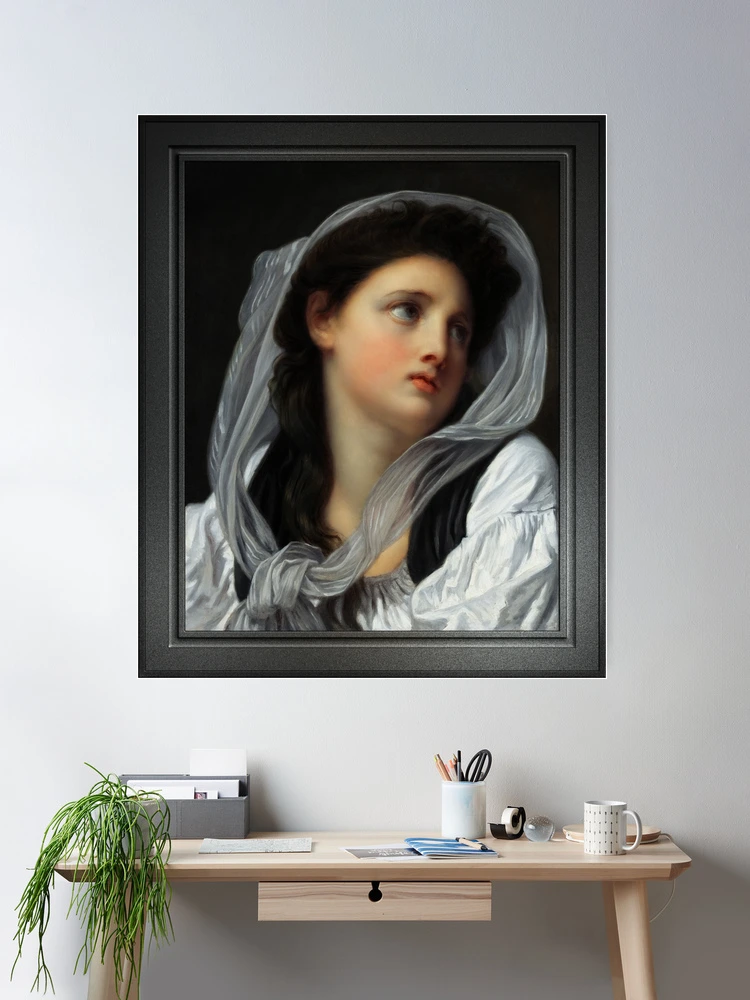
Grafika “Head Of A Young Woman c1780s” został stworzony przez znanego francuskiego artystę Jean-Baptiste Greuze (1725 – 1805). Greuze, a master of the Rococo and Neoclassical movements, has long been celebrated for his emotional portrayal of the human form, particularly in his genre scenes and portraiture. W tym obrazie, Greuze presents a close-up view of a young woman, capturing her delicate features and emotional expression. The subject’s appearance and pose evoke a quiet sense of vulnerability and contemplation, typical of the artist’s focus on intimate, personal moments.
Spis treści
Temat: A Moment of Vulnerability
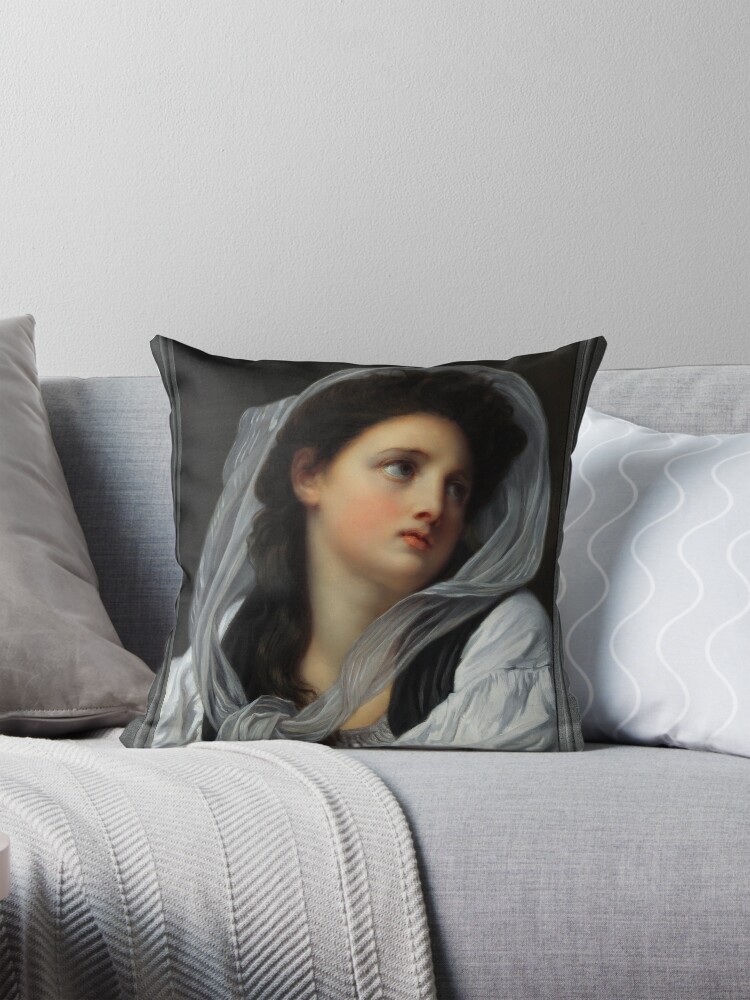
The young woman portrayed in this painting seems to be in a state of introspection, her gaze directed upward and slightly to the side, as though lost in thought or perhaps caught in a fleeting moment of emotion. Her head is slightly tilted, and her face, framed by flowing, soft fabric, adds an element of delicacy to the composition. The transparent veil-like material, which drapes gently over her head and shoulders, creates a soft contrast to the more defined features of her face, enhancing the subject’s fragile and ethereal quality. The veil’s soft folds suggest an underlying sense of modesty and demureness, qualities often emphasized in Greuze’s portraits of young women.
Her pale complexion, highlighted by soft brushstrokes, adds to the overall gentle mood of the piece. Jej oczy, slightly wide, exude a quiet vulnerability. The expression is not one of distress but rather one of thoughtful quietude, inviting the viewer to engage with her internal world, though it remains shrouded in mystery. The subtle play of light on her face further enhances her youthful innocence and purity, while the deep shadows surrounding her create a mood of melancholy, emphasizing her isolation in this intimate moment.
Materiały i techniki: A Masterful Rendering of Light and Texture
Greuze, known for his meticulous attention to detail, employed traditional oil painting techniques to create a strikingly realistic and textured portrait. The rendering of the young woman’s face and veil shows the artist’s exceptional ability to manipulate light and shadow, particularly in his treatment of the skin’s texture and the translucent fabric.
The artist’s mastery of chiaroscuro – the contrast between light and dark – creates a deep sense of volume in the subject’s face, allowing each delicate contour to emerge. The pale tones of her face are subtly warmed by the naturalistic application of color, creating a softness that feels almost tangible. Greuze’s use of the fine details in her hair and the transparent veil elevates the portrait beyond a simple likeness, offering instead a nuanced representation of the subject’s emotional depth.
Zasłona, a key element in the composition, is rendered with exceptional care. Each fold and layer is crafted to suggest a sense of weight and fluidity, and its lightness contrasts with the more defined features of the young woman’s face. The contrast between the smoothness of her skin and the texture of the veil emphasizes the artist’s understanding of fabric as both an element of fashion and a device to enhance the mood and meaning of the composition.
The Emotional Tone and Psychological Depth
Greuze’s work is often praised for its emotional depth, and this portrait of the young woman is no exception. The expression on her face hints at complex psychological states: she appears to be caught in a moment of emotional tension, one that does not necessarily suggest joy or sorrow but rather a contemplative or pensive state. The choice to depict the subject in such a vulnerable moment rather than in a more formal or rigid pose adds an element of relatability to the viewer, drawing them into the scene and inviting them to interpret her emotional state.
The mood created by the painting is one of quiet introspection, heightened by the somber dark background that isolates the young woman from her surroundings. This dark backdrop allows the viewer’s focus to remain entirely on the subject, further deepening the emotional resonance of the portrait.
The juxtaposition of light and dark, along with the contrast between the soft skin and the flowing fabric, creates a feeling of fragility that permeates the entire composition. This exploration of emotional depth was characteristic of the Rococo period, where portraiture was often used to convey not only the physical likeness of a subject but also their inner emotional life.
Wniosek: A Timeless Portrait of Youth and Vulnerability
“Head of a Young Woman” stands as a remarkable example of Jean-Baptiste Greuze’s skill in portraying the emotional complexity of the human figure. Through his masterful handling of light, cień, i tekstura, Greuze captures a moment of delicate beauty and introspection, inviting the viewer to contemplate not only the external features of the subject but also her internal world. The artwork is a testament to the artist’s ability to evoke complex psychological and emotional states through the medium of oil paint, offering a portrait that transcends time and remains poignant even today.
To dzieło sztuki cyfrowej, podobnie jak wszystkie dzieła sztuki, które można znaleźć na stronie internetowej Xzendor7, można kupić online w różnych formatach materiałów, w tym odbitki na płótnie, wydruki akrylowe, metalowe nadruki, druki na drewnie, wydruki w ramkach, plakaty, i jako zwijane wydruki na płótnie w różnych rozmiarach od 12 cale do 72 cale w zależności od rozmiaru rzeczywistej grafiki i sklepu z drukiem na żądanie, w którym zdecydujesz się kupić sztukę.
Grafika jest również dostępna na szerokiej gamie odzieży męskiej i damskiej, kubki, torby, szaliki, notesy i czasopisma oraz wiele produktów do dekoracji wnętrz.
O Artystce
Poniższe informacje pochodzą z NGA.gov
Jan urodził się w Tournus, Francja w 1725 jako szósty syn mistrza kafelek, który rozpoznał swój talent już w bardzo młodym wieku; wysłanie go do Lyonu, we Francji, aby studiować u francuskiego portrecisty Charlesa Grandona (1691 – 1762).
W wieku około 30 opuścił Lyon, i udał się do Paryża, Francja na studia w Académie royale de peinture et de sculpture lub Królewskiej Akademii Malarstwa i Rzeźby; która w tamtym czasie była najważniejszą instytucją artystyczną Francji w drugiej połowie Ancien Régime (Stary Regiem ~ 1500 do 1789), aż do jej zniesienia w r 1793 podczas Rewolucji Francuskiej.
Choć bardzo utalentowany i odnoszący duże sukcesy w latach sześćdziesiątych i siedemdziesiątych XVIII wieku, mając patronów pokroju markizy de Pompadour (1721 – 1764), Cesarzowa Rosji Katarzyna II (r. 1762 – 1796), i Ange Laurent z La Live de Jully (1725 – 1779); jego buntownicza natura i konflikty z przedstawicielami Akademii i Salonu okazałyby się jego nieszczęściem; zwłaszcza po ślubie z Anne Marie Babuty w r 1759; co okazałoby się dla niego katastrofą, jak wiadomo, miała różne romanse z jego uczniami i opiekunami, co spowodowało utratę dochodów i publiczne upokorzenie.
Kiedy małżeństwo się skończyło 34 lata później jego żona otrzymała znaczną ugodę, co pozostawiło go w trudnej sytuacji finansowej i do czasu jego śmierci w 1805 w wieku 80 był prawie spłukany.