

Hebe After The Fall c.1880
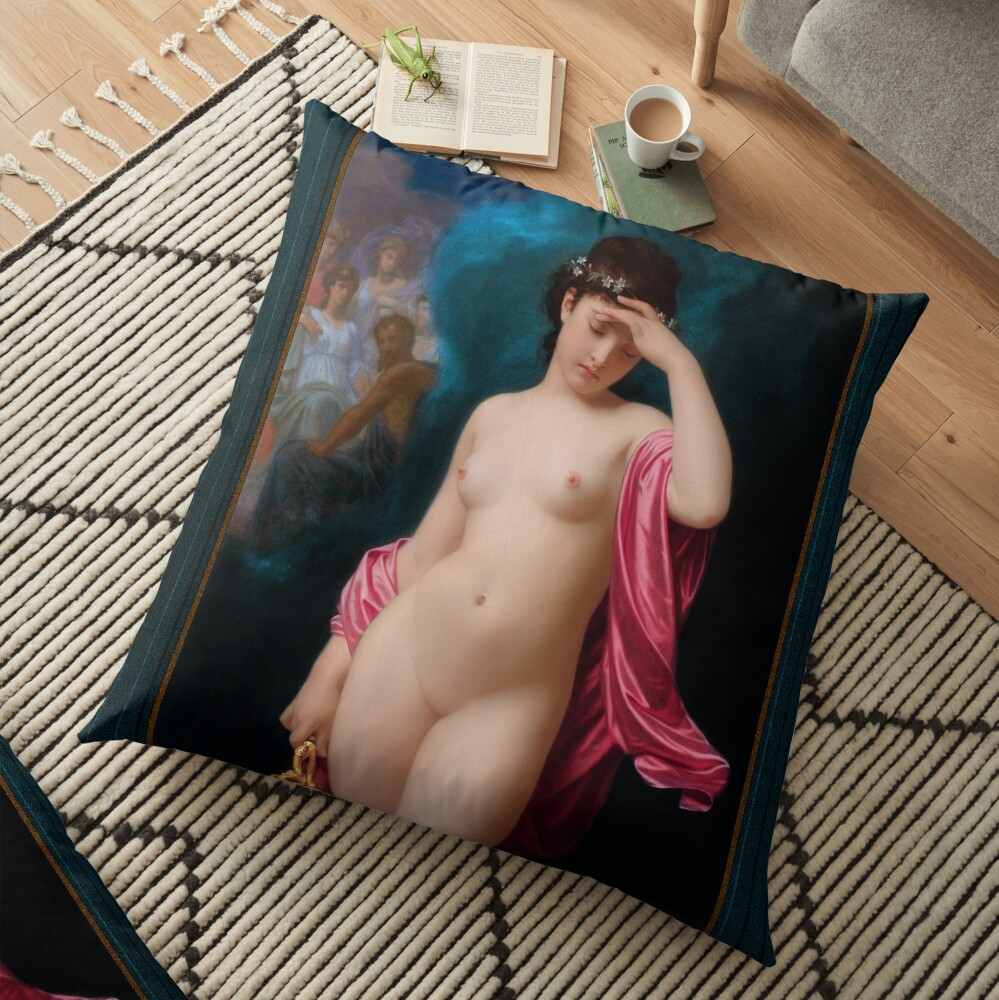
“Hebe After The Fall,” painted by the French artist Hugues Merle en 1880, captures a mythological scene filled with emotion and classical beauty. Hugues Merle, Naskiĝis en 1822 kaj enirante 1881, was known for his romantic interpretations of historical and mythological themes. This work, depicting the Greek goddess Hebe in a moment of vulnerability, is a prime example of Merle’s skill in blending sensuality with divine mythological elements, characteristic of his romantic style. The scene is dramatic yet serene, offering a glimpse into a world of gods, beleco, and timeless human emotion.
Enhavtabelo
La Ĉefa Temo: Havu, the Goddess of Youth
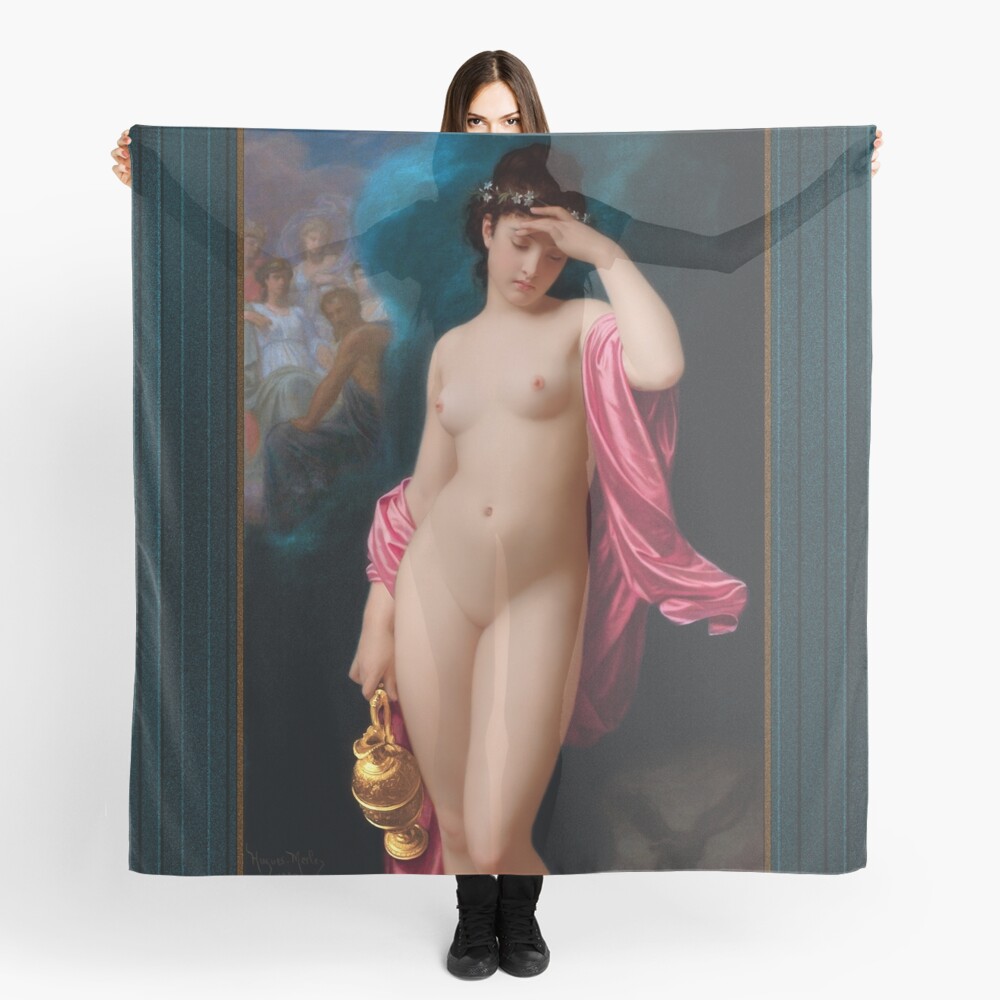
At the heart of the painting is Hebe, the goddess of youth, as she stands in a vulnerable pose, slightly recoiling, her right hand resting upon her forehead as though in deep reflection or in reaction to a sudden event. She is nude except for a flowing robe of rich pink, draped over her left shoulder and wrapping around her body. Her posture suggests a moment of contemplation or perhaps the aftermath of an emotional experience. Hebe’s youthfulness is emphasized by her delicate features, youthful face, and graceful stance. Her physical form, soft yet strong, is idealized according to classical beauty standards, making her seem divine, untouched by the harshness of mortality.
Her expression is one of subtle sadness, perhaps indicating the sorrow after a fall—whether literal or symbolic. This moment might refer to Hebe’s fall from grace in a mythological context or a broader interpretation of youth and innocence lost. The slight tilt of her head and the downward gaze suggest introspection or regret, as she processes the reality of her situation.
The Objects and Symbols: The Golden Goblet
In Hebe’s left hand, she holds a golden goblet, an object of great significance in ancient myth. The goblet could be interpreted as a symbol of her role as the cupbearer to the gods, serving nectar to the Olympian deities. The choice of a golden vessel imbues the piece with a sense of divine luxury, further elevating Hebe’s status as a celestial being. The delicate yet heavy design of the goblet contrasts with the purity and softness of her skin, symbolizing the tension between earthly desires and the ethereal nature of the gods.
The faint background figures are also significant, though they are less detailed and appear more ethereal, suggesting other deities or spiritual entities that hover on the edge of Hebe’s consciousness. These figures may represent gods or nymphs who witness the goddess’s plight, perhaps offering a subtle hint of support or simply standing as distant observers.
La Tereno: A Dreamlike Setting
The background of the painting is a swirl of blues and purples, with ethereal clouds and soft glowing light. These dreamlike elements add to the otherworldly quality of the scene, transforming the landscape into an almost celestial space. The terrain is devoid of any realistic earthly elements; there are no trees, no earth, no clear horizon line. Anstataŭe, it is as though the goddess exists in a divine, liminal space, caught between two worlds—between mortality and immortality, between the known and the unknown.
This blurred, surreal background enhances the mythological tone of the painting, leaving Hebe suspended in an unearthly environment that could be interpreted as a representation of the divine realm. The contrasting softness of the background against Hebe’s vibrant figure highlights her as the focal point of the piece, directing the viewer’s attention to her emotional and physical presence.
Materialoj kaj tekniko
Hugues Merle’s “Hebe After The Fall” was likely created using oil paints on canvas, as was common during the late 19th century for works that sought to achieve a high level of realism and detail. The artist’s attention to detail in Hebe’s facial expression, her flowing drapery, and the careful modeling of her figure shows the mastery of traditional techniques that Merle employed. His use of soft brushstrokes and a delicate color palette imbues the painting with a sense of calmness and grace, while also allowing for a rich texture and depth to the image.
The contrast between the smoothness of Hebe’s skin and the gentle ripples of her robe is achieved with skilled brushwork, demonstrating Merle’s proficiency in rendering fabric and flesh in a way that almost mimics life itself. This technique highlights the contrast between divine perfection and the fragile human condition, both of which are central to the painting’s theme.
La Temo: Youth, Vulnerability, and the Divine
The thematic focus of the painting revolves around the transient nature of youth and beauty, a common theme in Romantic and Classical art. Havu, as a goddess of youth, embodies this fleeting moment of life that is forever captured in her image. Her vulnerability in the painting can be seen as a reminder of the fragility of life, even for the gods, who are often depicted as eternal and invincible. The moment of her fall suggests that no one, not even the divine, is immune to the forces of fate or the passing of time.
This exploration of vulnerability is further emphasized by the soft, almost melancholic expression on Hebe’s face, indicating a deeper emotional experience than simply the visual representation of a goddess. The golden goblet in her hand, her only tangible possession in the piece, serves as a reminder of her divine role, but it also suggests the transitory nature of her role and her status among the gods.
The background figures, though indistinct, add an element of support and reflection, reminding the viewer that even in moments of fall or loss, the divine world is filled with unseen forces and entities that shape the experience. Whether these figures represent other gods, spirits, or abstract entities is left to the interpretation of the viewer, further adding to the mystery and layered meaning of the piece.
Humoro: A Sense of Quiet Reflection
The overall mood of the painting is one of calm introspection. Though Hebe’s body is poised in a moment of vulnerability, there is no sense of dramatic anguish. Anstataŭe, her pose, face, and the soft lighting suggest a quiet acceptance or a pensive pause. It’s as if the painting captures a brief, intimate moment in which the goddess reflects upon a fall—whether from grace or from a higher realm—before finding her way back to the divine world.
The subdued color palette, the ethereal background, and Hebe’s posture work together to evoke a mood of somber beauty, one that invites the viewer to ponder the complexities of divinity, juneco, kaj la paso de la tempo.
This is a retouched digital art old masters reproduction of a public domain image that is available for sale online as a kanvaso, metalo, akrila, wood and rolled print.
Ĉi tiu cifereca arta kreaĵo, kiel kun ĉiuj artaĵoj, kiuj troveblas en la retejo de Xzendor7, estas aĉetebla interrete en diversaj materialaj formatoj inkluzive de kanvasaj presaĵoj., akrilaj presaĵoj, metalaj presaĵoj, lignaj presaĵoj, enkadrigitaj presaĵoj, afiŝoj, kaj kiel rulitaj kanvasaj presaĵoj en diversaj grandecoj de 12 colojn al 72 coloj depende de la grandeco de la reala artaĵo kaj la presaĵo laŭpeta butiko, de kiu vi elektas aĉeti la arton.
La artaĵo ankaŭ haveblas sur larĝa gamo de vestaĵoj de viroj kaj virinoj, tasoj, totoj, koltukoj, kajeroj kaj ĵurnaloj kaj multaj hejmornamaj produktoj.
Artisto Bio
La Subaj Informoj Devenas Vikipedio.org kaj Rehs.com
Hugues Merle estis naskita en 1822 en La Zono, Francio kaj ĉirkaŭ la aĝo de 21 alvenis Parizon, Francio kie li studis pentraĵon sub la franca Historia kaj Portretfarbisto Léon Cogniet (1794 – 1880).
Kvankam oni scias malmulte pri la frua vivo de Hugues, oni supozas, ke li ricevis iom da arta edukado antaŭ ol li alvenis en Parizo en 1843; ĉar li komencis ekspozicii ĉe la Pariza Salono en 1847 kun sia peco Portreto de la aŭtoro kaj en 1848 li ekspoziciis la pecon Légende des Willis.
Ĉar tempo daŭris Hugues reputacio kiel portretisto kreskis sufiĉe dum la 1850-aj jaroj; kaj kiel sukcesa kaj elstara farbisto li povis altiri seriozajn artamantojn kiuj serĉis konstrui siajn artkolektojn..
Unu el tiuj fruaj kolektantoj de arto estis la 4-a Markizo de Hertford, Richard Seymour-Conway (1800-1870); kiu aĉetis sian salonsubmetaĵon Reading the Bible in 1859.
Dum la 1860-aj jaroj, Hugues-klientlisto de kolektantoj inkludis ne nur individuojn de la eŭropa kontinento, sed ankaŭ usonaj kolektantoj, kiel ekzemple William Walters de Baltimoro kiu komisiis La Skarlatan Leteron.