

Hebe After The Fall c.1880
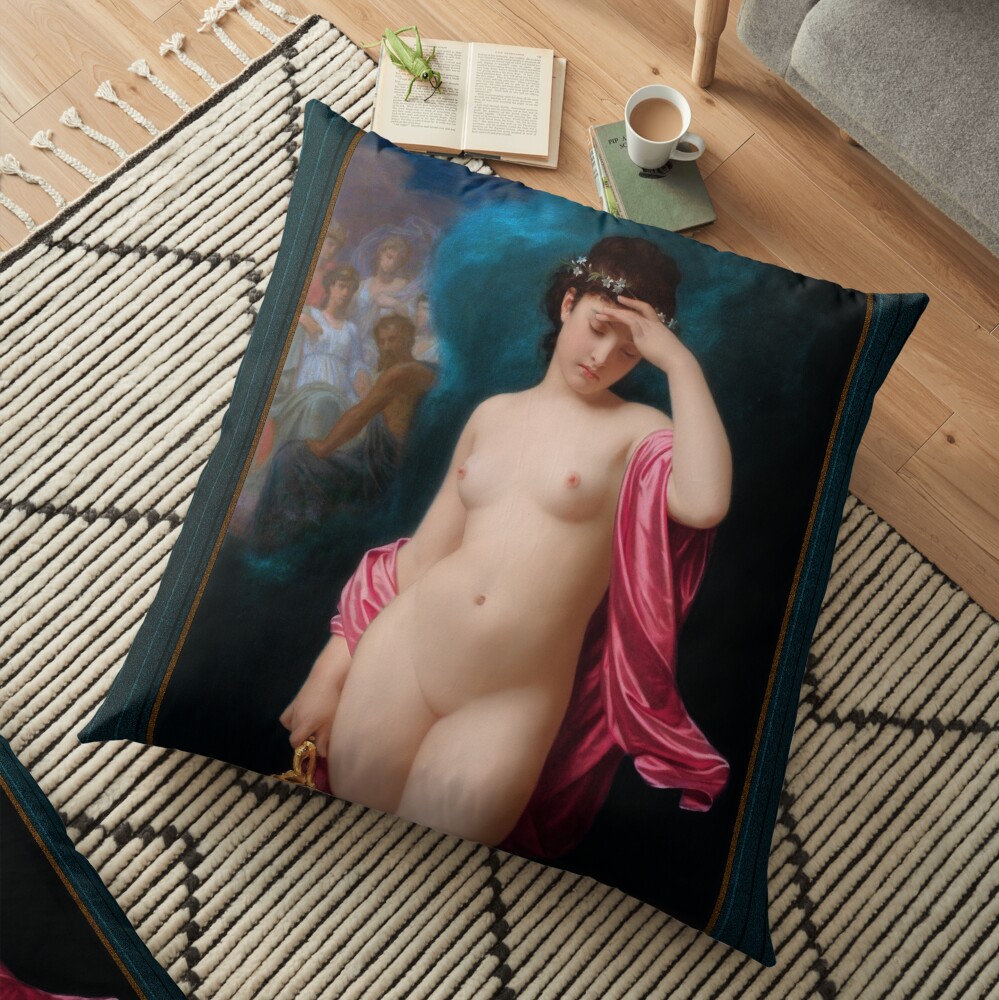
“Hebe After The Fall,” painted by the French artist Hugues Merle a-steach 1880, captures a mythological scene filled with emotion and classical beauty. Hugues Merle, rugadh ann 1822 agus a’ dol a-steach 1881, was known for his romantic interpretations of historical and mythological themes. An obair seo, depicting the Greek goddess Hebe in a moment of vulnerability, is a prime example of Merle’s skill in blending sensuality with divine mythological elements, characteristic of his romantic style. The scene is dramatic yet serene, offering a glimpse into a world of gods, bòidhchead, and timeless human emotion.
Clàr-innse
Am Prìomh Chuspair: Tha, the Goddess of Youth
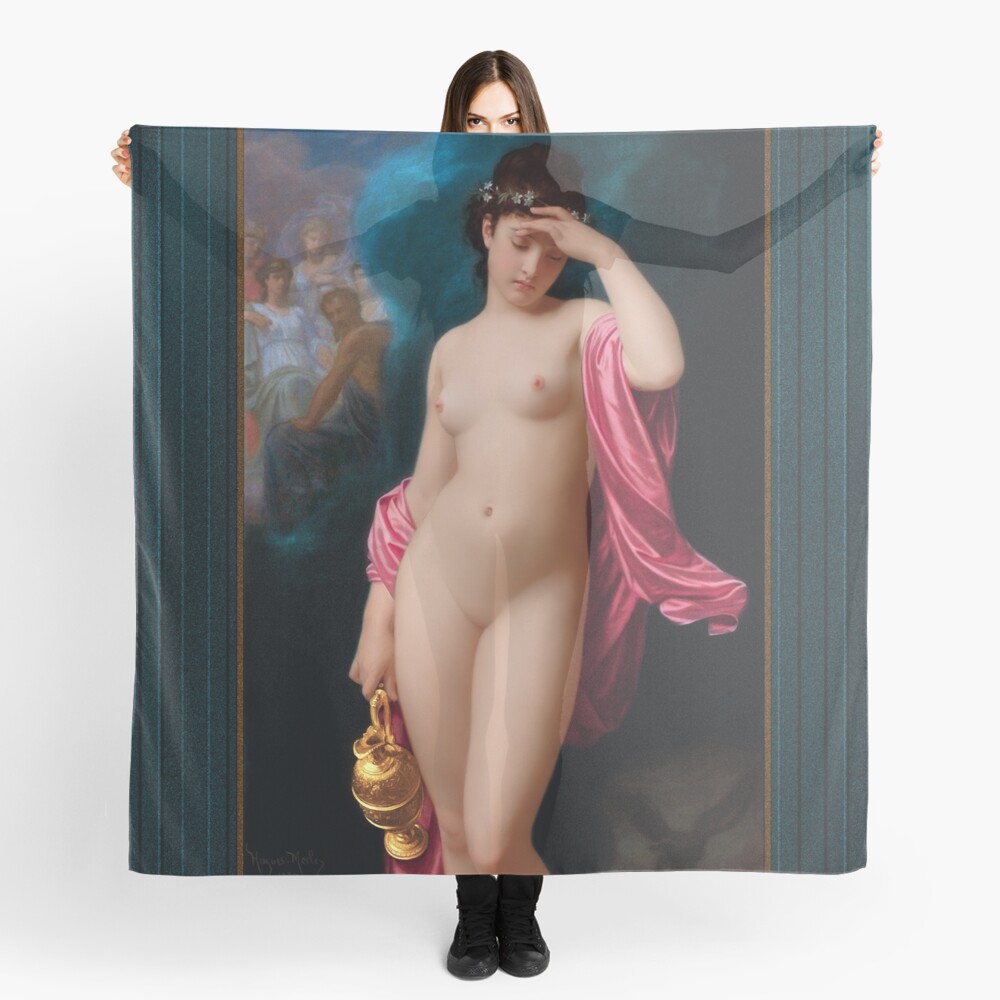
At the heart of the painting is Hebe, ban-dia na h-òige, as she stands in a vulnerable pose, slightly recoiling, her right hand resting upon her forehead as though in deep reflection or in reaction to a sudden event. She is nude except for a flowing robe of rich pink, draped over her left shoulder and wrapping around her body. Her posture suggests a moment of contemplation or perhaps the aftermath of an emotional experience. Hebe’s youthfulness is emphasized by her delicate features, youthful face, and graceful stance. Her physical form, soft yet strong, is idealized according to classical beauty standards, making her seem divine, untouched by the harshness of mortality.
Her expression is one of subtle sadness, perhaps indicating the sorrow after a fall—whether literal or symbolic. This moment might refer to Hebe’s fall from grace in a mythological context or a broader interpretation of youth and innocence lost. The slight tilt of her head and the downward gaze suggest introspection or regret, as she processes the reality of her situation.
The Objects and Symbols: The Golden Goblet
In Hebe’s left hand, she holds a golden goblet, an object of great significance in ancient myth. The goblet could be interpreted as a symbol of her role as the cupbearer to the gods, serving nectar to the Olympian deities. The choice of a golden vessel imbues the piece with a sense of divine luxury, further elevating Hebe’s status as a celestial being. The delicate yet heavy design of the goblet contrasts with the purity and softness of her skin, symbolizing the tension between earthly desires and the ethereal nature of the gods.
The faint background figures are also significant, though they are less detailed and appear more ethereal, suggesting other deities or spiritual entities that hover on the edge of Hebe’s consciousness. These figures may represent gods or nymphs who witness the goddess’s plight, perhaps offering a subtle hint of support or simply standing as distant observers.
An talamh: A Dreamlike Setting
The background of the painting is a swirl of blues and purples, with ethereal clouds and soft glowing light. These dreamlike elements add to the otherworldly quality of the scene, transforming the landscape into an almost celestial space. The terrain is devoid of any realistic earthly elements; there are no trees, no earth, no clear horizon line. An àite sin, it is as though the goddess exists in a divine, liminal space, caught between two worlds—between mortality and immortality, between the known and the unknown.
This blurred, surreal background enhances the mythological tone of the painting, leaving Hebe suspended in an unearthly environment that could be interpreted as a representation of the divine realm. The contrasting softness of the background against Hebe’s vibrant figure highlights her as the focal point of the piece, directing the viewer’s attention to her emotional and physical presence.
Stuthan agus innleachd
Hugues Merle “Hebe After The Fall” was likely created using oil paints on canvas, as was common during the late 19th century for works that sought to achieve a high level of realism and detail. The artist’s attention to detail in Hebe’s facial expression, her flowing drapery, and the careful modeling of her figure shows the mastery of traditional techniques that Merle employed. His use of soft brushstrokes and a delicate color palette imbues the painting with a sense of calmness and grace, while also allowing for a rich texture and depth to the image.
The contrast between the smoothness of Hebe’s skin and the gentle ripples of her robe is achieved with skilled brushwork, demonstrating Merle’s proficiency in rendering fabric and flesh in a way that almost mimics life itself. This technique highlights the contrast between divine perfection and the fragile human condition, both of which are central to the painting’s theme.
An Cuspair: Youth, So-leòntachd, and the Divine
The thematic focus of the painting revolves around the transient nature of youth and beauty, a common theme in Romantic and Classical art. Tha, as a goddess of youth, embodies this fleeting moment of life that is forever captured in her image. Her vulnerability in the painting can be seen as a reminder of the fragility of life, even for the gods, who are often depicted as eternal and invincible. The moment of her fall suggests that no one, not even the divine, is immune to the forces of fate or the passing of time.
This exploration of vulnerability is further emphasized by the soft, almost melancholic expression on Hebe’s face, indicating a deeper emotional experience than simply the visual representation of a goddess. The golden goblet in her hand, her only tangible possession in the piece, serves as a reminder of her divine role, but it also suggests the transitory nature of her role and her status among the gods.
The background figures, though indistinct, add an element of support and reflection, reminding the viewer that even in moments of fall or loss, the divine world is filled with unseen forces and entities that shape the experience. Whether these figures represent other gods, spirits, or abstract entities is left to the interpretation of the viewer, further adding to the mystery and layered meaning of the piece.
Mood: A Sense of Quiet Reflection
The overall mood of the painting is one of calm introspection. Though Hebe’s body is poised in a moment of vulnerability, there is no sense of dramatic anguish. An àite sin, her pose, aghaidh, and the soft lighting suggest a quiet acceptance or a pensive pause. It’s as if the painting captures a brief, intimate moment in which the goddess reflects upon a fall—whether from grace or from a higher realm—before finding her way back to the divine world.
The subdued color palette, the ethereal background, and Hebe’s posture work together to evoke a mood of somber beauty, one that invites the viewer to ponder the complexities of divinity, Òigridh, agus siubhal ùine.
Is e ealain didseatach ath-leasaichte a tha seo old masters reproduction of a public domain image that is available for sale online as a canabhas, meatailt, acrylic, fiodh agus clò rolaichte.
An cruthachadh ealain didseatach seo, mar a tha leis a h-uile obair-ealain a gheibhear air làrach-lìn Xzendor7 ri fhaighinn airson a cheannach air-loidhne ann an grunn chruthan stuth a’ gabhail a-steach clò-bhualaidhean canabhas, dealbhan acrylic, clò-bhualaidhean meatailt, clò-bhualaidhean fiodha, lèileagan frèam, postairean, agus mar chlò-bhualadh canabhas air a roiligeadh ann an grunn mheudan bho 12 òirlich gu 72 òirlich a rèir meud an fhìor obair-ealain agus a’ bhùth clò-bhualaidh air iarrtas a thaghas tu airson an ealain a cheannach.
Tha an obair-ealain cuideachd ri fhaighinn air raon farsaing de dh’ aodach fireannaich is boireannaich, mugaichean, toitean, sgarfaichean, leabhraichean notaichean agus irisean agus mòran stuthan sgeadachaidh dachaigh.
Neach-ealain Bio
Tha am fiosrachadh gu h-ìosal a’ tighinn bho Wikipedia.org agus Rehs.com
Rugadh Hugues Merle ann an 1822 ann an La Sône, An Fhraing agus timcheall air aois 21 ràinig Paris, An Fhraing far an do rinn e sgrùdadh air peantadh fo Pheantair Eachdraidh is Dealbh na Frainge Léon Cogniet (1794 – 1880).
Ged nach eil mòran fiosrachaidh mu bheatha thràth Hugues thathas a’ gabhail ris gun d’ fhuair e ìre de dh’ fhoghlam ealain mus do ràinig e Paris ann an 1843; oir thòisich e air taisbeanadh aig Salon Paris ann an 1847 leis a’ phìos aige Portrait of the author and in 1848 sheall e am pìos Légende des Willis.
Mar a chaidh ùine air adhart dh’ fhàs cliù Hugues mar dhealbhadair gu mòr anns na 1850n; agus mar pheantair soirbheachail agus follaiseach bha e comasach dha fìor leannanan ealain a thàladh a bha a’ coimhead ris na cruinneachaidhean ealain aca a thogail.
B’ e aon den luchd-cruinneachaidh ealain tràth sin an 4mh Marcas Hertford, Richard Seymour-Conway (1800-1870); a cheannaich an tagradh salon aige Leughadh a’ Bhìobaill a-steach 1859.
Anns na 1860an, Hugues client list of collectors included not only individuals from the European continent, ach cuideachd luchd-cruinneachaidh Ameireaganach, leithid Uilleam Walters à Baltimore a bharrantaich The Scarlet Letter.