

Le plus jeune frère (Le plus jeune frère)
“Le plus jeune frère” (Le plus jeune frère), peint en 1854 by the German artist Johann Georg Meyer (1813 – 1886), captures a tender and intimate moment in a domestic setting, exemplifying the genre of sentimental realism that was prevalent in mid-19th century Europe. The painting portrays three children, their expressions imbued with innocence and affection, contre un doux, atmospheric backdrop that enhances the emotional weight of the scene. This quiet and serene composition highlights Meyer’s attention to the subtleties of childhood emotions and familial love, rendered with a softness and warmth that invite the viewer to reflect on themes of family, care, and fragility.
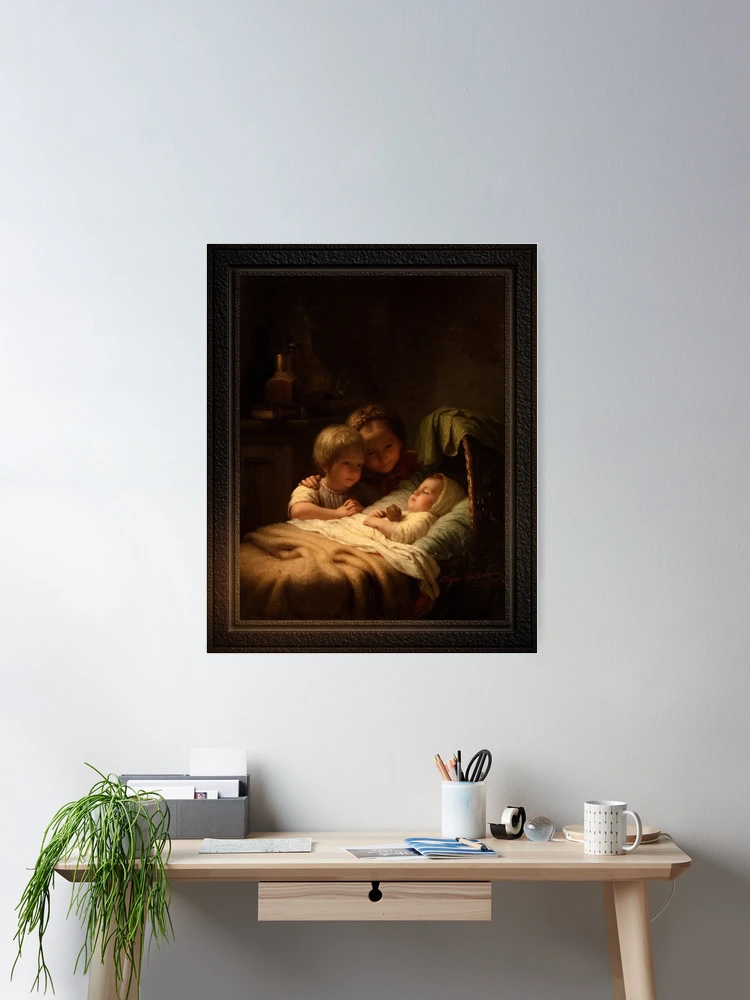
Table des matières
Composition and Figures
In the center of the composition lies the youngest child, swaddled in a light white blanket, sleeping peacefully in a cradle. Le doux, rounded features of the child, bathed in a gentle light, evoke a sense of tranquility and innocence. The sleeping infant, likely the subject of the painting’s title, is positioned as the focal point, symbolizing vulnerability and tenderness. Their eyes are closed, and their face is serene, creating a peaceful mood that contrasts with the more dynamic expressions of the surrounding children. The child’s tiny hand is curled around a small object, possibly a toy or comfort item, further enhancing the sense of peacefulness and contentment.
Flanking the cradle are two older siblings, their expressions filled with an affectionate interest and concern for the baby. The boy on the left, with his tousled blonde hair and wide eyes, gazes at the infant with a sense of deep love, while his hand rests on the edge of the cradle, gently touching the child. His posture is tender, suggestive of his role as a protective older sibling.
The girl on the right, with dark hair neatly styled in braids, leans forward with an expression of quiet joy, her lips slightly parted as though caught in a moment of reverence for the infant. The play of light and shadow on their faces suggests a shared emotional experience, one marked by familial devotion and a deep bond between the children.
Contexte et atmosphère
The background of the painting is dark and indistinct, rendered with subtle brushstrokes that suggest a cozy, dimly lit room, likely part of a modest home. There are a few elements that offer hints about the interior, such as the faint outlines of a wooden cabinet or shelves, and an assortment of domestic objects, which create a sense of familiarity and comfort.
The background does not distract from the figures in the foreground, instead serving to amplify the emotional intimacy of the scene. The painter has skillfully used muted tones of brown, or, and cream to craft an atmosphere that is both warm and quiet, invoking feelings of calm and security. The soft blending of light and shadow enhances the peacefulness of the moment, allowing the figures to emerge gently from the darkness.
Palette de couleurs et technique
Meyer’s use of color is restrained yet evocative. The palette of browns, soft greens, crèmes, and muted yellows imbues the scene with a warm, almost golden hue, reflecting the calm and comforting nature of the subject matter. The light source seems to come from the left, casting a soft glow on the children’s faces and bodies while leaving parts of the room in shadow. This play of light and shadow emphasizes the forms and textures of the figures, particularly the softness of the children’s clothing and the delicate texture of the blankets. The choice of colors suggests a deep emotional warmth, heightening the viewer’s emotional connection to the scene.
The painting’s technique is notable for its fine detail and subtle realism. Meyer uses a soft, almost velvety brushwork to depict the textures of the children’s faces, their clothing, and the folds of the bedding, creating a smooth and tender finish. The artist has a masterful command of light, using it not just to illuminate the figures but to enhance the emotional tone of the painting. The light seems to symbolically embrace the children, highlighting their faces and bodies in a manner that suggests care, protection, et l'amour.
Ambiance et thème
L'ambiance de “Le plus jeune frère” is one of quiet reverence and emotional tenderness. The closeness of the siblings to the sleeping infant evokes a sense of familial love and protection, as well as a deep connection to the simple joys of childhood. Il y a une qualité intemporelle dans la scène, as though the act of watching over a younger sibling is a universal experience, one that transcends time and culture. The peaceful expressions of the children, coupled with the calm environment, convey a mood of safety and harmony, inviting the viewer to reflect on the precious nature of childhood and the bonds that tie families together.
The theme of childhood innocence is central to the painting, with the depiction of the infant’s peaceful sleep standing as a metaphor for the purity and vulnerability of early life. The two older children’s attentive gazes and their protective postures reinforce the idea of familial responsibility and love. Meyer’s careful rendering of the figures and their emotional expressions underscores the theme of care, making this work not only a representation of childhood but also an exploration of the intimate emotional connections between siblings.
Conclusion
“Le plus jeune frère” stands as an exemplary work of 19th-century sentimental realism, capturing a deeply emotional moment within a domestic setting. Johann Georg Meyer’s painting transcends mere depiction, offering a narrative that speaks to the universal experiences of childhood and family. Grâce à son utilisation magistrale de la lumière, Couleur, and brushwork, Meyer evokes a sense of warmth and tenderness that resonates with viewers even today. Le doux, peaceful scene reflects a bygone era when the bonds of family were cherished and protected, and childhood innocence was considered sacred.
Le plus jeune frère est une reproduction numérique retouchée d'un chef-d'œuvre d'art du domaine public.
Cette création d'art numérique, comme toutes les œuvres d'art disponibles sur le site Web Xzendor7, elles sont disponibles à l'achat en ligne dans une variété de formats de matériaux, y compris des impressions sur toile., impressions acryliques, impressions métalliques, gravures sur bois, impressions encadrées, affiches, et sous forme d'impressions sur toile roulées dans une variété de tailles de 12 pouces à 72 pouces en fonction de la taille de l'œuvre d'art réelle et de la boutique d'impression à la demande auprès de laquelle vous choisissez d'acheter l'art.
L’œuvre d’art est également disponible sur une large gamme de vêtements pour hommes et femmes., tasses, fourre-tout, écharpes, cahiers et journaux et de nombreux produits de décoration intérieure.
À propos de l'artiste
Informations ci-dessous dérivées de Wikipedia.org
Johann Meyer a commencé ses études artistiques en 1834 à l'âge de 21, quand il est allé à Düsseldorf et est entré à l'Académie des Arts, dirigé par le peintre romantique allemand Friedrich Wilhelm Schadow (1789 – 1862), qui était le fils du sculpteur germano-prussien Johann Gottfried Schadow (1764 – 1850).
Sept ans plus tard dans 1841 Meyer son propre studio à Düsseldorf, mais a ensuite déménagé à Berlin en 1853 à mesure que sa popularité et sa renommée augmentaient.
Bien que l'intérêt initial de Meyer ait été de créer des scènes de la Bible; plus tard dans sa carrière, il s'est tourné vers la création de scènes de genre de la vie quotidienne , avec un accent sur la paysannerie de Hesse, puis sur la représentation de l'aspect pathétique de la vie de famille.
Des images telles que « Le jubilé d'un pasteur de Hesse » c1843, 'Réveillon de Noël,''Buff de l'aveugle,''Le retour du soldat,''L'inondation' c1846, « La fille repentante » c1852, sont pleins d'une profonde sympathie pour les « simples annales des pauvres ».
Il a également peint d'autres scènes qui s'inspirent de la vie d'enfance, qui comprenait « La petite fille aux fleurs c1853 », 'Le conte de fées,' ' Enfants jouant au buff de Blindman,' ' Grand-père et petit-fils,' et d'autres.
Alors que plus tard dans sa carrière a également fait des peintures de jeunes femmes, soit dans des poses simples ou en groupe; et ceux-ci incluaient « The Tryst », « La lettre d'amour » et « La lettre » c1873.