

Geschiedenis van een komeet (History Of A Comet) c1897
Luis Ricardo Falero's schilderij “Geschiedenis van een komeet” (Geschiedenis van een komeet), gemaakt in 1897, embodies the intersection of science, mythologie, en sensualiteit, blending them into a narrative that speaks to the imagination of its time. Born in Spain in 1851 en passeren 1896, Falero was known for his romanticized depictions of the female figure, often intertwining her with celestial themes. His works were steeped in allegory and mysticism, exploring the interplay between the human form and the cosmic. “Geschiedenis van een komeet” is geen uitzondering; it is a captivating representation of a comet’s journey, personified in the form of a celestial woman, evoking both mystery and grandeur.
Inhoudsopgave
Het hoofdonderwerp en de compositie
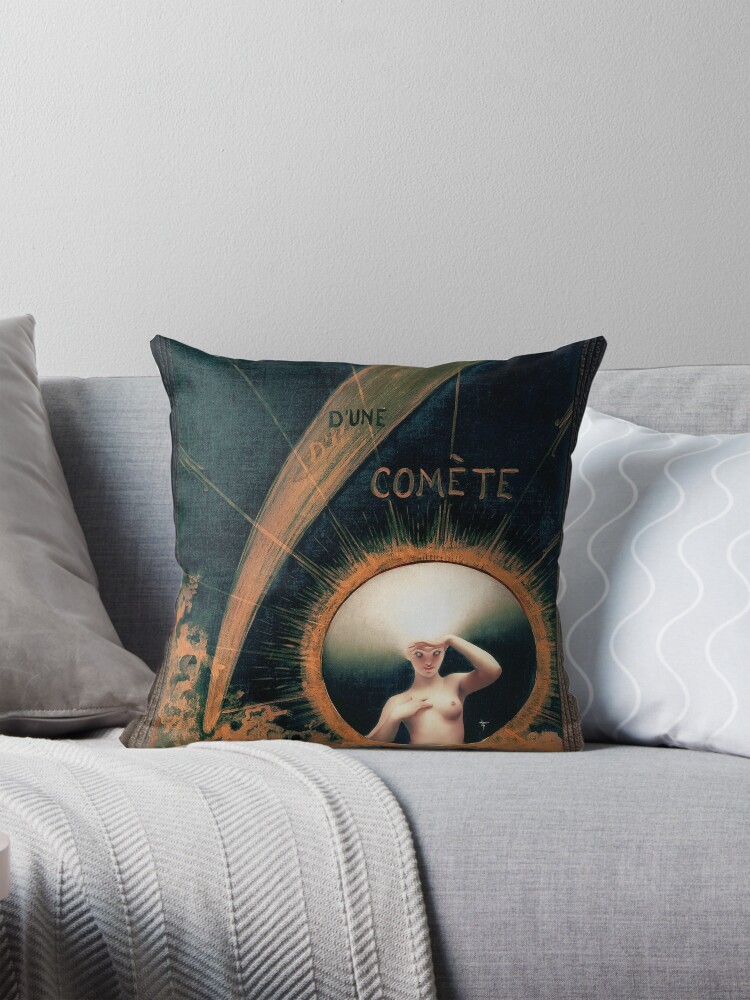
At the heart of the painting is a striking female figure, luminous and ethereal, who gazes out of the canvas, drawing the viewer into a surreal interaction. Haar houding, with one arm raised to shield her eyes, suggests that she is a cosmic being, perhaps an embodiment of the comet herself. This woman, naked and seemingly untouched by time, is framed by a glowing, otherworldly aura. Her pale, almost ghostly complexion contrasts sharply with the dark, textured backdrop, emphasizing her luminous quality.
The subject’s features are soft and symmetrical, characteristic of Falero’s idealized female form. Her hair is a silvery halo, radiating outward, further reinforcing her celestial nature. The figure is situated in front of a large, circular area of darkness, which serves as a portal or the center of the comet’s tail. The bright, jagged rays of the comet’s tail streak across the canvas, converging at the woman’s form and illuminating her silhouette. The comet is both the subject and the symbol of the artwork, offering a dual narrative of scientific discovery and mythological imagination.
Objecten, Terrain, and Symbolism
The background of the painting is a deep, velvety green that transitions into a dark, almost cosmic blue as it moves outward, creating a sense of depth and infinity. This color palette suggests the boundless nature of the universe, where the comet’s passage and the woman’s ethereal presence symbolize the intersection of the known and the unknown.
The comet’s tail itself is rendered in sweeping, fiery strokes that emanate from the upper left corner, arching across the canvas towards the woman. These strokes are not merely artistic embellishments but serve as a direct visual representation of the comet’s path through the sky. The comet is both a literal object in the painting and a symbol of the transient nature of time and existence. It embodies movement, change, and the constant passage of celestial bodies through the cosmos.
The woman’s physical nudity is not just an artistic choice but a deliberate metaphor. It suggests purity and vulnerability, making her a vessel for cosmic forces. Her raised arm, which shields her eyes, invokes the idea of revelation and discovery. De kijker, through her gaze, is invited to witness the unfolding of the comet’s story, much like how astronomers might peer through telescopes to understand the universe. The idea of revelation is further emphasized by the surrounding elements, such as the trailing streaks of the comet, which allude to the idea of a narrative unfolding through time.
Stijl, Thema, en stemming
Falero’s technique in “Geschiedenis van een komeet” blends elements of Romanticism and Symbolism, creating a scene that is both dreamlike and charged with emotional intensity. The exaggerated, almost mystical qualities of the comet and the woman suggest a thematic focus on the unknown and the exploration of celestial bodies. The painting’s atmospheric quality, where the celestial and human realms meet, also touches on themes of fate and destiny.
The mood of the painting is one of quiet contemplation, but it is also imbued with a sense of grandeur and awe. The woman’s serene expression and the comet’s fiery passage create an otherworldly tension between the cosmic and the human. The color contrasts—the pale figure against the dark background, the warm glow of the comet’s tail against the cool tones of the universe—enhance this sense of duality. There is an undeniable mysticism to the work, with the viewer left to wonder about the true nature of the comet and the woman, and the larger cosmic forces at play.
Falero’s choice to integrate the celestial body as both a scientific and mythological object underscores the late 19th century’s fascination with astronomy and the growing interest in the mysteries of the universe. The painting’s blending of these elements is a hallmark of the Symbolist movement, which sought to explore deeper truths beyond the material world.
Materialen en techniek
In terms of materials, Falero likely employed oil paints on canvas, a medium that allowed for the rich layering and luminous quality that defines the work. His brushstrokes are both delicate and deliberate, adding texture and depth to the comet’s tail and the woman’s figure. The painting’s composition is highly controlled, with the central figure carefully framed by the radiating light of the comet. This control over the composition adds to the otherworldly precision of the work, heightening the sense of cosmic order and harmony.
The painting’s intricate detailing of the comet’s tail and the softness of the woman’s skin indicate Falero’s mastery of the medium. His blending of light and shadow is particularly notable in the way the comet’s rays illuminate the woman’s body, creating a dramatic contrast that draws attention to the figure while simultaneously suggesting the vast, cosmic space in which she exists.
Histoire dune Comete is een geretoucheerde digitale kunst oude meesters reproductie van een afbeelding uit het publieke domein.
Bio van kunstenaar afgeleid Wikipedia.org
Falero werd geboren in Granada en had oorspronkelijk een carrière bij de Spaanse marine, maar gaf het op aan de teleurstelling van zijn ouders; toen hij besloot naar Parijs te reizen, waar hij kunst studeerde, scheikunde en werktuigbouwkunde.
Tijdens is studies in scheikunde en werktuigbouwkunde; hij vond de experimenten die hij moest uitvoeren te gevaarlijk, waardoor hij zijn aandacht alleen op het schilderen richtte.
Als gevolg hiervan werd hij een leerling van de Franse portretschilder en oriëntalist Gabriel-Joseph-Marie-Augustin Ferrier (1847 – 1914). Na Parijs, hij verhuisde naar Londen, waar hij zijn studie voortzette, en uiteindelijk geregeld.
Falero had een bijzondere interesse in astronomie en verwerkte hemelse sterrenbeelden in veel van zijn werken, zoals “Het huwelijk van een komeet” en “Tweelingsterren”. Zijn interesse en kennis van astronomie brachten hem er ook toe om de werken van Camille Flammarion te illustreren.
In 1896, het jaar van zijn dood, Maud Harvey klaagde Falero aan wegens vaderschap. Het pak beweerde dat Falero Harvey had verleid toen ze dat was 17, eerst als zijn dienstmeisje, en dan zijn model. Toen hij ontdekte dat ze zwanger was, hij stuurde haar weg.
Ze won de zaak en kreeg vijf shilling per week ter ondersteuning van hun kind. Falero stierf in het University College Hospital, Londen, op de leeftijd van 45