

Idleness c1900
Ghjuvanni Guglielmu Godward, a prominent British painter known for his stunning depictions of the Classical world, created the artwork “Idleness” in 1900. Godward (1861 – 1922), celebrated for his mastery in portraying women in serene, timeless poses within classical and mythological settings, paints a poignant image of stillness and leisure in this particular work. The scene, though filled with vibrant color and serene composition, evokes a timeless mood that blends the antique with an almost dreamlike quality. Godward’s style, often associated with the Academic tradition, is on full display in this painting, where the skillful use of light, struttura, and classical elements invites the viewer into a moment frozen in time.
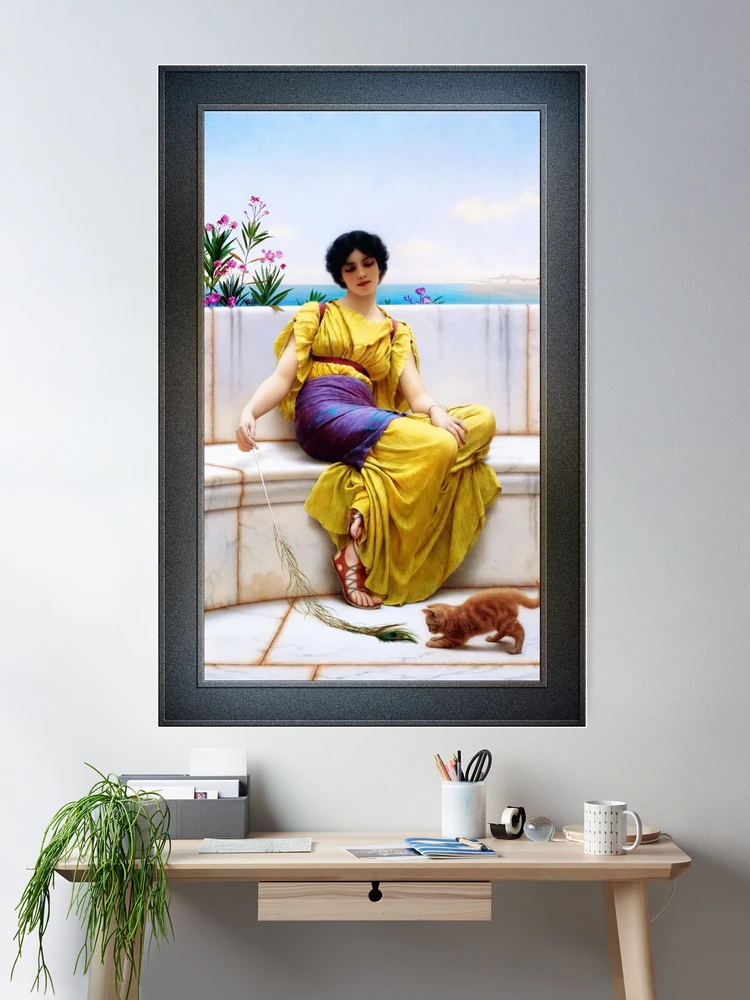
Table of Contents
U sughjettu
À u core di “Idleness” is the depiction of a young woman, sitting gracefully on a marble bench with a contemplative expression. Her delicate posture and the way she holds a long peacock feather, gently draped from her fingers, imply a quiet moment of repose, as she uses it to play with a kitten. Her body, draped in flowing garments of rich yellow and purple, suggests a figure both in the midst of relaxation and deep thought. The colors of her attire, set against the cool tones of the surrounding environment, add an ethereal quality to her figure, elevating her presence to that of an idealized beauty.
The woman’s dark, short hair contrasts with the golden hues of her clothing, creating a visual balance that complements the soft and inviting mood of the piece. Her facial expression is peaceful, with her gaze lowered as if lost in thought or perhaps in idle contemplation. It is an image of tranquility, drawing the viewer’s attention to the subject’s serene beauty. The slowness and grace of her movements are accentuated by the absence of any evident action or hurry in her pose, fitting the title “Idleness” perfectly. Her limbs, languidly arranged, exude a sense of stillness that enhances the theme of leisure.
Oggetti è Materiali
The bench on which the young woman rests is made of polished marble, its surface smooth and lustrous, contributing to the luxurious and timeless atmosphere of the artwork. The marble’s cool, pale tones contrast beautifully with the warmer hues of her attire. The surrounding scene includes delicate touches of floral elements, with vibrant pink flowers and green foliage sprouting from pots or planters that frame the scene. These natural elements serve to soften the otherwise pristine environment, adding a touch of liveliness to the otherwise tranquil setting.
The woman’s bare feet are visible, suggesting a connection to the earth beneath her, while her sandals are softly laced, further emphasizing her relaxed state. The twine she holds seems to gently cascade from her hand, a quiet object that contrasts with the elegance of her posture. The composition overall uses these subtle details, her clothing, the marble bench, the plants, and the twine, to evoke a sense of harmony between the subject and her environment, suggesting an idyllic escape from the demands of everyday life.
Terrain è Sfondate
The backdrop of “Idleness” features a coastal vista, with a soft blue sky and distant views of the sea. The horizon appears calm, with gentle ripples on the water’s surface that mirror the peaceful stillness of the scene. This landscape, while not highly detailed, is nonetheless a crucial element in conveying the sense of serenity and escape. The background serves as a visual reminder of the natural world and its role in providing the perfect setting for the woman’s contemplative repose.
The architecture surrounding the subject, though minimal, suggests an outdoor space—perhaps a garden or courtyard of some ancient villa. The use of white and light tones in the stonework is in harmony with the soft pastel colors of the sky, further enhancing the atmosphere of classical elegance and beauty. The gentle curves of the stonework lead the viewer’s eye towards the figure, focusing attention on the stillness of the subject amidst a tranquil, almost dreamlike, setting.
Stile è tecnica
Godward’s style is one rooted in the academic traditions of the 19th century, influenced by his early training under classical painters and his deep admiration for the ancient Roman and Greek worlds. In “Idleness,” his attention to detail is evident in the texture of the woman’s gown, the softness of her skin, and the lustrous quality of the marble. Each fold of the woman’s clothing is carefully modeled to convey the weight and flow of the fabric, while the skin is rendered with a soft glow that highlights the artist’s ability to capture the nuances of light.
The use of color is one of the defining features of Godward’s style. The warm yellow of the woman’s dress contrasts beautifully with the cooler blues of the sea and sky, creating a harmonious palette that exudes calm and contentment. The juxtaposition of purple and yellow further enhances the vibrant yet restrained mood of the painting. The choice of colors is not just aesthetically pleasing but serves to emphasize the classical theme of timeless beauty and the idea of idleness as an ideal state of mind.
Godward’s meticulous brushwork and mastery of light and shadow create a sense of depth and dimension within the composition. The sunlight that softly illuminates the woman’s face and the folds of her clothing enhances the sense of warmth in the scene. This soft rendering of light and shadow contrasts with the clarity of the background, making the figure appear almost ethereal in comparison. The careful application of paint, combined with Godward’s ability to capture the texture of different surfaces, such as the smooth marble, the softness of the woman’s skin, and the delicate fabric of her dress, demonstrates his exceptional skill as an artist.
Umore è tema
L'umore di “Idleness” is one of peacefulness, relaxation, and an almost reverent stillness. The figure of the young woman, with her contemplative pose and serene expression, captures the essence of the theme of idleness: a moment in time where nothing is required, and all that exists is the peaceful state of being. This sense of timeless leisure is further reinforced by the classical setting and the absence of any hurried motion in the scene. There is no sense of urgency or distraction in this moment, only the quiet, almost sacred, experience of simply being.
The theme of idleness, a concept often revered in classical art, suggests a harmonious balance between human beings and nature. It invites the viewer to reflect on the value of stillness and the simple pleasures of life. In this work, Godward celebrates the beauty of leisure, not as a fleeting or wasteful moment, but as an ideal state of existence that connects the human figure with nature and the timeless, mondu classicu.
Idleness is a remastered digital art old masters reproduction of a public domain image that is available as a stampa su tela in linea.
Questa creazione d'arte digitale, cum'è cù tutte l'opere d'arte chì ponu esse truvate nantu à u situ web di Xzendor7 hè dispunibule per cumprà in linea in una varietà di formati di materiale cumprese stampe di tela., stampe acriliche, stampe metalliche, stampe di lignu, stampe in cornice, manifesti, è cum'è stampe su tela rolled in una varietà di dimensioni da 12 centimetri à 72 centimetri secondu a dimensione di l'opera d'arte attuale è a stampa nantu à a tenda chì sceglite di cumprà l'arte da.
L'opera d'arte hè ancu dispunibule nantu à una larga gamma di vestiti di l'omi è di e donne, mugs, tote, sciarpe, quaderni è ghjurnali è parechji prudutti di decoru di casa.
À propositu di l'artista
Info sottu Da Wikipedia.org
John William Godward era u maiò di cinque figlioli, è fù chjamatu dopu à u so babbu Ghjuvanni è u missiavu Guglielmu.
Hà esibitu à l'Accademia Reale da 1887. Quandu si trasfirìu in Italia cù unu di i so mudelli 1912, a so famiglia rumpiu ogni cuntattu cù ellu è ancu tagliatu a so maghjina da i ritratti di famiglia. Godward hà tornatu in Inghilterra 1921, mortu in 1922, è hè intarratu in u cimiteru di Brompton, West London.
Unu di i so pitturi più cunnisciuti hè Dolce far Niente (1904), chì hè stata acquistata per a cullizzioni di Andrew Lloyd Webber in 1995. Cum'è in u casu di parechje altre pitture, Godward pintò più di una versione; in stu casu, un prima (è menu cunnisciuti) 1897 versione cù un altru 1906 versione.
Si suicidò à l'età di 61 è si dice chì hà scrittu in a so nota di suicidiu chì “u mondu ùn hè abbastanza grande per [tramindui] me è un Picasso”.
A so famiglia straniera, chì avia disappruvatu di diventà un artista, si vergognavanu di u so suicidiu è brusgiavanu i so carte. Solu una fotografia di Godward hè cunnisciuta per sopravvive.
Godward era un neo-classicista vittoriano, è dunque, in teoria, un seguitore di Frederic Leighton. Tuttavia, hè più strettamente alleatu stilisticu à Sir Lawrence Alma-Tadema, cù quale hà spartutu un incantu per a rendizione di l'architettura classica - in particulare, caratteristiche di u paisaghju staticu custruitu da marmaru.
A maiò parte di l'imaghjini esistenti di Godward presentanu e donne in vestiti classici posati contr'à e caratteristiche di u paisaghju; Bien qu'il y ait des figures semi-nues et entièrement nues incluses dans son œuvre, un esempiu notevoli essendu “In u Tepidarium c1913”.
Un titulu spartutu cù una pittura cuntruversa di Alma-Tadema di u stessu sughjettu chì reside in u “Galleria d'Arte Lady Lever”. I tituli riflettenu a fonte d'ispirazione di Godward; chì era a civiltà classica, in particulare quellu di l'Antica Roma; un sughjettu chì lia Godward strettamente à Alma-Tadema artisticamente.
Siccomu a borsa di studiu classica era più diffusa trà l'audienza potenziale per i so dipinti durante a so vita chè in l'oghje., A ricerca meticulosa di i dettagli era impurtante per ottene una reputazione cum'è artista in questu generu.
Alma-Tadema era un archeologu è ancu un pittore, chì hà assistitu à i siti storichi è cullighjava artefatti chì hà utilizatu dopu in i so pitture: Godward, ancu, studiatu tali dettagli cum'è l'architettura è u vestitu, per assicurà chì e so opere portanu u timbru di l'autenticità.
In più, Godward hà sbulicatu è meticulosamente rende altre caratteristiche impurtanti in i so pitture, pelli d'animali di cui i dipinti “Riposa à meziornu c1910” è “A Cool Retreat c1910” cuntene esempi di tali interpretazioni è ancu fiori salvatichi “Nerissa c1906” è “Fiori d'estate c1903”.
L'apparizione di belle donne in pose studiate in tanti di i tele di Godward face chì parechji novi vinuti à e so opere l'anu categurizatu erroneamente cum'è Pre-Raphaelite., in particulare chì a so paleta hè spessu una vibrante culurita. A scelta di u sughjettu (civiltà antica versus, per esempiu, legenda arturiana) hè più propriamente quellu di u neo-classicista vittorianu.
In cumunu cù numerosi pittori cuntimpuraniu cun ellu, Godward era un "High Dreamer Victorian", pruducia images di un mondu idealized è romanticized chì, in u casu di Godward è Alma-Tadema, hè vinutu à esse criticatu cum'è una visione di u mondu di i Vittoriani in togas.
Godward “hà rapidamente stabilitu una reputazione per i so dipinti di giovani donne in un ambiente classicu è a so capacità di trasmette cù sensibilità è maestria tecnica a sensazione di texture di carne cuntrastanti., marmura, pelliccia è tessuti.
L'inclinazione di Godward per a creazione d'opere d'arti ambientate in u periodu classicu hè probabilmente vinutu da u periodu di tempu in u quali era natu.; cum'è era l'ultimu rinascimentu classicu à grande scala in i pitture occidentali, chì fiorì in Inghilterra da l'anni 1860 finu à l'anni 1890.