

Idleness c1900
Seán Uilliam Godward, a prominent British painter known for his stunning depictions of the Classical world, created the artwork “Idleness” in 1900. Diabhalta (1861 – 1922), celebrated for his mastery in portraying women in serene, timeless poses within classical and mythological settings, paints a poignant image of stillness and leisure in this particular work. The scene, though filled with vibrant color and serene composition, evokes a timeless mood that blends the antique with an almost dreamlike quality. Godward’s style, often associated with the Academic tradition, is on full display in this painting, where the skillful use of light, uigeacht, and classical elements invites the viewer into a moment frozen in time.
Clár na nÁbhar
An tÁbhar
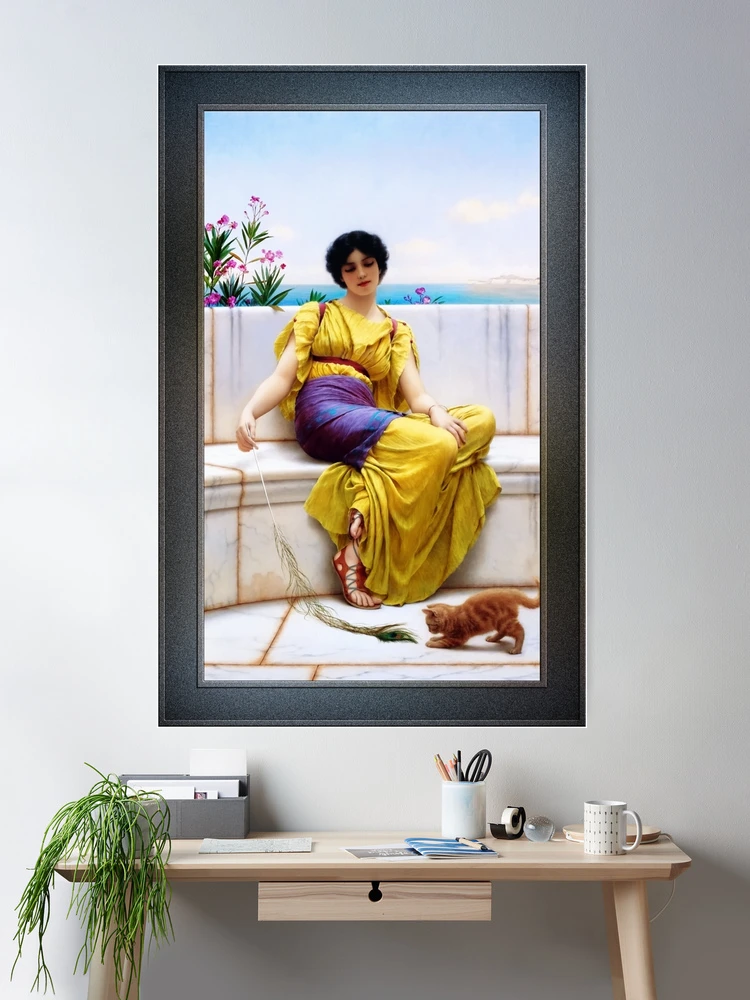
I gcroílár na “Idleness” is the depiction of a young woman, sitting gracefully on a marble bench with a contemplative expression. Her delicate posture and the way she holds a long peacock feather, gently draped from her fingers, imply a quiet moment of repose, as she uses it to play with a kitten. A corp, draped in flowing garments of rich yellow and purple, suggests a figure both in the midst of relaxation and deep thought. The colors of her attire, set against the cool tones of the surrounding environment, add an ethereal quality to her figure, elevating her presence to that of an idealized beauty.
The woman’s dark, short hair contrasts with the golden hues of her clothing, creating a visual balance that complements the soft and inviting mood of the piece. Her facial expression is peaceful, with her gaze lowered as if lost in thought or perhaps in idle contemplation. It is an image of tranquility, drawing the viewer’s attention to the subject’s serene beauty. The slowness and grace of her movements are accentuated by the absence of any evident action or hurry in her pose, fitting the title “Idleness” perfectly. Her limbs, languidly arranged, exude a sense of stillness that enhances the theme of leisure.
Cuspóirí agus Ábhair
The bench on which the young woman rests is made of polished marble, its surface smooth and lustrous, contributing to the luxurious and timeless atmosphere of the artwork. The marble’s cool, pale tones contrast beautifully with the warmer hues of her attire. The surrounding scene includes delicate touches of floral elements, le bláthanna bándearga bríomhara agus duilliúr glas ag sproutadh ó photaí nó plandálaithe a fhrámaíonn an radharc. Feidhmíonn na heilimintí nádúrtha seo chun an timpeallacht a bheadh gann ar bhealach eile a mhaolú, ag cur beocht leis an suíomh a bheadh suaimhneach eile.
Tá cosa lom na mná le feiceáil, ag moladh nasc leis an talamh faoina bráid, agus a sandals lásaithe go bog, ag cur béim bhreise ar a staid shuaimhneach. Is cosúil go bhfuil an sreangán atá aici ag imeacht go réidh óna lámh, rud ciúin atá i gcodarsnacht le galántacht a staidiúir. Úsáideann an comhdhéanamh foriomlán na sonraí subtle seo, a cuid éadaigh, an bhinse marmair, na plandaí, agus an sreangán, chun mothú comhréiteach a mhúscailt idir an t-ábhar agus a timpeallacht, ag moladh éalú idéalach ó éilimh an tsaoil laethúil.
Tír -raon agus cúlra
Cúlra na “Idleness” gnéithe radharc cósta, with a soft blue sky and distant views of the sea. The horizon appears calm, with gentle ripples on the water’s surface that mirror the peaceful stillness of the scene. This landscape, while not highly detailed, is nonetheless a crucial element in conveying the sense of serenity and escape. The background serves as a visual reminder of the natural world and its role in providing the perfect setting for the woman’s contemplative repose.
The architecture surrounding the subject, though minimal, suggests an outdoor space—perhaps a garden or courtyard of some ancient villa. The use of white and light tones in the stonework is in harmony with the soft pastel colors of the sky, further enhancing the atmosphere of classical elegance and beauty. The gentle curves of the stonework lead the viewer’s eye towards the figure, focusing attention on the stillness of the subject amidst a tranquil, almost dreamlike, setting.
Stíl agus teicníc
Godward’s style is one rooted in the academic traditions of the 19th century, influenced by his early training under classical painters and his deep admiration for the ancient Roman and Greek worlds. I “Idleness,” his attention to detail is evident in the texture of the woman’s gown, the softness of her skin, and the lustrous quality of the marble. Each fold of the woman’s clothing is carefully modeled to convey the weight and flow of the fabric, while the skin is rendered with a soft glow that highlights the artist’s ability to capture the nuances of light.
The use of color is one of the defining features of Godward’s style. The warm yellow of the woman’s dress contrasts beautifully with the cooler blues of the sea and sky, creating a harmonious palette that exudes calm and contentment. The juxtaposition of purple and yellow further enhances the vibrant yet restrained mood of the painting. The choice of colors is not just aesthetically pleasing but serves to emphasize the classical theme of timeless beauty and the idea of idleness as an ideal state of mind.
Godward’s meticulous brushwork and mastery of light and shadow create a sense of depth and dimension within the composition. The sunlight that softly illuminates the woman’s face and the folds of her clothing enhances the sense of warmth in the scene. This soft rendering of light and shadow contrasts with the clarity of the background, making the figure appear almost ethereal in comparison. The careful application of paint, combined with Godward’s ability to capture the texture of different surfaces, such as the smooth marble, the softness of the woman’s skin, and the delicate fabric of her dress, demonstrates his exceptional skill as an artist.
Meon agus Téama
An giúmar de “Idleness” is one of peacefulness, relaxation, and an almost reverent stillness. The figure of the young woman, with her contemplative pose and serene expression, captures the essence of the theme of idleness: a moment in time where nothing is required, and all that exists is the peaceful state of being. This sense of timeless leisure is further reinforced by the classical setting and the absence of any hurried motion in the scene. There is no sense of urgency or distraction in this moment, only the quiet, almost sacred, experience of simply being.
The theme of idleness, a concept often revered in classical art, suggests a harmonious balance between human beings and nature. It invites the viewer to reflect on the value of stillness and the simple pleasures of life. In this work, Godward celebrates the beauty of leisure, not as a fleeting or wasteful moment, but as an ideal state of existence that connects the human figure with nature and the timeless, classical world.
Idleness is a remastered digital art old masters reproduction of a public domain image that is available as a priontáil chanbhás ar líne.
Cruthú ealaíne digiteach seo, mar atá an saothar ealaíne go léir atá le fáil ar shuíomh Gréasáin Xzendor7 ar fáil le ceannach ar líne i bhformáidí éagsúla ábhar lena n-áirítear priontaí canbháis, priontaí aicrileach, priontaí miotail, priontaí adhmaid, priontaí frámaithe, póstaeir, agus mar phriontaí chanbhás rollta i méideanna éagsúla ó 12 orlach go 72 orlach ag brath ar mhéid an tsaothair ealaíne iarbhír agus ar an siopa priontála ar éileamh a roghnaíonn tú an ealaín a cheannach uaidh.
Tá an saothar ealaíne ar fáil freisin ar raon leathan éadaí fear agus ban, mugaí, totes, scaifeanna, leabhair nótaí agus irisleabhair agus go leor táirgí maisiúcháin tí.
Faoin Ealaíontóir
Eolas Thíos Ó Wikipedia.org
Ba é John William Godward an duine ba shine de chúigear clainne, agus ainmníodh é i ndiaidh a athar John agus a sheanathair William.
Thaispeáin sé san Acadamh Ríoga ó 1887. Nuair a bhog sé go dtí an Iodáil le ceann dá samhlacha i 1912, bhris a theaghlach as gach teagmháil leis agus fiú gearrtha a íomhá ó pictiúir teaghlaigh. Godward ar ais go Sasana i 1921, fuair bás i 1922, agus tá sé curtha i Reilig Brompton, Londain Thiar.
Ar cheann de na pictiúir is cáiliúla dá chuid tá Dolce far Niente (1904), a ceannaíodh do bhailiú Andrew Lloyd Webber i 1995. Mar a tharla i gcás roinnt pictiúr eile, Phéinteáil Godward níos mó ná leagan amháin; sa chás seo, níos luaithe (agus níos lú aithne) 1897 leagan le tuilleadh 1906 leagan.
Rinne sé féinmharú in aois a 61 agus deirtear go bhfuil sé scríofa ina nóta féinmharaithe go “níl an domhan mór go leor le haghaidh [araon] mé féin agus Picasso”.
A chlann choimhthíoch, nach raibh aon chead aige a bheith ina ealaíontóir, bhí náire air faoina fhéinmharú agus dódh a chuid páipéir. Níl ach grianghraf amháin de Godward ar eolas a tháinig slán.
Neo-Chlasaiceach Victeoiriach ab ea Godward, agus dá bhrí sin, go teoiriciúil, leantóir Frederic Leighton. ach, tá baint níos dlúithe aige le Sir Lawrence Alma-Tadema ó thaobh stíle de, lena roinn sé penchant maidir le hailtireacht Chlasaiceach a thabhairt - go háirithe, gnéithe tírdhreacha statacha tógtha as marmair.
I bhformhór mór na n-íomhánna de chuid Godward tá mná i ngúna clasaiceach agus iad suite in aghaidh gnéithe tírdhreacha; cé go bhfuil roinnt figiúirí leath-nude agus iomlán nude san áireamh ina oeuvre, sampla suntasach a bheith “Sa Tepidarium c 1913”.
Teideal roinnte le péintéireacht Alma-Tadema conspóideach den ábhar céanna a bhfuil cónaí air sa “Dánlann Ealaíne Lady Lever”. Léiríonn na teidil foinse inspioráide Godward; a bhí sibhialtacht clasaiceach, go háirithe ceann na Róimhe Ársa; ábhar atá ceangailte go dlúth le Alma-Tadema go healaíonta.
Ós rud é go raibh an scoláireacht Chlasaiceach níos forleithne i measc an lucht féachana a d’fhéadfadh a bheith ann dá phictiúir le linn a shaoil ná mar a bhí sa lá atá inniu ann, Bhí tábhacht le miontaighde mionsonraithe chun seasamh mar ealaíontóir sa seánra seo a bhaint amach.
Seandálaí chomh maith le péintéir ab ea Alma-Tadema, a d’fhreastail ar láithreacha stairiúla agus a bhailigh déantáin a d’úsáid sé ina phictiúir níos déanaí: Diabhalta, freisin, rinne sé staidéar ar mhionsonraí mar ailtireacht agus gúna, lena chinntiú go raibh stampa na barántúlachta ar a chuid saothar.
Freisin, Dhein sé gnéithe tábhachtacha eile ina phictiúir go cúramach agus go cúramach, craicne ainmhithe a bhfuil na pictiúir “Suaimhneas Meán lae c1910” agus “Retreat Cool c1910” tá samplaí de léiriú den sórt sin chomh maith le bláthanna fiáine “Nerissa c1906” agus “Bláthanna an tSamhraidh c1903”.
Mar gheall ar chuma na mban áille a bhfuil staidéar déanta orthu i mórán canbhásanna Godward is cúis le go leor daoine nua isteach ina shaothar é a rangú trí dhearmad mar Réamh-Raphaelite., go háirithe mar is minic a bhíonn a phailéad bríomhar ildaite. An rogha ábhar (sibhialtacht ársa i gcoinne, mar shampla, Finscéal Arthurian) níos fearr ná an Nua-chlasaiceach Victeoiriach.
Mar aon leis an iliomad péintéirí comhaimseartha leis, Bhí Godward ina ‘Aislingeoir Ard-Victeoiriach’, íomhánna de dhomhan idéalaithe agus rómánsaithe a tháirgeadh a, i gcás Godward agus Alma-Tadema araon, a cháineadh mar radharc domhanda ar Victeoiriach i dtogas.
Diabhalta “bhunaigh sé cáil go tapa as a phictiúir de mhná óga i suíomh clasaiceach agus a chumas mothúcháin uigeachtaí codarsnacha den fheoil a chur in iúl le híogaireacht agus le máistreacht theicniúil., marmair, fionnaidh agus fabraicí.
Is dócha gur tháinig fonn Godward ar shaothair ealaíne a chruthú sa tréimhse chlasaiceach ón tréimhse ama inar rugadh é.; mar gurbh í an athbheochan chlasaiceach iomlán deiridh i bpictiúir an iarthair é, a d’fhás i Sasana ó na 1860idí suas go dtí na 1890idí.