

Erromako Osteria batean
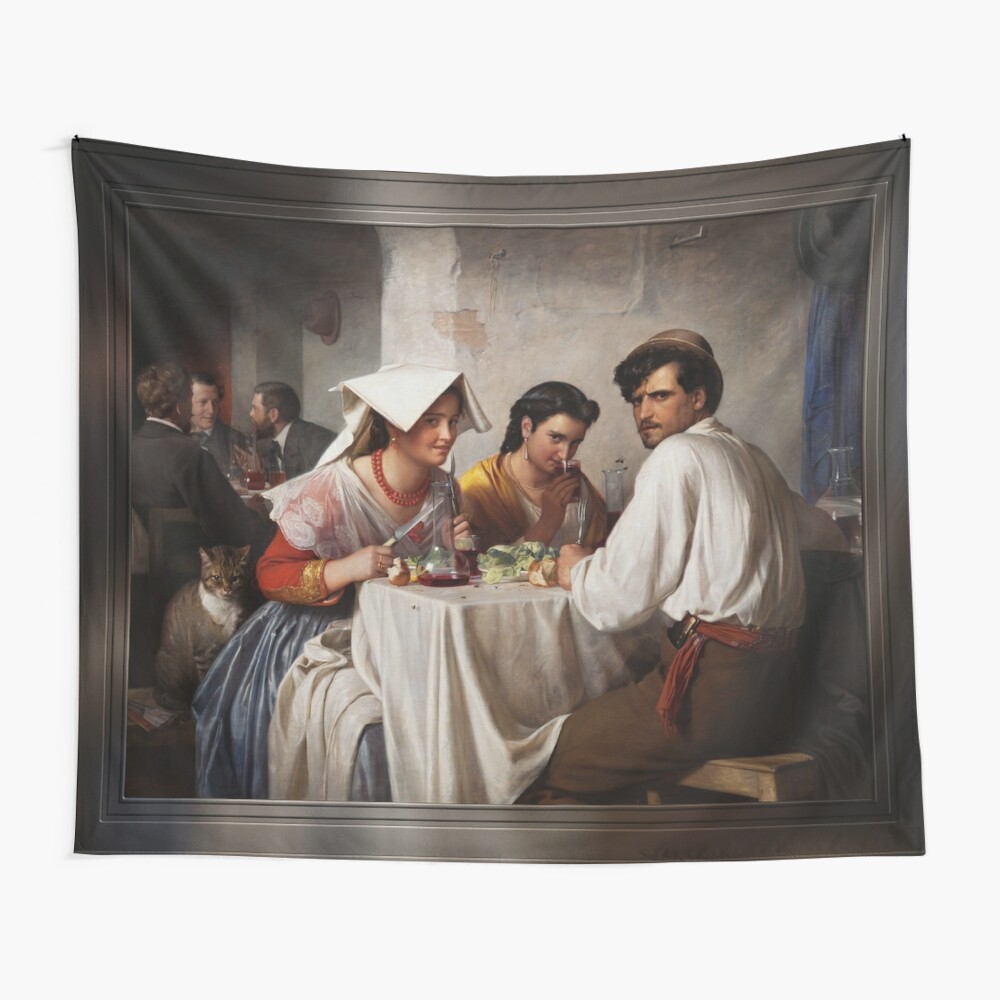
Erromako Osteria batean (Erromako Osteria batetik) c1866 daniar pintorearen eskutik Carl Heinrich Bloch (1834 – 1890); Rembrandten lanen eragina izan zuen, eta Danimarkako artistarik aipagarrienetakotzat hartu zuten, bere lan gogoantuenetako bat serie bat izanik 23 Frederiksborg jauregiko Erregearen Kaperarako eskatutako Kristoren bizitzari buruzko margolanak.
Erromatar Osteria batean enkargatu zitzaion Blochs lagun Moritz G. Meltxor (margolanaren atzealdean sartzen dena lagunekin hizketan; eta bistarantz bizkarra duen figura Bloch bera da), eta bere generoko koadro ezagunenetako bat da.
Alboko Oharra: Erromatar Osteria edo Osteria jatorrian ardoa eta janari sinpleak kontsumitzera joaten zen tokia zen; baina gaur, horrelako tokiak menu labur batean jarritako tokiko espezialitatea diren elikagaietara bideratuago daude.

In a Roman Osteria is a retouched digital art old masters reproduction of a public domain image that you can purchase online as a mihise inprimatua.
Beheko informazioa Wikipedia.org
Carl Heinrich Bloch was born in Copenhagen, Denmark and studied there at the Royal Danish Academy of Art (Det Kongelige Danske Kunstakademi) under Wilhelm Marstrand.
Bloch’s parents wanted their son to enter what they considered to be a respectable profession – an officer in the Navy. Hau, hala ere, was not what he wanted.
His only interest was drawing and painting, and he was consumed by the idea of becoming an artist. He went to Italy to study art, passing through the Netherlands, where he became acquainted with the work of Rembrandt, which became a major influence on him.
Bloch met his wife, Alma Trepka, in Rome, where he married her on 31 Maiatza 1868. They were happily married until her early death in 1886.
His early work featured rural scenes from everyday life. Bertatik 1859 to 1866, Bloch lived in Italy, and this period was important for the development of his historical style.
His first great success was the exhibition of his “Prometheus Unbound” in Copenhagen in 1865. After the death of Marstrand, he finished the decoration of the ceremonial hall at the University of Copenhagen.
The sorrow over losing his wife weighed heavily on Bloch, and being left alone with their eight children after her death was very difficult for him.
In a New Year’s letter from 1866 to Bloch, H. C. Andersen wrote the following: “What God has arched on solid rock will not be swept away!” Another letter from Andersen declared “Through your art you add a new step to your Jacob-ladder into immortality.”
In a final ode, from a famous author to a famous artist, H.C. Andersen said “Write on the canvas; write your seal on immortality. Then you will become noble here on earth.”
He was then commissioned to produce 23 paintings for the King’s Chapel at Frederiksborg Palace. These were all scenes from the life of Christ which have become very popular as illustrations.
The originals, painted between 1865 eta 1879, are still at Frederiksborg Palace. The altarpieces can be found at Holbaek, Odense, Ugerloese and Copenhagen in Denmark, as well as Loederup, Hoerup, and Landskrona in Sweden.
Bloch died of cancer on 22 Otsaila 1890. His death came as “an abrupt blow for Nordic art” according to an article by Sophus Michaelis. Michaelis stated that “Denmark has lost the artist that indisputably was the greatest among the living.”
Kyhn stated in his eulogy at Bloch’s funeral that “Bloch stays and lives.” A prominent Danish art critic, Karl Madsen, stated that Bloch reached higher toward the great heaven of art than all other Danish art up to that date.
Madsen also said “If there is an Elysium, where the giant, aberatsa, warm and noble artist souls meet, there Carl Bloch will sit among the noblest of them all!” (From the Carl Bloch Site).