

In The Grove Of The Temple Of Isis
“In The Grove Of The Temple Of Isis” by the British artist Iain Uilleam Godward (1861 – 1922) captures an idyllic and timeless moment that transports the viewer to an ancient, classical world. Known for his expertise in depicting the serene beauty of women, classical architecture, and lush landscapes, Godward presents an image filled with grace and elegance. Godward was a prominent figure in the Neo-Classical movement, a style which focused on the revival of ancient Greek and Roman ideals, yet with an air of romanticism. This particular work, executed at the peak of his career in 1915, continues to reflect his admiration for the classical world while showcasing his mastery over texture, dath, agus cruth.
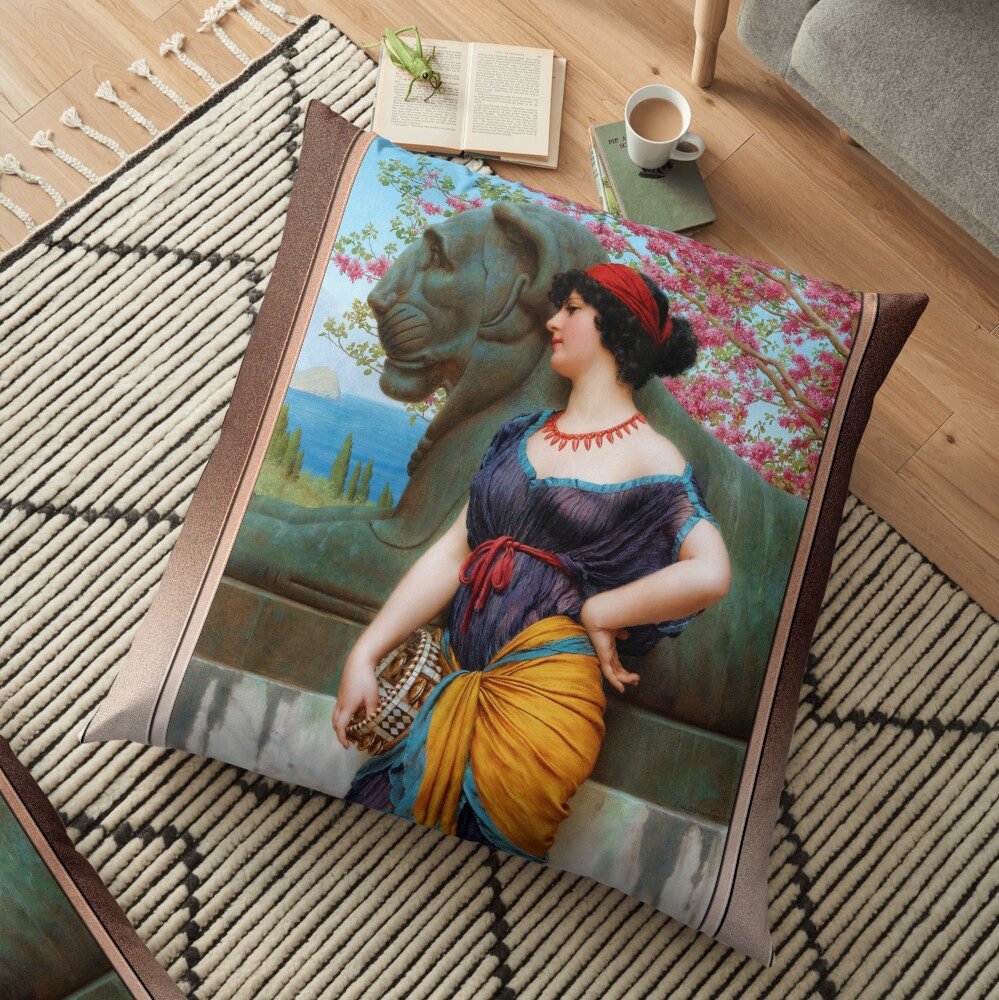
The painting features a woman poised in the shadows of a grove within the ruins of a temple dedicated to Isis, the ancient Egyptian goddess associated with fertility, magic, and motherhood. The backdrop of the temple ruins suggests the faded grandeur of antiquity, contrasting with the vibrant and alive portrayal of the woman. This juxtaposition between the lifeless stones of the temple and the youthful energy of the female figure is a testament to Godward’s ability to capture the passage of time while simultaneously celebrating beauty and vitality.
Clàr-innse
An cuspair: The Woman in the Grove
The central subject of Godward’s piece is a young woman draped in flowing classical attire, reminiscent of the Greco-Roman style. Her rich, layered robes of indigo and yellow silk cascade down her figure with an intricate sense of movement. The contrast between the dark purple of the gown and the bright golden hue of the sash offers a rich, luxurious color palette that highlights the sensuality of the fabric as it clings to the woman’s curves. The light catches the delicate folds of her clothing, which seem to shimmer, as though alive with movement. An suidheachadh aice, elegant yet relaxed, reflects the calm nature of the classical world that Godward is known for capturing in his works.
The woman’s face, turned slightly toward the viewer, reveals a serene expression. Tha na feartan aice air an snaidheadh gu grinn, emphasizing the idealized beauty of women that was characteristic of Godward’s style. The small details such as her jewelry, a simple, yet elegant necklace, add to the sense of wealth and refinement. Her dark hair, pulled back and adorned with a red ribbon, complements the surrounding landscape and further enforces the sense of timeless grace. The woman appears absorbed in her surroundings, her gaze cast slightly down as if contemplating the ancient temple behind her, or perhaps reflecting on the mysteries of the past.
Anns na làmhan aice, she holds a tambourine, which further connects her to the ritualistic and ceremonial life of the ancient world. This instrument, often associated with divine and sacred practices, hints at the religious or ritualistic theme of the painting, aligning with the temple’s association with Isis. The tambourine may also symbolize a connection to music and dance, which were intrinsic to the worship practices in ancient temples.
The Temple and The Setting
The painting’s background is dominated by the crumbling remnants of a classical temple, half-obscured by lush foliage. This juxtaposition between the temple ruins and the living woman symbolizes the enduring spirit of beauty amid the passing of time. Na tobhtaichean, which likely once formed part of a grand structure dedicated to Isis, appear weathered and aged, with portions of the stonework barely visible through the verdant overgrowth. This setting evokes the passage of centuries, with nature slowly overtaking human creations, but it also serves as a reminder of the power and grandeur of the ancient world.
Flanking the temple ruins are flowering trees, their pink blossoms in full bloom, creating a stark contrast to the ancient stone. An lus, almost dreamlike vegetation hints at a warm, Mediterranean climate, further connecting the work to the romanticized vision of antiquity. The flowers introduce a note of vitality, which not only enhances the visual beauty of the piece but also suggests the cyclical nature of life, with the blooming trees offering a sense of renewal in contrast to the decay of the temple. An solas, soft blues and greens of the distant landscape hint at the calm, peaceful existence of the classical world, a world where nature and humanity lived in harmony.
Stuthan agus innleachd
Godward’s technique is characterized by meticulous attention to detail, as evidenced in every brushstroke of the fabric, the woman’s skin, and the architecture. The use of oil paints gives the piece its depth and richness, allowing Godward to play with texture and light to create an almost photographic realism. The smooth finish of the woman’s skin contrasts with the rough texture of the stone, while the translucent quality of her clothing enhances the softness of her form. Godward’s handling of light in the composition is another striking feature; the sunlight filtering through the trees highlights the contours of the woman’s face and body, while also casting soft shadows that create a sense of depth and realism.
The Mood and Themes
The overall mood of the painting is one of serenity and tranquility. The woman’s calm demeanor and poised stance convey a sense of peace, as though she is at one with the ancient world surrounding her. This peacefulness is further emphasized by the gentle presence of nature, with the flowering trees and soft landscape inviting contemplation and reflection. Na dathan, primarily rich purples, òir, agus uaine, create a harmonious balance that evokes a sense of timeless beauty and quietude.
Gu cuspaireil, the painting touches on the idealization of ancient cultures, particularly those of Egypt and Rome, and the reverence for beauty that characterized the Neo-Classical movement. Godward’s ability to merge the ancient with the living, the mythological with the natural, brings forth an appreciation for the eternal aspects of culture and humanity. The temple ruins, the woman, and the natural landscape together create a narrative of past grandeur and present serenity, reminding the viewer that beauty endures beyond the physical.
In The Grove Of The Temple Of Isis is a remastered digital art old masters reproduction of a public domain image that is available as metal, acrylic agus clò-bhualaidhean canabhas air-loidhne.
An cruthachadh ealain didseatach seo, mar a tha leis a h-uile obair-ealain a gheibhear air làrach-lìn Xzendor7 ri fhaighinn airson a cheannach air-loidhne ann an grunn chruthan stuth a’ gabhail a-steach clò-bhualaidhean canabhas, dealbhan acrylic, clò-bhualaidhean meatailt, clò-bhualaidhean fiodha, lèileagan frèam, postairean, agus mar chlò-bhualadh canabhas air a roiligeadh ann an grunn mheudan bho 12 òirlich gu 72 òirlich a rèir meud an fhìor obair-ealain agus a’ bhùth clò-bhualaidh air iarrtas a thaghas tu airson an ealain a cheannach.
Tha an obair-ealain cuideachd ri fhaighinn air raon farsaing de dh’ aodach fireannaich is boireannaich, mugaichean, toitean, sgarfaichean, leabhraichean notaichean agus irisean agus mòran stuthan sgeadachaidh dachaigh.
Neach-ealain Bio
Fiosrachadh gu h-ìosal bho Wikipedia.org
B 'e John William NicBward am fear as sine de chòig chloinne, agus chaidh ainmeachadh air athair Eòin agus seanair Uilleam.
Sheall e aig an Acadamaidh Rìoghail bho 1887. Nuair a ghluais e dhan Eadailt le aon de na modalan aige a-steach 1912, Bhris a theaghlach a h-uile conaltradh ris agus eadhon gearradh an ìomhaigh aige bho dhealbhan teaghlaich. Thill Diaward a Shasainn a-steach 1921, bhàsaich e ann an 1922, agus tha e air a thiodhlacadh ann an cladh Brumpton, Lunnainn an Iar.
Is e aon de na dealbhan as ainmeil aige Dolce Far Niente (1904), a chaidh a cheannach airson cruinneachadh Anndra Lloyd Webber ann an 1995. Mar a tha ann an cùis grunn dhealbhan eile, Pheant Godward barrachd air aon dreach; sa chùis seo, na bu thràithe (agus nach eil cho aithnichte) 1897 dreach le dreach eile 1906 dreach.
Chuir e às dha fhèin aig aois 61 agus thathar ag ràdh gun do sgrìobh e a bhith a 'toirt cunntas fèin-mharbhadh sin “Chan eil an saoghal mòr gu leòr airson [an dà chuid] mi fhìn agus picasso”.
An teaghlach aige, nach robh air aontachadh mu bhith na neach-ealain, bha nàire air a fèin-mharbhadh agus loisg e na pàipearan aige. Chan eil ach aon dealbh de dhath a 'mairsinn beò.
Bha Godward na Neo-chlasaigeach Bhictorianach, agus uime sin, ann an teòiridh, neach-leantainn Frederic Leighton. Ach, tha e nas dlùithe ann an stoidhle ri Sir Lawrence Alma-Tadema, leis an robh e a ’co-roinn penchant airson ailtireachd Clasaigeach a thoirt seachad - gu sònraichte, feartan cruth-tìre statach air an togail le marmor.
Tha a ’mhòr-chuid de na h-ìomhaighean a tha ann an Godward a’ nochdadh boireannaich ann an èideadh clasaigeach air an cur an aghaidh feartan cruth-tìre; ged a tha cuid de fhigearan leth-nude agus làn nude air an toirt a-steach don oeuvre aige, eisimpleir sònraichte a bhith “Anns an Tepidarium c1913”.
Tiotal a chaidh a cho-roinn le dealbh connspaideach Alma-Tadema den aon chuspair a tha a ’fuireach anns an “Gailearaidh Ealain Lady Lever”. Tha na tiotalan a ’nochdadh stòr brosnachaidh Godward; a bha na shìobhaltachd clasaigeach, gu sònraichte an Ròimh Àrsaidh; Cuspair a 'ceangal dìochuimhne gu dlùth gu h-ealana gu h-ealanta.
Leis gu robh sgoilearachd clasaigeach nas sgaoilte am measg an luchd-èisteachd a dh 'fhaodadh a bhith ann airson na dealbhan aige fad a bheatha na anns an latha a dh' fhalbh na san latha a th 'ann an latha an-diugh, Bha rannsachadh mion-fhiosrachadh failteus cudromach gus neach-ealain fhaighinn san ghnothach seo.
Bha Alma-Tadema na arc-eòlaiche a bharrachd air peantair, a bha a 'frithealadh làraich eachdraidheil agus artifacts a chaidh an cleachdadh a-rithist anns na dealbhan aige: Godward, cuideachd, Rinn e sgrùdadh air mion-fhiosrachadh mar ailtireachd agus èideadh, gus dèanamh cinnteach gum biodh stampa na fìreantachd air na rinn e.
A bharrachd air, Thug Godward seachad feartan cudromach eile anns na dealbhan aige gu cùramach agus gu faiceallach, craiceann bheathaichean às a bheil na dealbhan “Rest Noon Day c1910” agus “Retreat fionnar c1910” tha eisimpleirean ann de leithid de riochdachadh a bharrachd air flùraichean fiadhaich “Nerissa c1906” agus “Flùraichean Samhraidh c1903”.
Bidh coltas boireannaich brèagha a chaidh a sgrùdadh ann an uimhir de chnabh-cana-cheannaiche droma a 'toirt mòran de dhaoine ùra air a sheòrsachadh gu mearachdach mar a bhith rop-raphelite, gu h-àraidh leis gu bheil am paileas aige gu math dathach beòthail. An roghainn cuspair (seann shìobhaltas an aghaidh, mar eisimpleir, Uirsgeul Arthurian) nas freagarraiche na Neo-chlasaigeach Bhictorianach.
Coltach ri grunn pheantairean co-aimsireil leis, Bha Godward na ‘High Victorian Dreamer’, a ’dèanamh ìomhaighean de shaoghal air leth freagarrach agus romansach a, ann an cùis an dà chuid Godward agus Alma-Tadema, a chàineadh mar shealladh cruinne de Bhictòrianaich ann an togas.
Godward “stèidhich e cliù gu luath airson na dealbhan aige de bhoireannaich òga ann an suidheachadh clasaigeach agus a chomas a bhith a ’cur an cèill le cugallachd agus maighstireachd teignigeach faireachdainn inneach eadar-dhealaichte feòil, marmor, bian agus aodach.
Is dòcha gun tàinig penchant Godward airson a bhith a ’cruthachadh pìosan ealain a chaidh a shuidheachadh anns an ùine chlasaigeach bhon àm san do rugadh e; oir b ’e an ath-bheothachadh clasaigeach làn-sgèile mu dheireadh ann an dealbhan an iar, shoirbhich sin ann an Sasainn bho na 1860an suas gu na 1890an.