

In The Grove Of The Temple Of Isis
“In The Grove Of The Temple Of Isis” by the British artist John William Godward (1861 – 1922) captures an idyllic and timeless moment that transports the viewer to an ancient, classical world. Known for his expertise in depicting the serene beauty of women, classical architecture, and lush landscapes, Godward presents an image filled with grace and elegance. Godward was a prominent figure in the Neo-Classical movement, a style which focused on the revival of ancient Greek and Roman ideals, yet with an air of romanticism. This particular work, executed at the peak of his career in 1915, continues to reflect his admiration for the classical world while showcasing his mastery over texture, kleur, en vorm.
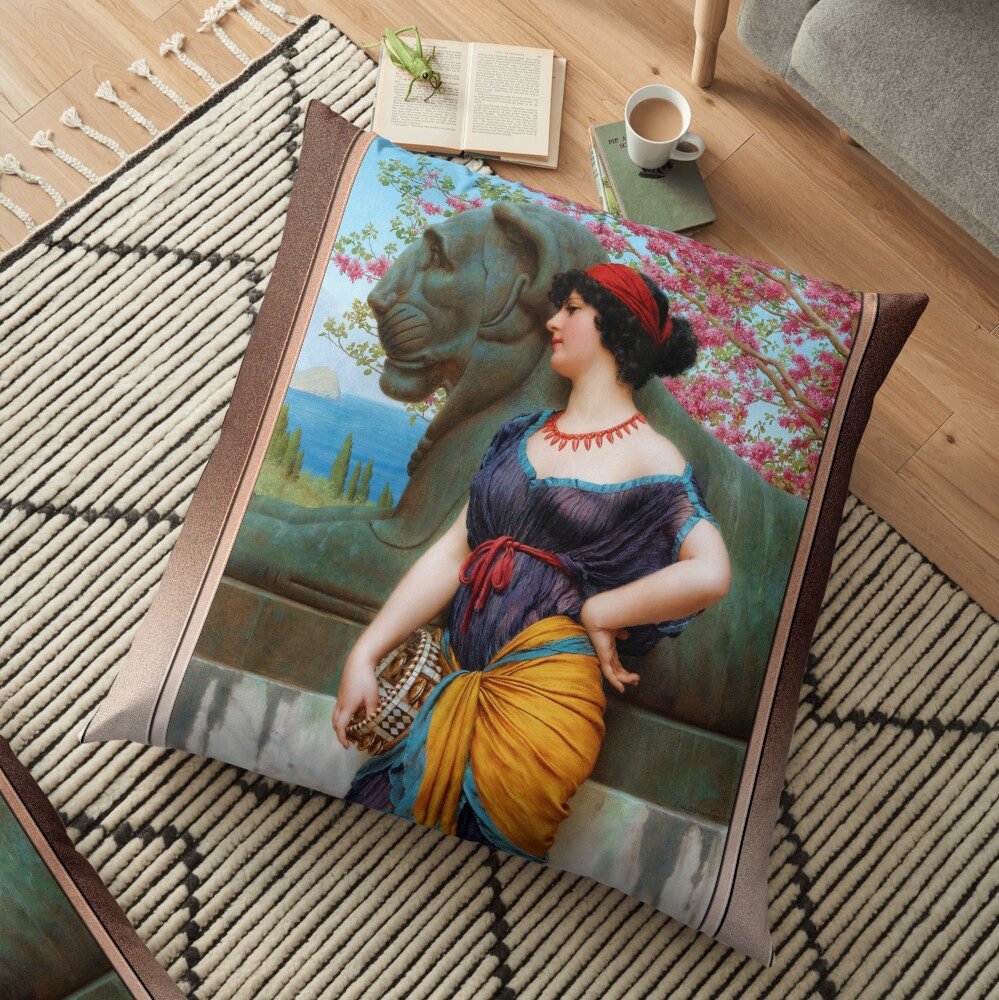
The painting features a woman poised in the shadows of a grove within the ruins of a temple dedicated to Isis, the ancient Egyptian goddess associated with fertility, magic, and motherhood. The backdrop of the temple ruins suggests the faded grandeur of antiquity, contrasting with the vibrant and alive portrayal of the woman. This juxtaposition between the lifeless stones of the temple and the youthful energy of the female figure is a testament to Godward’s ability to capture the passage of time while simultaneously celebrating beauty and vitality.
Inhoudsopgave
Het onderwerp: The Woman in the Grove
The central subject of Godward’s piece is a young woman draped in flowing classical attire, reminiscent of the Greco-Roman style. Her rich, layered robes of indigo and yellow silk cascade down her figure with an intricate sense of movement. The contrast between the dark purple of the gown and the bright golden hue of the sash offers a rich, luxurious color palette that highlights the sensuality of the fabric as it clings to the woman’s curves. The light catches the delicate folds of her clothing, which seem to shimmer, as though alive with movement. Haar houding, elegant yet relaxed, reflects the calm nature of the classical world that Godward is known for capturing in his works.
The woman’s face, turned slightly toward the viewer, reveals a serene expression. Her features are finely sculpted, emphasizing the idealized beauty of women that was characteristic of Godward’s style. The small details such as her jewelry, a simple, yet elegant necklace, add to the sense of wealth and refinement. Her dark hair, pulled back and adorned with a red ribbon, complements the surrounding landscape and further enforces the sense of timeless grace. The woman appears absorbed in her surroundings, her gaze cast slightly down as if contemplating the ancient temple behind her, or perhaps reflecting on the mysteries of the past.
In haar handen, she holds a tambourine, which further connects her to the ritualistic and ceremonial life of the ancient world. This instrument, often associated with divine and sacred practices, hints at the religious or ritualistic theme of the painting, aligning with the temple’s association with Isis. The tambourine may also symbolize a connection to music and dance, which were intrinsic to the worship practices in ancient temples.
The Temple and The Setting
The painting’s background is dominated by the crumbling remnants of a classical temple, half-obscured by lush foliage. This juxtaposition between the temple ruins and the living woman symbolizes the enduring spirit of beauty amid the passing of time. De ruïnes, which likely once formed part of a grand structure dedicated to Isis, appear weathered and aged, with portions of the stonework barely visible through the verdant overgrowth. This setting evokes the passage of centuries, with nature slowly overtaking human creations, but it also serves as a reminder of the power and grandeur of the ancient world.
Flanking the temple ruins are flowering trees, their pink blossoms in full bloom, creating a stark contrast to the ancient stone. The lush, almost dreamlike vegetation hints at a warm, Mediterranean climate, further connecting the work to the romanticized vision of antiquity. The flowers introduce a note of vitality, which not only enhances the visual beauty of the piece but also suggests the cyclical nature of life, with the blooming trees offering a sense of renewal in contrast to the decay of the temple. Het licht, soft blues and greens of the distant landscape hint at the calm, peaceful existence of the classical world, a world where nature and humanity lived in harmony.
Materialen en techniek
Godward’s technique is characterized by meticulous attention to detail, as evidenced in every brushstroke of the fabric, the woman’s skin, and the architecture. The use of oil paints gives the piece its depth and richness, allowing Godward to play with texture and light to create an almost photographic realism. The smooth finish of the woman’s skin contrasts with the rough texture of the stone, while the translucent quality of her clothing enhances the softness of her form. Godward’s handling of light in the composition is another striking feature; the sunlight filtering through the trees highlights the contours of the woman’s face and body, while also casting soft shadows that create a sense of depth and realism.
The Mood and Themes
The overall mood of the painting is one of serenity and tranquility. The woman’s calm demeanor and poised stance convey a sense of peace, as though she is at one with the ancient world surrounding her. This peacefulness is further emphasized by the gentle presence of nature, with the flowering trees and soft landscape inviting contemplation and reflection. De kleuren, primarily rich purples, goud, and greens, create a harmonious balance that evokes a sense of timeless beauty and quietude.
Thematisch, the painting touches on the idealization of ancient cultures, particularly those of Egypt and Rome, and the reverence for beauty that characterized the Neo-Classical movement. Godward’s ability to merge the ancient with the living, the mythological with the natural, brings forth an appreciation for the eternal aspects of culture and humanity. The temple ruins, the woman, and the natural landscape together create a narrative of past grandeur and present serenity, reminding the viewer that beauty endures beyond the physical.
In The Grove Of The Temple Of Isis is a remastered digital art old masters reproduction of a public domain image that is available as metal, acryl en canvasafdrukken online.
Deze digitale kunstcreatie, zoals bij alle kunstwerken die op de Xzendor7-website te vinden zijn, is deze online te koop in verschillende materiaalformaten, waaronder canvasafdrukken, acryl afdrukken, metalen prints, hout prints, ingelijste afdrukken, affiches, en zoals opgerolde canvasafdrukken in verschillende maten uit 12 inch tot 72 inch, afhankelijk van de grootte van het daadwerkelijke kunstwerk en de print on demand-winkel waar je de kunst wilt kopen.
Het artwork is ook beschikbaar op een breed scala aan heren- en dameskleding, mokken, bakken, sjaals, notitieboekjes en tijdschriften en veel woondecoratieproducten.
Bio -kunstenaar
Info hieronder van Wikipedia.org
John William Godward was de oudste van vijf kinderen, en is vernoemd naar zijn vader John en grootvader William.
Hij exposeerde op de Koninklijke Academie van 1887. Toen hij met een van zijn modellen naar Italië verhuisde 1912, zijn familie verbrak alle contact met hem en sneed zelfs zijn afbeelding uit familiefoto's. Godward keerde in Engeland terug naar Engeland 1921, overleden in 1922, en wordt begraven op de begraafplaats van Brompton, West-Londen.
Een van zijn bekendste schilderijen is Dolce far Niente (1904), die werd aangekocht voor de collectie van Andrew Lloyd Webber in 1995. Zoals bij verschillende andere schilderijen, Godward schilderde meer dan één versie; in dit geval, een eerder (en minder bekend) 1897 versie met verder 1906 versie.
Hij pleegde zelfmoord op de leeftijd van 61 en er wordt gezegd dat hij dat in zijn afscheidsbrief heeft geschreven “waar de wereld niet groot genoeg voor is [beide] ikzelf en een Picasso”.
Zijn vervreemde familie, die het er niet mee eens was dat hij kunstenaar werd, schaamden zich voor zijn zelfmoord en verbrandden zijn papieren. Er is slechts één foto van Godward bekend die bewaard is gebleven.
Godward was een Victoriaanse neoclassicist, en daarom, in theorie, een volgeling van Frederic Leighton. Echter, hij is stilistisch nauwer verbonden met Sir Lawrence Alma-Tadema, met wie hij een voorliefde deelde voor de weergave van klassieke architectuur - in het bijzonder, statische landschapselementen opgebouwd uit marmer.
De overgrote meerderheid van de bestaande afbeeldingen van Godward toont vrouwen in klassieke kleding, geposeerd tegen landschapselementen; hoewel er enkele halfnaakte en volledig naakte figuren in zijn oeuvre voorkomen, een opmerkelijk voorbeeld is “In het Tepidarium c1913”.
Een titel die wordt gedeeld met een controversieel schilderij van Alma-Tadema met hetzelfde onderwerp dat zich in de “Kunstgalerie Lady Lever”. De titels weerspiegelen de inspiratiebron van Godward; dat was de klassieke beschaving, met name die van het oude Rome; een onderwerp dat Godward artistiek nauw met Alma-Tadema verbindt.
Gegeven het feit dat de klassieke wetenschap tijdens zijn leven wijdverspreider was onder het potentiële publiek voor zijn schilderijen dan tegenwoordig, nauwgezet detailonderzoek was belangrijk om als kunstenaar in dit genre een reputatie te verwerven.
Alma-Tadema was zowel archeoloog als schilder, die historische locaties bezocht en artefacten verzamelde die hij later in zijn schilderijen gebruikte: Godward, te, bestudeerde details als architectuur en kleding, om ervoor te zorgen dat zijn werken het stempel van authenticiteit droegen.
Daarnaast, Godward heeft andere belangrijke kenmerken van zijn schilderijen nauwgezet en nauwgezet weergegeven, dierenhuiden waarvan de beschilderingen “Middagrust c1910” en “Een cool toevluchtsoord c1910” bevat voorbeelden van een dergelijke weergave, evenals wilde bloemen “Nerissa circa 1906” en “Zomerbloemen c1903”.
De verschijning van mooie vrouwen in bestudeerde poses op zoveel van Godward’s doeken zorgt ervoor dat veel nieuwkomers in zijn werken hem ten onrechte categoriseren als Prerafaëlitisch., vooral omdat zijn palet vaak levendig kleurrijk is. De keuze van het onderwerp (oude beschaving versus, bijvoorbeeld, Arthur-legende) is beter gezegd dat van de Victoriaanse neoclassicist.
Net als talrijke schilders uit zijn tijd, Godward was een ‘Hoge Victoriaanse Dromer’, het produceren van beelden van een geïdealiseerde en geromantiseerde wereld, in het geval van zowel Godward als Alma-Tadema, werd bekritiseerd als een wereldbeeld van Victorianen in toga's.
Godward “bouwde al snel een reputatie op vanwege zijn schilderijen van jonge vrouwen in een klassieke setting en zijn vermogen om met gevoeligheid en technisch meesterschap het gevoel van contrasterende texturen van vlees over te brengen, marmer, bont en stoffen.
Godward's voorliefde voor het maken van kunstwerken die zich afspelen in de klassieke periode kwam waarschijnlijk voort uit de periode waarin hij werd geboren; aangezien het de laatste grootschalige klassieke heropleving in de westerse schilderkunst was, die in Engeland bloeide van de jaren 1860 tot de jaren 1890.