

Sa Spotsolas
Saothar ealaíne Edward Mason Eggleston, Sa Spotsolas, a cruthaíodh i 1937, gabhann sé spiorad bríomhar fuinniúil na ré trí phortráid iontach de dhamhsóir. Rugadh i 1882 agus bás i 1941, Léiríonn saothar Eggleston an t-aistriú idir an Art Deco agus gluaiseachtaí na luath-aimseartha. Aithnítear as an úsáid ghlan atá aige as dathanna agus cumadóireacht dhinimiciúla, Baile Uí Choileáin úsáideann an píosa seo chun téamaí gluaiseachta a iniúchadh, grásta, agus mealltacht na feidhmíochta. Éiríonn an bhean a léirítear sa phéinteáil mar phríomhcharachtar i scéal a labhraíonn lena healaíontacht agus le mealltacht réchúiseach an stáitse..
Clár na nÁbhar
Ábhar agus Comhdhéanamh
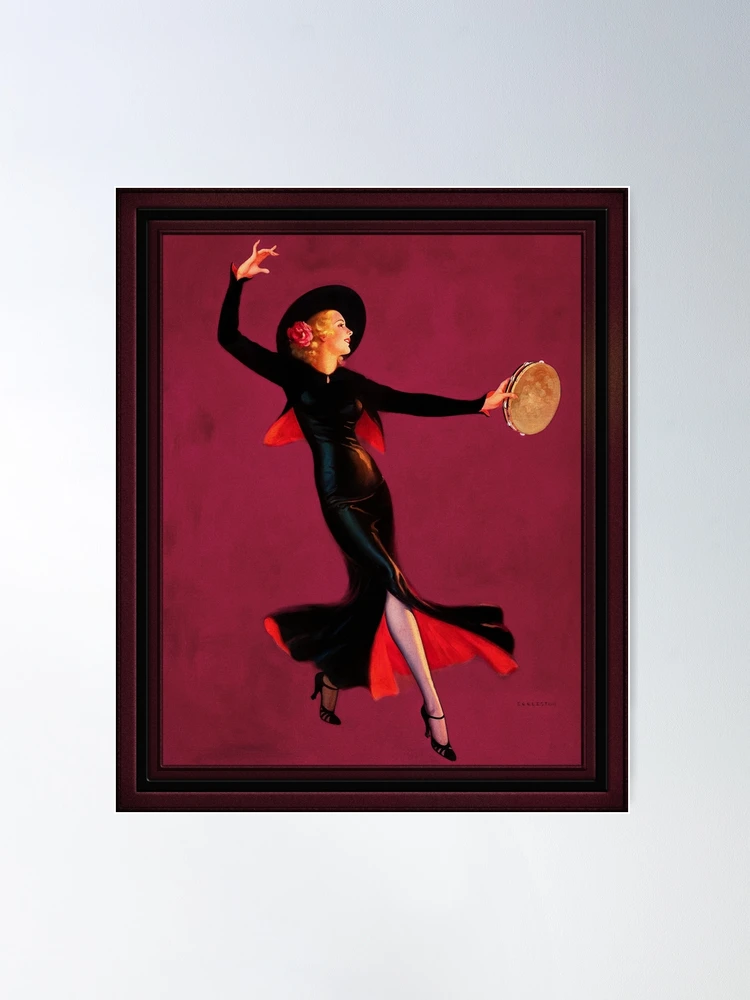
Is bean é figiúr lárnach an phíosa, i lár an rince, cóirithe i gúna dubh galánta agus fíor-mhaisiúil. A posture, with one arm raised high and the other extended forward holding a tambourine, suggests a vibrant, fluid motion, bringing her to life within the confines of the canvas. Her right leg is positioned in a graceful, almost balletic stance, emphasizing the energy of the dance. This pose, along with her expression of enjoyment and concentration, conveys the joy of performing. Her head is tilted slightly back, and her gaze is directed toward the upper left of the canvas, suggesting an engagement with an invisible audience or an internal immersion in the music.
Her attire is key to the artwork’s aura of elegance. The black dress, which hugs her figure closely, is adorned with a vivid scarlet red lining visible at the back, adding a touch of drama to the figure’s silhouette. The woman’s hat, which features a black brim, is decorated with a single red rose, enhancing the contrast of colors while also contributing to the 1930s fashion sensibility. The black dress contrasts sharply with the bright red hue, intensifying the visual impact of the work, while the black heels and accessories further add to her polished, refined appearance.
Pailéad Dathanna agus Ábhair
Eggleston’s color palette in Sa Spotsolas is dominated by rich contrasts between dark, sultry tones and vivid accents of red. The deep crimson background envelops the subject in a saturated, almost theatrical environment, emphasizing the dancer’s energy and presence. The background’s simplicity, devoid of any extraneous elements, ensures that the woman remains the undivided focus of the painting. Her skin is rendered in light, soft tones that contrast with the surrounding dark hues, giving her an almost ethereal glow against the vibrant red backdrop. The rose in her hair and the lining of her dress serve as intentional color highlights, contributing to the visual drama and thematic connection to the dancer’s radiant performance.
Eggleston’s use of the smooth, almost glowing texture of the background against the lively, almost tactile depiction of the dancer’s clothing and accessories is a subtle yet powerful way to highlight the subject’s motion and energy. The careful blending of these hues enhances the emotional vibrancy of the painting, contributing to its dramatic atmosphere.
An Meon agus an Téama
The mood of the painting is one of confidence, allure, and artistic dedication. Ní hamháin gur ábhar éighníomhach í an bhean sa phictiúr ach rannpháirtí gníomhach i léiriú dinimiciúil. Tá tuiscint ar chumhacht ina staidiúir, agus í i gceannas ar an tambóirín agus ar an rince a bhíonn ar siúl aici. Feidhmíonn an tambóirín féin mar uirlis cheoil agus mar shiombail den rithim agus den bhuille, ag cur eilimint thadhlach le gluaiseachtaí an rinceora. An figiúr, tumtha ina feidhmíocht, léiríonn sé an sineirgíocht idir an corp agus an ceol, áit a dtagann an rince agus an fhuaim le chéile mar léiriú uatha ar an gcruthaitheacht.
Léiríonn léiriú Eggleston den damhsóir téamaí níos leithne na 1930idí freisin., tráth a raibh na taibh-ealaíona ríthábhachtach don timpeallacht chultúrtha. The dramatic presentation of the figure speaks to the era’s growing fascination with jazz, theater, and film. An phéintéireacht seo, mar sin, is not just a static portrait but a celebration of the dance and performance culture that flourished in this period. The spotlight, both literal and figurative, is placed squarely on the dancer, making her the embodiment of the performing arts of the time.
The painting’s theme revolves around the artist’s portrayal of both the physical and emotional dimensions of performance. The dancer’s flowing motion is mirrored by the smooth, fluid strokes of Eggleston’s brushwork, emphasizing the harmony between the dancer’s body and the space in which she performs. This connection suggests that the performer’s art is as much about movement and grace as it is about a deeper connection with the rhythm of life.
Stíl Ealaíne
Sa Spotsolas can be viewed as a product of its time, reflecting Eggleston’s mastery of precision and mood-setting within the visual constraints of the 1930s. The work embodies aspects of the Art Deco style, evident in its elegant yet exaggerated forms, as well as the dynamic interplay of geometric shapes and contrasting colors. While not strictly conforming to all Art Deco ideals, the painting does exhibit the period’s celebration of glamour and stylized representation.
Eggleston’s skillful handling of light and shadow also invites comparisons to the broader realism movement, which sought to capture not only the form of its subjects but the emotional content beneath their surfaces. Through his emphasis on color, éadrom, and movement, Eggleston’s rendering of the dancer moves beyond a simple depiction of her outward appearance to reveal something more ethereal, a moment of grace frozen in time. The soft lighting around the subject contrasts sharply with the angular, sharp details in the tambourine and dress, highlighting the sense of motion while still preserving the subject’s detailed form.
Conclúid
Edward Mason Eggleston’s Sa Spotsolas remains a timeless exploration of performance, gluaiseacht, agus elegance. The artist’s masterful use of color and composition captures the essence of the dancer’s world, one of rhythm, grásta, and exuberant expression. Tríd an bpíosa seo, Eggleston invites the viewer to step into the world of the stage, where every motion is both a visual and emotional spectacle. Agus é sin á dhéanamh, he not only immortalizes the beauty of the performer but also the universal appeal of art itself, grounded in the power of movement and self-expression.
Is éard atá in In The Spot Light ná seanmháistrí ealaíne digiteacha atá á n-athachtú ar íomhá fearainn phoiblí.
Cruthú ealaíne digiteach seo, mar atá an saothar ealaíne go léir atá le fáil ar shuíomh Gréasáin Xzendor7 ar fáil le ceannach ar líne i bhformáidí éagsúla ábhar lena n-áirítear priontaí canbháis, priontaí aicrileach, priontaí miotail, priontaí adhmaid, priontaí frámaithe, póstaeir, agus mar priontaí chanbhás rollta i méideanna éagsúla ó 12 orlach go 72 orlach ag brath ar mhéid an tsaothair ealaíne iarbhír agus ar an siopa priontála ar éileamh a roghnaíonn tú an ealaín a cheannach uaidh.
Tá an saothar ealaíne ar fáil freisin ar raon leathan éadaí fear agus ban, mugaí, totes, scaifeanna, leabhair nótaí agus irisleabhair agus go leor táirgí maisiúcháin tí.
Beathaisnéis Ealaíontóir
Eolas Thíos Ó Wikipedia.org
Edward Mason Eggleston (22 Samhain 1882 - 14 Eanáir 1941) Péintéir Meiriceánach a bhí speisialaithe i bportráidí féilire de mhná, faiseanta agus iontach.
Ba maisitheoir tráchtála cáiliúil é freisin ag déanamh oibre do chuideachtaí mar an Fisk Tire Company, Iarnród Pennsylvania, agus Taispeántas na Lochanna Móra.
D’fhreastail sé ar Scoil Ealaíne Columbus i Columbus, Ohio agus bhog sé go Nua Eabhrac faoi 1915, áit ar oibrigh sé chun clúdaigh iris a léiriú, póstaeir taistil, fógraí agus féilirí.
D'oibrigh sé go príomha le péinteanna ola ar chanbhás, agus le pastail freisin, dathanna uisce, agus gouache.
Thapaigh Eggleston treocht Mheiriceá i dtreo fantaisíochta escapist le linn blianta an Spealadh Mór sna 1930idí.
Déantar cur síos air mar “scéalaíocht,” dhírigh a chuid saothar féilire ar mhná i gúnaí agus hataí stylish agus faiseanta, feistis snámha, nó costumed mar mhná Dúchasacha-Mheiriceá, “Bandia na hÉigipte,” cailíní bradach, agus mná i gcarachtar Peter Pan