

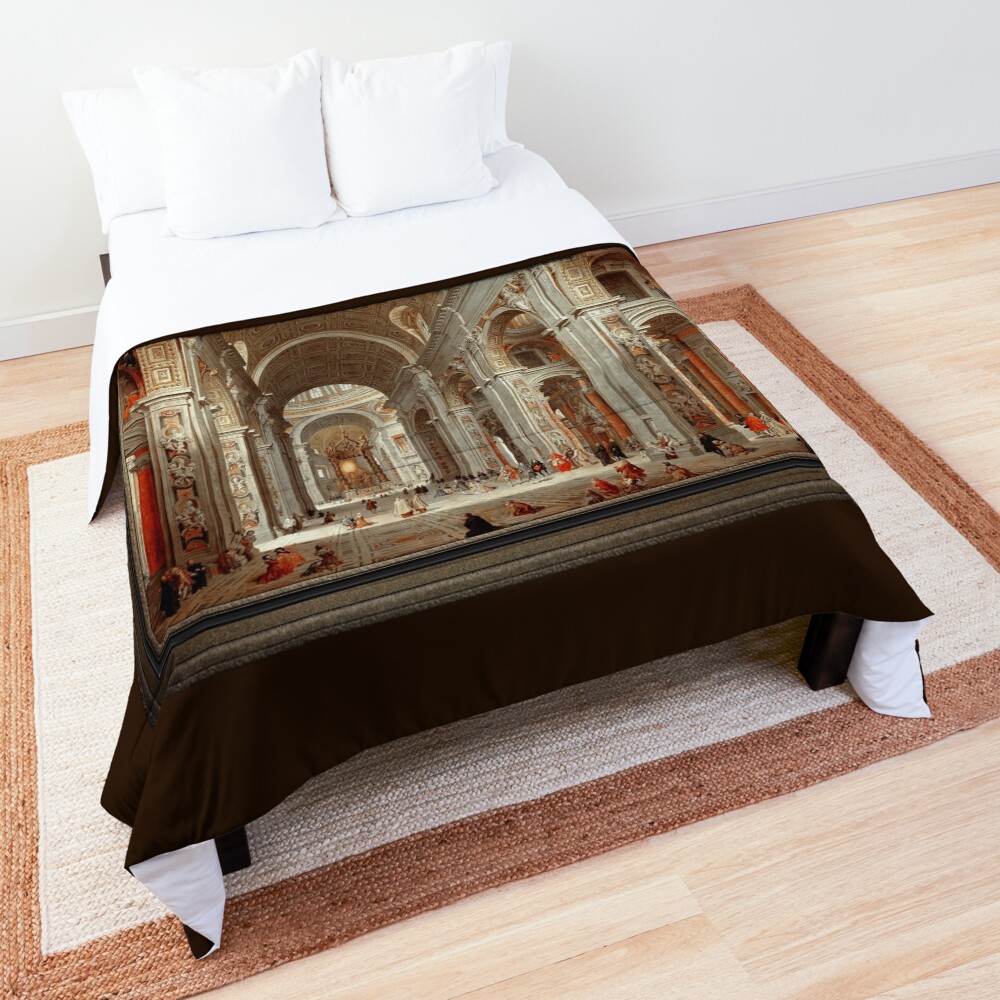
Interior View of St Peters Basilica c1750
Interior View of St Peters Basilica is a magnificent painting created in 1750 by the renowned Italian artist Giovanni Paolo Pannini (1691 – 1765). This masterful work exemplifies Pannini’s extraordinary ability to capture the grandeur of arkitektur and the spirit of classical antiquity.
Through his artistic vision, Pannini offers an inside view of one of the most iconic architectural structures in the world; St. Peter’s Basilica in Vatican City. The composition not only illustrates the architectural wonders of the space but also immerses the viewer in a detailed narrative of daily life in the grand cathedral during the 18th century.
Indholdsfortegnelse
Hovedemne og komposition
The painting’s primary subject is the interior of St. Peters Basilika, a symbol of both religious devotion and architectural excellence. Pannini presents a sweeping view of the basilica’s vast nave, with towering columns, intricate arches, and expansive ceilings, all rendered with great precision and grandeur.
The vaults and domes rise majestically toward the heavens, drawing the viewer’s gaze upward toward the light that seems to pour into the structure from above. The large, circular windows and the dome of the church create a contrast between the serene, soft illumination from the windows and the richly detailed interiors.
The layout of the painting mirrors the layout of the basilica itself, offering a perspective that guides the viewer’s eye from the foreground, filled with figures, toward the distant altar, which is adorned with golden rays of light. The vastness of the space is emphasized by the presence of numerous small figures scattered throughout the scene, some in worship, others in casual conversation, and still more engaged in quieter, reflective activities. This addition of human figures brings life to the artwork, making the monumental space feel more approachable, yet still awe-inspiring.
Architectural Details
The intricacy and magnificence of St. Peter’s Basilica are captured through Pannini’s detailed renderings of the basilica’s structural elements. The soaring columns of the nave are painted with sharp precision, giving the illusion of depth and grandeur. The artist incorporates exquisite details of the marble textures, particularly in the columns’ rich reddish hues and creamy veins, contributing to the sense of luxury and permanence that pervades the building. I baggrunden, elaborate arches and coffered ceilings stretch endlessly, further emphasizing the vast scale of the space.
One of the most striking features in the painting is the dome designed by Michelangelo. Pannini captures the essence of the dome’s curvature and its sculptural form, which seems to soar beyond the limits of the canvas, filling the viewer with a sense of awe. The use of light and shadow in the painting gives a tangible texture to the surfaces, lending a three-dimensional quality to the architecture. The colors are rich yet subdued, with earthy tones of stone and marble contrasting beautifully with the golden accents of the altar and religious icons.
Human Figures and Interaction
A significant aspect of Pannini’s work is the inclusion of human figures, which add a sense of scale and activity to the otherwise static space. These individuals are depicted in various poses—some kneeling in prayer, others engaged in conversation or walking through the grand nave. Pannini’s attention to the varied gestures and clothing of these figures further enriches the narrative. The elegantly dressed men and women in the foreground offer a glimpse into the social life of the 18th century, showcasing the attire and customs of the time.
The interactions among the figures in the scene suggest a peaceful coexistence within the sacred space. Some figures seem to pause in contemplation before the altar, while others, perhaps tourists or pilgrims, look around with admiration. This human presence, though small in comparison to the vast architecture, serves to enhance the grandeur of the basilica. It also invites the viewer to reflect on the spiritual and cultural significance of the church as a gathering place for both the faithful and the curious.
Mood and Atmosphere
The mood of the painting is one of reverence and awe. The grandeur of the basilica’s interior creates a sense of tranquility and solemnity, while the human figures add a feeling of warmth and human presence. The use of light and shadow contributes to the overall atmosphere, with rays of light streaming through the large windows and casting a gentle glow on the figures and columns. The warm hues of the painting, combined with the serene figures in repose, create a peaceful, almost meditative environment.
There is also a sense of timelessness in the scene. The figures in the painting, while clearly of the 18th century, seem to be engaged in a kind of eternal ritual within the hallowed walls of the basilica. The architecture, although representing the pinnacle of 17th-century Baroque design, also seems to transcend time, suggesting that the church has stood as a witness to countless generations of worshippers. The mood is contemplative and reverent, encouraging the viewer to reflect not only on the grandeur of the basilica but also on its significance as a place of religious and historical importance.
Konklusion
Giovanni Paolo Pannini’s “Indvendig udsigt over St.. Peters Basilika” is a breathtaking portrayal of one of the most celebrated architectural marvels in the world. Through meticulous attention to architectural detail, careful rendering of light and shadow, and the inclusion of human figures, Pannini conveys the awe-inspiring scale and spiritual significance of the basilica.
The painting serves as both a historical record and a work of art that captures the essence of 18th-century religious life. The balance between grandeur and intimacy, between architecture and humanity, allows the viewer to experience St. Peter’s Basilica not just as a monumental structure, but as a living, breathing space where art, arkitektur, and faith converge.
Indvendig udsigt over St.. Peter’s Basilica is a retouched digital art reproduction of a public domain image.
Kunstner bio afledt fra Wikipedia.org
Giovanni Paolo Panini eller Giovanni Paolo Pannini var en maler og arkitekt, der arbejdede i Rom og primært er kendt som en af vedutisti (“se malere”).
Som maler, Pannini er bedst kendt for sine udsigter over Rom, hvor han interesserede sig særligt for byens antikviteter.
Blandt hans mest berømte værker er hans syn på det indre af Pantheon (på vegne af Francesco Algarotti 1712 – 1764 – En venetiansk polymat), og hans vedute malerier af billedgallerier med udsigt over Rom.
De fleste af hans værker, især ruinernes, har en fantasifuld og uvirkelig udsmykning karakteristisk for capriccio -temaer. I dette ligner de capricci af den italienske maler og grafiker Marco Ricci (1676 – 1730).
Panini malede også portrætter, herunder en af pave Benedikt XIV (født Prospero Lorenzo Lambertini 1675 – 1758 – Leder af den katolske kirke fra 1740 – 1758).
I Rom, Panini fik et navn for sig selv som dekoratør af paladser. Nogle af hans værker omfattede Villa Patrizi c1719/25, Palazzo de Carolis c1720, og Seminario Romano c1721/22).
I 1719, Panini blev optaget i kongregationen af Virtuosi al Pantheon. Han underviste i Rom ved Accademia di San Luca og Académie de France, hvor han siges at have påvirket Jean-Honoré Fragonard. I 1754, han tjente som prinsen (direktør) fra Accademia di San Luca.