

Its Nothing To Sneeze At
Its Nothing To Sneeze At arabera Gil Elvgren (1914 – 1980), one of the most celebrated American illustrators of the 20th century. This piece exemplifies the vibrant and engaging style that made Elvgren famous, combining humor, sententzia, and a touch of glamour.
urtean jaioa 1914, Elvgren’s career spanned much of the 20th century, and he is best known for his pin-up art, a genre that defined much of mid-century American illustration. His use of color, argia, and playful narratives in his work set a hallmark for advertisements, aldizkariak, and calendars throughout the era.
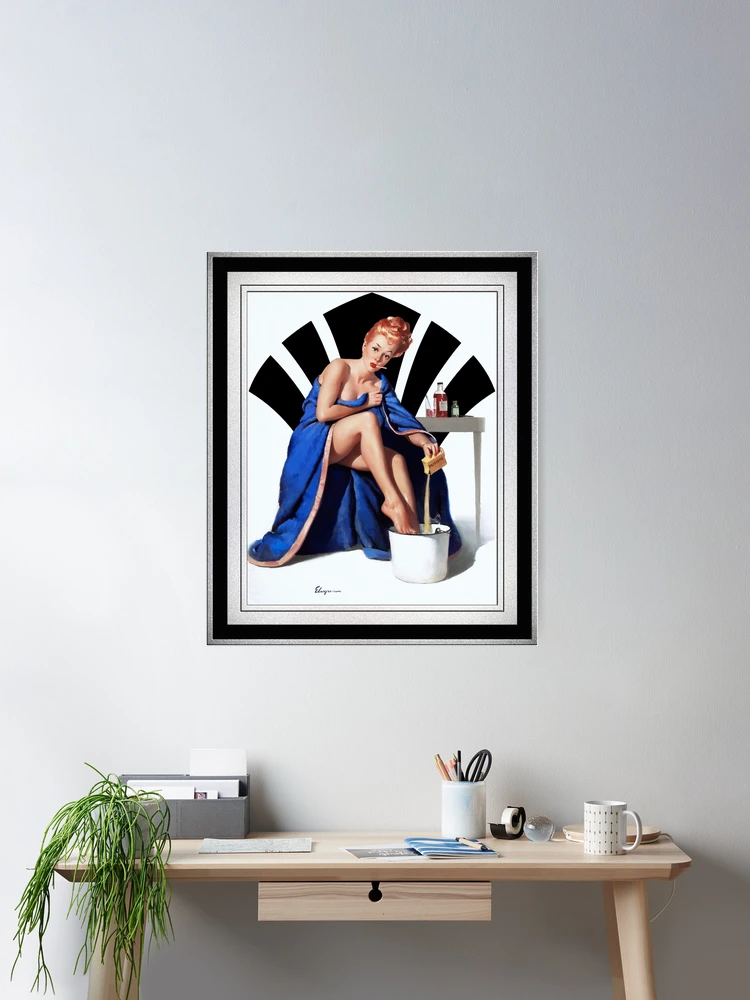
The painting portrays a young woman seated with her feet in a basin of mustard, Elvgren-en ikusle askorentzat ezaguna izango zen erremedio bat, hotza edo minak bezalako gaitzetarako sendabide arrunt gisa.. Alabaina, Etxeko eszena honek ez du umorerik eta ironia ludikorik gabe geratzen.
Emakumearen aurpegi-adierazpenak egoerari buruzko frustrazioa eta jakin-mina iradokitzen du, artelanaren tonu arina areagotuz. Bere jarrera, belaun bat altxatuta eta beste oina mostaza-bainuan murgilduta, ikuslearen arreta emakumearen figurara bideratzen du modu dotore baina komiko batean.
Edukien taula
Gai nagusia
Erdiko irudia Ez da ezer doministiku egiteko bata urdin bizidun batez jantzitako emakume gazte bat da. Bata, arrosa delikatua moztu batekin apainduta, aske dago bere formaren gainean, adding an element of seductiveness without being overtly revealing. Her strawberry blonde hair is styled in a vintage updo, giving her an air of classic 1950s beauty, further emphasizing her timeless femininity.
Her posture is slightly awkward, adding to the narrative of the scene: she is trying to find relief from an ailment, and her uncertain expression, combined with the mundane but uncomfortable treatment, invites both empathy and humor from the viewer. The angle at which she sits, with her legs crossed and one foot submerged, creates an intimate yet comical moment in a domestic setting.
Ezarpena eta objektuak
Irudiaren atzean, a table is placed, atop which rests a small collection of items: a bottle of whiskey, a glass, and what seems to be a medicinal bottle, perhaps a cure or tonic to accompany her treatment.
These objects reinforce the domestic, eszenaren izaera pribatua, but they also point to the time period’s typical imagery, where relaxation and health remedies were often portrayed as part of a woman’s role in maintaining a household. The bottle of whiskey also suggests the idea of indulgence or comfort, playing into the classic visual codes of 1950s Americana.
The most significant object, hala ere, is the mustard box in the woman’s hand. She is in the process of pouring mustard into the basin of water, an action that is at once comical and relatable. Mustard baths were considered an old-fashioned remedy, but its inclusion here is both playful and nostalgic, reinforcing the humorous undertones of the painting. The mustard itself is represented in rich, bold yellow, providing a striking contrast to the otherwise soft color palette of the scene.
The backdrop of the painting features an abstract fan-like design, reminiscent of a 1950s Art Deco influence. This geometric pattern not only frames the figure but also adds a sense of dynamism to the otherwise calm scene. The fan-like design could be interpreted as a subtle nod to the popular aesthetic of the mid-20th century, reinforcing the painting’s roots in its time period.
Aldartea eta Gaia
Ez da ezer doministiku egiteko is a study in juxtaposition. On the surface, it portrays a typical domestic scene: a woman at home, relaxing, and attending to her health. Alabaina, Elvgren infuses the painting with humor and lightheartedness, turning an ordinary moment into something more playful and inviting. The title itself suggests a double entendre, “sneeze” evoking the common cold or sickness, but also potentially pointing to the comical situation the woman finds herself in.
The mood is decidedly light and fun. The woman’s facial expression, a mix of slight bemusement and embarrassment, encourages the viewer to smile in sympathy, as if sharing in her mild misfortune. The use of bright colors, such as the woman’s blue robe and the yellow mustard, creates a lively contrast that enhances the playful nature of the scene. There is a sense of immediacy in the moment, as if the viewer has just walked into this woman’s world and is witnessing a brief, humorous episode in her daily life.
Estiloa eta Materialak
In terms of artistic style, Elvgren’s brushwork is smooth and refined, with a clear focus on realism. The rendering of the woman’s skin, ilea, and robe is done with great attention to detail, creating a lifelike quality that makes the scene all the more relatable. His use of lighting is strategic, highlighting the woman’s figure and bringing out the warmth in her skin tone.
Shadows are carefully placed to suggest volume and depth, adding to the overall realism of the piece. Atzealdea, by contrast, is more simplified and abstract, allowing the figure to stand out as the primary focal point.
The materials used in the painting are typical of Elvgren’s oeuvre: oil paints, applied in layers to build texture and richness. The medium’s fluidity allows for a smooth, akabera leundua, gaiaren glamourra areagotzen duena, ziapearen distira eta mahai gaineko botilen gainazal islatzaileak bezalako xehetasun sotilak ahalbidetzen dituena..
It's Nothing To Sneeze At arte digitaleko maisu zaharren erreprodukzioa da, domeinu publikoko irudi baten erreprodukzioa. mihise inprimatu sarean.
Bio artista honetatik eratorria Wikipedia.org
Gillette A. Elvgren St.-en jaio zen. Paulo, Minnesota, eta Unibertsitateko Batxilergoan ikasi zuen. Graduatu ondoren, artea ikasten hasi zen Minneapolis Institute of Arts-en.
Geroago Chicagora joan zen American Academy of Art-en ikastera, eta Akademian graduatu zen depresio handian, hogeita bi urterekin.
Graduatu ondoren, Elvgren Stevens eta Gross-eko artisten egongelan sartu zen, Chicagoko publizitate agentzia ospetsuena, eta Haddon Sundblom artistaren babesle bihurtu zen.
In 1937, Gil Louis F-rentzat egutegiko pin-upak margotzen hasi zen. Dow, Ameriketako argitaletxe nagusietako bat, denbora horretan buruz sortu zuen 60 neska pin-up 22″ × 28″ mihiseetan lan egiten du eta inprimatutako sinadura batekin bereizten ditu.
Bere pin-up asko Bigarren Mundu Gerran hegazkin militarretan sudur-arte gisa erreproduzitu ziren; eta garai honetan izan zen 1944, Brown and Bigelow Publishing Company-k hurbildu zuela Elvgren; oraindik egutegiak ekoizten arloan nagusi den enpresa, publizitate-espezialitateak eta sustapen-merkantzia.
Hurrengo urtean 1945 arte 1972, Elvgren marroiarekin lotuta zegoen & Bigelow argitaletxea, eta lanean hasi zen 24 hazbetez 30 hazbeteko mihiseak, hurrengorako erabiliko zuen formatua 30 urteak, eta bere lana kurtsiboan sinatu zuen.
Elvgren arrakasta komertziala izan zen. Hainbat tokitan bizi izan zen, eta 1930etik 1970era arte jardun zuen. In 1951 bere etxeko estudio batean hasi zen margotzen, gero Winnetkan, Illinois, argiztapena konfiguratzeko laguntzaile bat erabiliz, atrezzo eta eszenak eraiki, argazki multzoak, eta bere margoak prestatu.
Bere bezeroen artean Brown eta Bigelow bezalako konpainia ezagunak zeuden, Coca Cola, General Electric eta Sealy Mattress Company, batzuk aipatzearren. Gainera, 1940ko eta 1950eko hamarkadetan hainbat aldizkaritarako ipuinak ilustratu zituen, esaterako, The Saturday Evening Post eta Good Housekeeping.
Elvgren-ek bere ibilbidean margotu zituen modelo eta Hollywoodeko kondairen artean Myrna Hansen zegoen, Donna Reed, Barbara Hale, Arlene Dahl, Lola Albright eta Kim Novak.