

Il n'y a rien à éternuer
Il n'y a rien à éternuer par Gil Elvgren (1914 – 1980), l'un des illustrateurs américains les plus célèbres du XXe siècle. Cette pièce illustre le style vibrant et engageant qui a rendu Elvgren célèbre., combiner l'humour, sensualité, et une touche de glamour.
Né dans 1914, La carrière d'Elvgren a duré une grande partie du 20e siècle, et il est surtout connu pour son art pin-up, un genre qui a défini une grande partie de l’illustration américaine du milieu du siècle. Son utilisation de la couleur, lumière, et les récits ludiques dans son travail constituent une marque distinctive des publicités, les magazines, et calendriers à travers l'époque.
Le tableau représente une jeune femme assise les pieds dans une bassine de moutarde, un remède qui aurait été familier à de nombreux auditeurs d'Elvgren en tant que remède courant contre des maladies telles que le rhume ou les courbatures.. pourtant, cette scène domestique n'est pas sans une touche d'humour et d'ironie ludique.
L’expression du visage de la femme suggère à la fois frustration et curiosité face à la situation., amplifier le ton léger de l’œuvre d’art. Sa pose, avec un genou levé et l'autre pied immergé dans le bain de moutarde, dirige l’attention du spectateur sur la silhouette de la femme d’une manière élégante et comique.
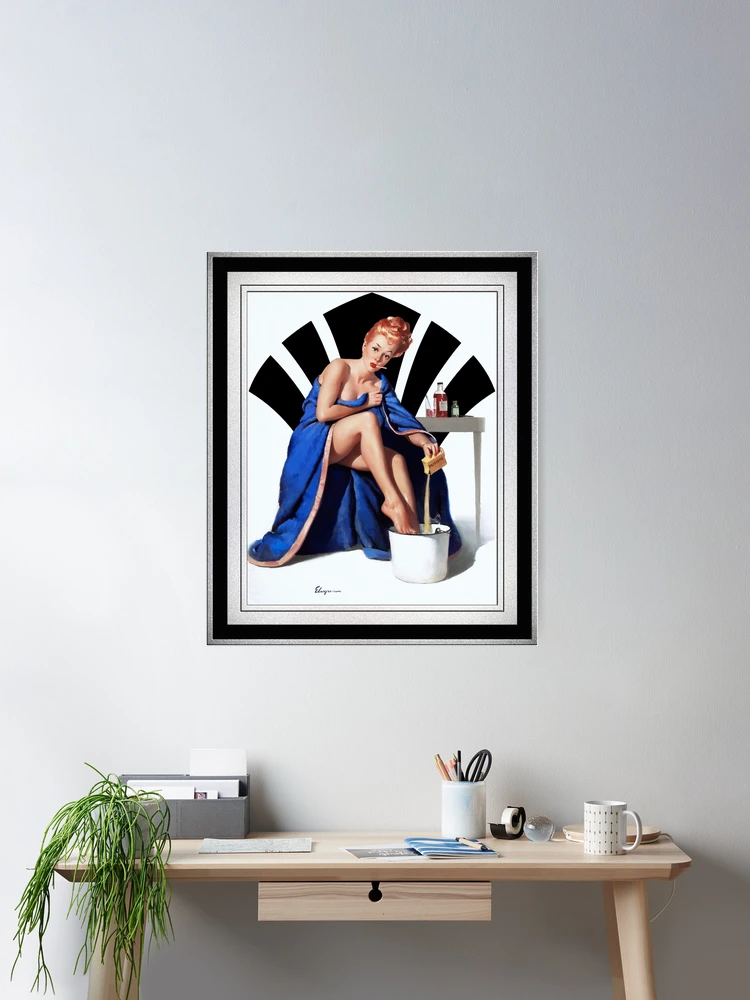
Table des matières
Le sujet principal
Le personnage central de Il n'y a rien à éternuer est une jeune femme vêtue d'une robe bleue éclatante. La robe, orné d'une délicate bordure rose, est légèrement drapée sur sa forme, ajouter un élément de séduction sans être ouvertement révélateur. Ses cheveux blond vénitien sont coiffés dans un chignon vintage, lui donnant un air de beauté classique des années 1950, soulignant encore davantage sa féminité intemporelle.
Sa posture est un peu gênante, ajouter au récit de la scène: elle essaie de trouver un soulagement à une maladie, et son expression incertaine, combiné avec le traitement banal mais inconfortable, invite à la fois l'empathie et l'humour de la part du spectateur. L'angle sous lequel elle est assise, avec les jambes croisées et un pied immergé, crée un moment intime mais comique dans un cadre domestique.
Le décor et les objets
Derrière la silhouette, une table est placée, au sommet duquel repose une petite collection d'objets: une bouteille de whisky, un verre, et ce qui semble être une bouteille médicinale, peut-être un remède ou un tonique pour accompagner son traitement.
Ces objets renforcent le caractère domestique, caractère privé de la scène, mais ils soulignent également l’imagerie typique de l’époque, où la relaxation et les remèdes de santé étaient souvent présentés comme faisant partie du rôle de la femme dans l’entretien du ménage. La bouteille de whisky suggère aussi l'idée de gourmandise ou de réconfort, jouer avec les codes visuels classiques de l'Americana des années 1950.
L'objet le plus significatif, pourtant, est la boîte à moutarde dans la main de la femme. Elle est en train de verser de la moutarde dans la bassine d'eau, une action à la fois comique et pertinente. Les bains de moutarde étaient considérés comme un remède démodé, mais son inclusion ici est à la fois ludique et nostalgique, renforcer les nuances humoristiques du tableau. La moutarde elle-même est représentée en riche, jaune vif, offrant un contraste saisissant avec la palette de couleurs par ailleurs douce de la scène.
La toile de fond du tableau présente un motif abstrait en forme d'éventail., rappelant une influence Art déco des années 1950. Ce motif géométrique encadre non seulement la silhouette, mais ajoute également une sensation de dynamisme à la scène par ailleurs calme.. Le design en forme d'éventail pourrait être interprété comme un clin d'œil subtil à l'esthétique populaire du milieu du 20e siècle., renforcer les racines du tableau dans son époque.
L'ambiance et le thème
Il n'y a rien à éternuer est une étude de juxtaposition. Sur la surface, il dépeint une scène domestique typique: une femme à la maison, relaxant, et veiller à sa santé. pourtant, Elvgren insuffle au tableau humour et légèreté, transformer un moment ordinaire en quelque chose de plus ludique et invitant. Le titre lui-même suggère un double sens, “éternuer” évoquant un rhume ou une maladie, mais aussi potentiellement pointant vers la situation comique dans laquelle se trouve la femme.
L'ambiance est résolument légère et amusante. L'expression du visage de la femme, un mélange de légère perplexité et d'embarras, encourage le spectateur à sourire avec sympathie, comme si elle partageait son léger malheur. L'utilisation de couleurs vives, comme la robe bleue de la femme et le jaune moutarde, crée un contraste vivant qui renforce le caractère ludique de la scène. Il y a un sentiment d'immédiateté dans le moment, comme si le spectateur venait d'entrer dans le monde de cette femme et était témoin d'un bref, épisode humoristique de sa vie quotidienne.
Style et matériaux
En termes de style artistique, Le pinceau d'Elvgren est doux et raffiné, avec un accent clair sur le réalisme. Le rendu de la peau de la femme, cheveux, et la robe est réalisée avec une grande attention aux détails, créer une qualité réaliste qui rend la scène encore plus pertinente. Son utilisation de l’éclairage est stratégique, mettant en valeur la silhouette de la femme et faisant ressortir la chaleur de son teint.
Les ombres sont soigneusement placées pour suggérer le volume et la profondeur, ajoutant au réalisme global de la pièce. Le contexte, par contre, est plus simplifié et abstrait, permettant à la figure de s'imposer comme le principal point focal.
Les matériaux utilisés dans la peinture sont typiques de l’œuvre d’Elvgren: peintures à l'huile, appliqué en couches pour créer de la texture et de la richesse. La fluidité du médium permet une fluidité, finition polie qui rehausse le glamour du sujet tout en permettant des détails subtils comme le brillant de la moutarde et les surfaces réfléchissantes des bouteilles sur la table.
Il n'y a rien à éternuer est une reproduction remasterisée de maîtres anciens d'art numérique d'une image du domaine public qui est disponible en tant que impression sur toile.
Biographie de l'artiste dérivée de Wikipedia.org
Gillette A. Elvgren est né à St. Paul, Minnesota, et a fréquenté le lycée universitaire. Après l'obtention du diplôme, il a commencé à étudier l'art au Minneapolis Institute of Arts.
Il a ensuite déménagé à Chicago pour étudier à l'American Academy of Art, et diplômé de l'Académie pendant la grande dépression, à vingt-deux ans.
Après l'obtention du diplôme, Elvgren a rejoint l'écurie des artistes de Stevens et Gross, L'agence de publicité la plus prestigieuse de Chicago, et est devenu un protégé de l'artiste Haddon Sundblom.
Dans 1937, Gil a commencé à peindre des pin-up de calendrier pour Louis F. Dow, l'une des principales sociétés d'édition américaines, pendant laquelle il a créé environ 60 pin-up travaille sur toile 22″ × 28″ et les distingue par une signature imprimée.
Beaucoup de ses pin-up ont été reproduites sous forme d'art du nez sur des avions militaires pendant la Seconde Guerre mondiale; et c'était à cette époque dans 1944, qu'Elvgren a été approché par la Brown and Bigelow Publishing Company; une entreprise qui domine toujours le domaine dans la production de calendriers, spécialités publicitaires et articles promotionnels.
L'année suivante à partir de 1945 jusqu'à ce que 1972, Elvgren était associé au Brown & Maison d'édition Bigelow, et a commencé à travailler avec 24 pouce par 30 toiles pouces, un format qu'il utilisera pour le prochain 30 années, et a signé son travail en cursive.
Elvgren a été un succès commercial. Il a vécu dans divers endroits, et a été actif des années 1930 aux années 1970. Dans 1951 il a commencé à peindre dans un atelier dans sa maison, puis à Winnetka, Illinois, utiliser un assistant pour configurer l'éclairage, construire des accessoires et des scènes, ensembles de photographies, et prépare ses peintures.
Ses clients comprenaient des entreprises bien connues comme Brown et Bigelow, du Coca, General Electric et la Sealy Mattress Company, pour n'en nommer que quelques-uns. en plus, dans les années 1940 et 1950, il a illustré des histoires pour une multitude de magazines, tels que The Saturday Evening Post et Good Housekeeping.
Parmi les mannequins et les légendes hollywoodiennes qu'Elvgren a peintes au cours de sa carrière figurait Myrna Hansen, Donna Roseau, Barbara Hale, Arlène Dahl, Lola Albright et Kim Novak.